


How to Choose the Best Refrigerator for Home Without Regretting It Later
Introduction
If you want the best refrigerator for home use, start with the part people usually ignore: a fridge runs 24x7 for the next 12–15 years, and the wrong choice sticks around. That means this isn’t really a quick shopping decision. It’s more like choosing something you’ll live with every single day, whether you notice it or not.
The real question is not which model looks best on the floor, but which one fits your kitchen, your power bill, and the way your household actually stores food. And honestly, that’s where most people get tripped up. A glossy finish can be tempting, sure, but the details are what decide whether you’ll feel good about the purchase a year from now.
Quick Highlights
- Fit the fridge to your routine first.
- Capacity matters more than showroom appeal.
- Energy use adds up for years.
- Kitchen measurements can save a bad mistake.
- Service support matters more than launch hype.
What type of refrigerator fits your kitchen and routine?
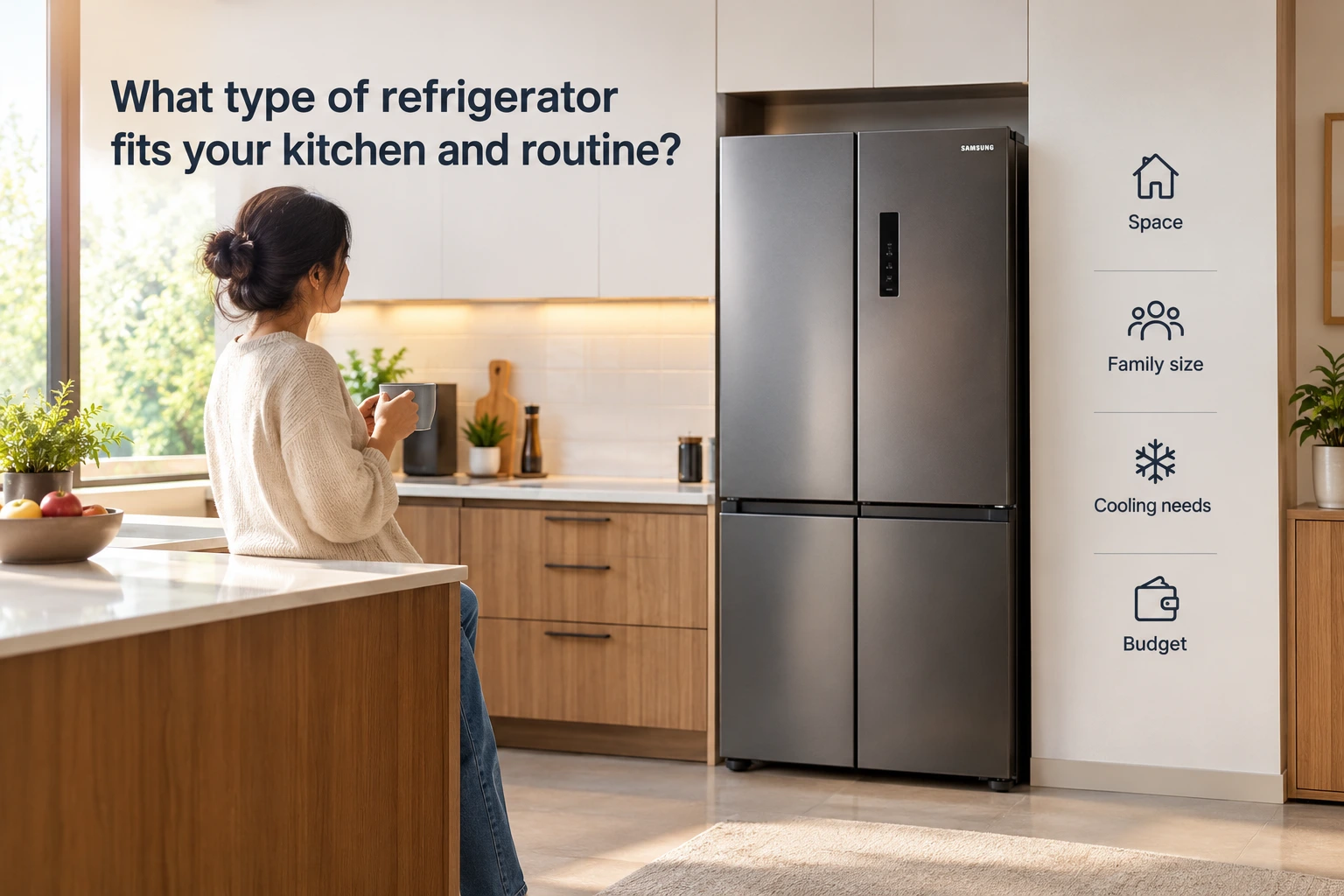
The first decision is shape, because storage habits and kitchen layout matter more than brand names at this stage. That might sound obvious, but people still skip it. They start comparing colors, finishes, and fancy control panels before they’ve even asked a basic question: how will this fridge actually work in my home?
India’s main options here are single-door, double-door, side by side refrigerator, and French door refrigerator, with capacity ranges and door swing patterns that change how the fridge works in daily life.
Think about how often you cook and shop for groceries before making a decision on a refrigerator. If you often store leftovers, bulk vegetables or frozen foods, a little extra capacity may be more practical.
The choice gets clearer once you stop thinking in abstract “best” terms and start matching the format to the space you live with. Look at your cooking routine, your grocery habits, and the way people move around the kitchen. Suddenly the decision feels less confusing.
The main refrigerator types people compare in India
- Top freezer refrigerator: the classic Indian kitchen staple, usually 180L–300L, affordable and efficient.
- Bottom freezer refrigerator: fresh food sits at eye level, which changes daily use more than people expect.
- Side by side refrigerator: equal fridge and freezer columns, usually starting at 500L, with a narrow door swing.
- 3 door refrigerator: fresh food, freezer, and a convertible third zone for shifting storage needs.
- 4 door refrigerator: independent temperature zones for different food types, aimed at premium buyers.
Now, a lot of shoppers think bigger automatically means better. But a huge unit can become annoying if your kitchen is compact or if you mostly store the same few items. On the other hand, a smaller fridge can feel cramped fast if you batch-cook, keep lots of vegetables, or regularly store leftovers. That’s why refrigerator types matter so much. They solve different problems.
How much refrigerator capacity do you actually need?
Capacity is where a lot of people overbuy or underbuy, because litres sound abstract until the fridge starts filling up after a normal grocery run. One weekend shop, a few containers, some milk, produce, and frozen food — and suddenly the “big enough” fridge doesn’t feel so big anymore. Or the opposite happens, where you pay for space you never really use.
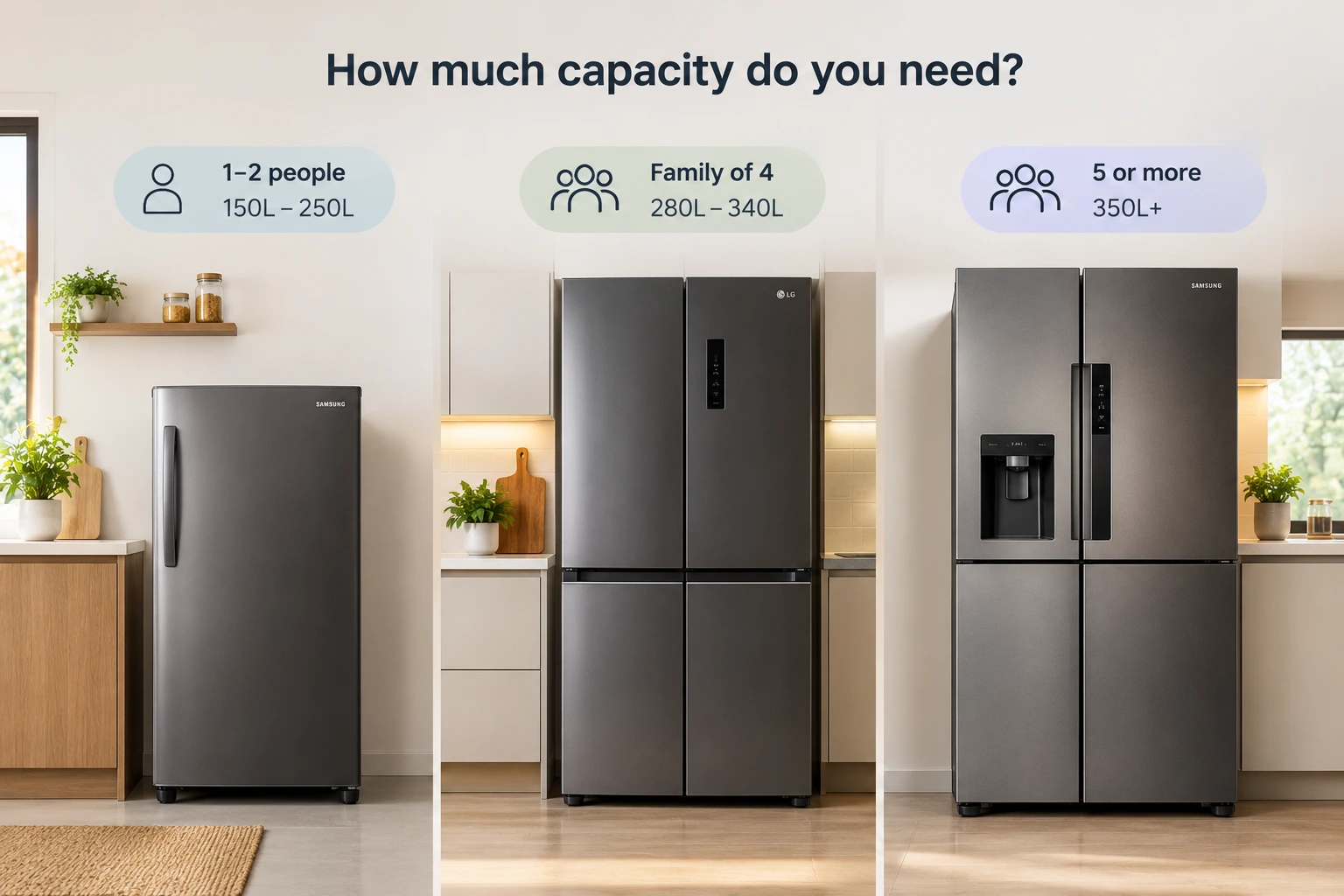
The simple rule given here is 50L per adult, with 150L–250L for 1–2 people, 280L–340L for a family of 4, and 350L+ for 5 or more. That rule matters more than a sales pitch because it connects directly to how often you shop and how much you freeze. If your habits are simple, you don’t need to stretch for extra capacity just because it sounds safer.
One thing people forget is that usable space is not always the same as listed space. Shelves, bins, and door compartments all affect how practical the interior feels. So when you’re comparing options, try to imagine the items you store most often. If you usually keep tall bottles, large containers, or trays, the interior layout can matter just as much as the headline capacity.
What size works for different household sizes
- 1–2 people: 150L–250L
- Family of 4: 280L–340L
- 5 or more: 350L+
Why star ratings and compressor choice change your long-term cost
This is the section that affects the electricity bill every month for years, so it deserves more attention than sticker price usually gets. A fridge seems like a one-time purchase, but it quietly keeps spending for you in the background. That’s why energy efficiency isn’t a boring technical detail. It’s a real money issue.
A BEE 5 star refrigerator at 250L typically uses 175–190 kWh per year, while a 3 star refrigerator of the same size uses about 230–260 kWh. That gap is one reason an inverter compressor refrigerator often makes more sense than a cheaper conventional model over time. The upfront price may be higher, but the running cost can be lower for years.
Also worth saying: the newer the model, the more likely the label reflects updated testing standards. So don’t just glance at the stars. Check the label details carefully, because those numbers are meant to help you compare fairly, not just decorate the door.
The numbers that matter on the energy label
Also worth checking: the year on the BEE label, because benchmarks get revised every 2–3 years and an old sticker can mislead you. That tiny detail can change how efficient a model really looks on paper, and it’s easy to miss if you’re rushing.
Which features are worth paying for, and which ones are mostly noise?
Once size and efficiency are set, the details that affect daily use start to matter more than spec-sheet glamour. How to Choose the Best Refrigerator for Home Without Regretting It Later. This is the stage where a fridge becomes either quietly helpful or slightly irritating every day. And the annoying thing is, the flashy extras are not always the useful ones.
Frost-free technology, inverter compressor systems, adjustable shelves, convertible refrigerator compartments, and stabiliser free refrigerator operation are the features that repeatedly show up as practical wins. If you’ve ever had to manually defrost a freezer, you already know why that matters. If you live somewhere with voltage swings, the stabiliser point suddenly becomes more than a buzzword.
Smart cooling tools can help too, but only if they solve a real habit in the home rather than just adding a screen. A lot of smart features sound impressive in a store demo. In real life, the useful ones are usually the simple ones that save time or reduce hassle.
Features that change how the fridge behaves every day
- Frost-free technology: skips manual defrosting.
- Inverter compressor: adjusts speed with load and can save up to 30% more power than a conventional compressor.
- Adjustable shelves and door bins: useful for steel dabbas and two-litre bottles.
- Convertible compartments: switch sections between fridge and freezer mode.
- Stabiliser-free operation: good models handle 130V–300V without a separate stabiliser.
Cooling tech that is useful, not just flashy
App controls, door-open alerts, and phone-based temperature monitoring can be genuinely useful if the household actually uses them. For some people, these features are just nice extras. For others, they solve real problems, like forgetting the door is open or checking settings without digging through menus.
Multi-airflow and Twin Cooling systems keep fridge and freezer humidity independent, which helps vegetables last longer. That’s not a tiny thing if you buy fresh produce often. It can mean less spoilage, less smell mixing, and food that stays usable longer. Small improvement, yes. But over time, small improvements matter.
How kitchen layout changes what you should buy
A fridge that fits on paper can still fail in real life if the route into the kitchen is too tight or the door opens the wrong way. This is one of those lessons people only learn after delivery day, which is exactly when it becomes expensive to fix. So it’s worth slowing down here.
The practical checks here are width, height, depth, ventilation clearance, door swing, hinge side, heat sources, and a dedicated earthed socket. These sound basic, but they’re the kind of basics that prevent regret. A fridge can be technically perfect and still feel awkward every day if it blocks movement or gets too close to a hot appliance.
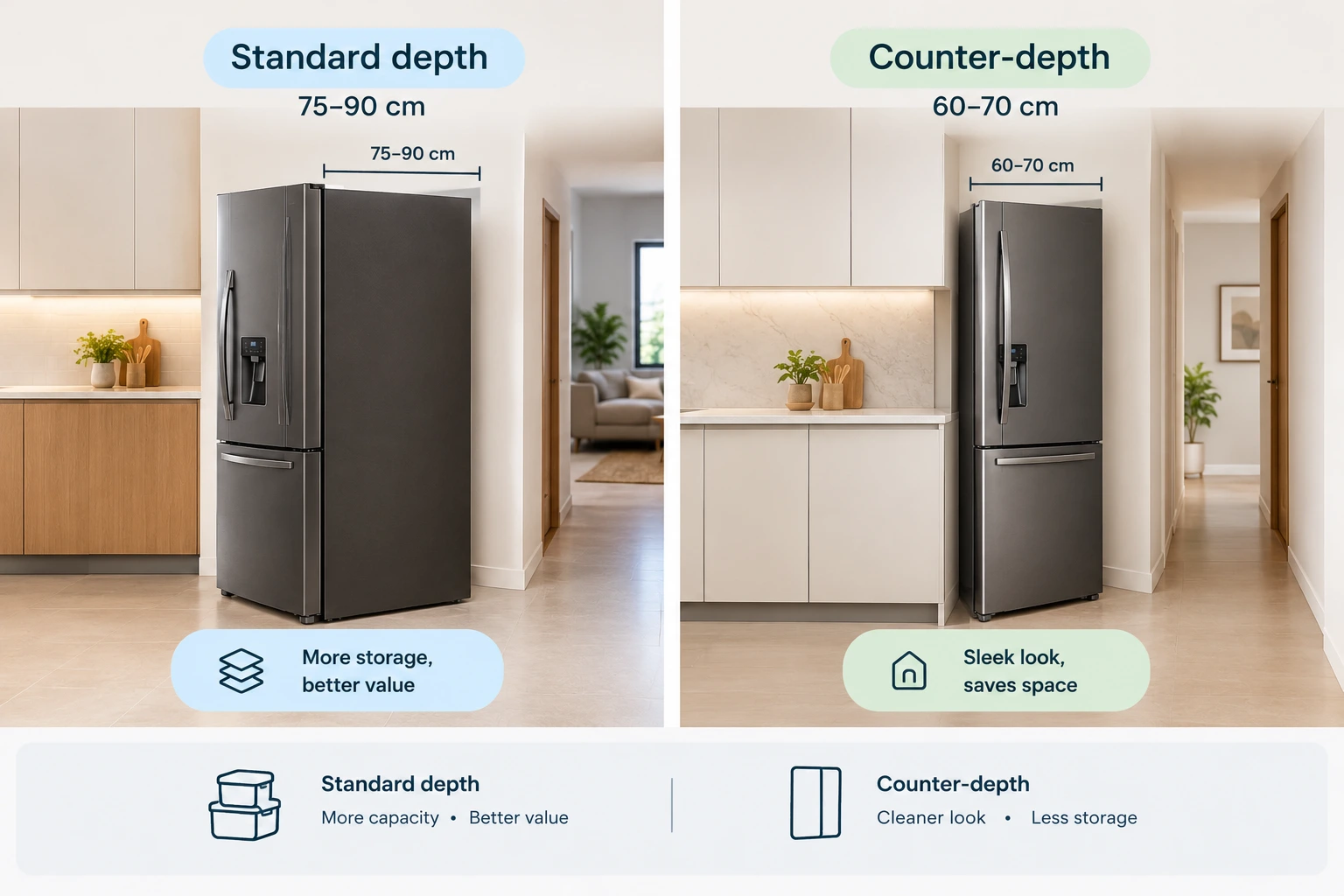
This is also where standard depth and counter depth refrigerator choices stop being theoretical and start affecting how the room feels. If your kitchen is open and compact, depth can change the whole look. If you have room to spare, capacity may matter more than appearance. It really depends on how you use the space.
What to measure before you order
- Kitchen width, height, and depth.
- Leave 2–3 inches around the unit for ventilation.
- Measure the delivery route: main door, corridors, lift, and tight turns.
- Check door swing and hinge side.
- Keep the fridge away from the gas stove, oven, and direct sunlight.
- Plan for a dedicated, earthed socket close by.
Standard depth vs. counter depth refrigerator
| Type | Typical depth | Main trade-off |
|---|---|---|
| Standard depth | 75–90 cm | More capacity for the price, but it can eat into walking space. |
| Counter-depth refrigerator | 60–70 cm | Cleaner built-in look, less usable storage, usually higher cost. |
For a modular kitchen with a tight passage, counter-depth is often worth the premium. For most family kitchens, standard depth still gives better value per litre. That’s the trade-off in plain language: looks and space efficiency versus raw storage and value.
How to think about cost beyond the sticker price
The purchase price is only the first bill, not the full cost of ownership. This is the part people usually underestimate, because the showroom number feels like the whole story. But the fridge keeps costing you through electricity, maintenance, and the occasional repair.
Annual electricity cost, AMC after warranty, and spare part availability matter as much as the model itself, especially over a 12–15 year lifespan. That’s a long time. A model that seems a little pricier today can easily become the cheaper one later if it uses less power and gets better support.
Brands such as LG, Samsung, Whirlpool, and Godrej stand out here because their service networks across India can matter more five years in than any launch feature. If something goes wrong after the warranty ends, you’ll care far more about turnaround time and part availability than about a smart demo mode you barely used.
What to compare before you finalise a model
- Annual electricity cost
- AMC after warranty
- Spare part availability
- Service network strength in your city
Which refrigerator fits a small household, a family of 4, or a large home?
Once the technical details are clear, the decision becomes more direct: match the fridge to the household, not the other way around. That sounds simple, but it’s where a lot of people go wrong. They buy for a future lifestyle they may never really use, or they choose too small and end up annoyed every week.
A small household on a tight budget usually lands on a 3 star single-door refrigerator at 180L–220L, while a family of 4 tends to do best with a frost-free double door fridge with inverter compressor and a 4–5 star rating. Large families or premium buyers are the ones who genuinely benefit from a 3 door refrigerator or 4 door refrigerator with smart connectivity and convertible storage.
If you’re in between categories, think about your habits first. Do you cook daily? Do you freeze meat or bread? Do you shop in bulk? Those answers often matter more than headcount alone.
Simple household-based recommendations
- Small household, tight budget: 3 star single-door refrigerator, 180L–220L.
- Family of 4: frost-free double: door fridge with inverter compressor and 4–5 star rating.
- Large family or premium buyer: 3 door refrigerator or 4 door refrigerator with smart connectivity and convertible storage.
FAQ
These questions come from the smaller doubts people usually still have after they’ve narrowed the size, type, and budget.
Q: What size refrigerator is best for a family of four?
Between 280L and 340L works for most families of four. The 50L per adult rule is the easiest starting point, then adjust upward if you cook in bulk or host often.
Q: Is the BEE 5 star refrigerator rating really worth it?
Usually yes, because a 5 star refrigerator at 250L uses about 175–190 kWh a year, compared with 230–260 kWh for a 3 star model of the same size. Over time, that difference is hard to ignore.
Q: Which refrigerator type is best for small kitchens?
A top freezer refrigerator or compact single-door refrigerator is usually the safest bet. A side by side refrigerator can also work if the narrow door swing matters more than overall footprint.
Q: How long does a refrigerator usually last?
A well-maintained inverter-compressor model typically lasts 12–15 years. Strong service support makes that lifespan easier to reach.
Conclusion
The best refrigerator for home use is the one that fits your household’s storage pattern, kitchen space, and electricity cost, not just the one with the most impressive spec sheet. That’s really the heart of it. A fridge should disappear into your routine in the best way possible: quietly useful, not constantly demanding attention.
If you start with capacity, then check star rating, compressor type, layout fit, and long-term service support, the choice becomes much less risky. And once you think this way, you’re far less likely to regret the purchase later. That’s the real win here — not just buying a refrigerator, but buying one that still feels right years down the line.

Related Products






Amazon Great Freedom Sale 2026 refrigerator deals slash prices on Haier LG Samsung
Amazon Great Freedom Sale 2026 is pushing large refrigerators into a sharper price band, with Samsung’s 653L side-by-side model listed at Rs. 67,990, down from Rs. 1,13,000. The sale also brings LG, Haier and Godrej models into view, along with bank discounts, Amazon Pay rewards and no-cos...

Mijia Refrigerator 425L launches with 14 compartments and flexible cooling
Xiaomi has put the Mijia Refrigerator 425L on Youpin for 2,699 yuan, with a 55L flexible temperature zone doing much of the heavy lifting. The new model is designed for buyers who want a large-capacity fridge that can handle everyday food storage, plus items like baby milk, fish, or dry go...

Google Home Speaker Pre Orders Open With Gemini for Home
Google has opened pre-orders for its new Home Speaker in select markets, with US and New Zealand buyers able to order now ahead of June 25 shipping. The $99.99 speaker brings Gemini for Home features, a dynamic light ring, and support for connected-home devices in Google’s wider ecosystem. Go...

Xiaomi Mijia Smart Dishwasher launches with 20-set built-in capacity
Xiaomi has launched the Mijia Smart Dishwasher with a 156L cavity, space for 144 pieces, and a 20-set built-in capacity. It also brings 52,000 Pa water pressure, dual rotating spray arms, and a triple-spray setup, making the main selling point simple: one load is meant to handle a lot more...

LG smart TV privacy claims spark backlash over voice and ACR tracking
LG smart TV privacy claims are facing renewed scrutiny after a viral security report alleged that some OLED TVs can track viewing across apps, HDMI, USB, and cable inputs. The bigger issue now is not just targeted advertising, but how much data a connected TV may collect in the living room...