


Oppo Enco Air5 Review: 52dB ANC, Long Battery Life, and the Trade-offs at Rs 3,299
Introduction
The Oppo Enco Air5 review starts with a pretty simple promise: a low price, strong specs, and a few features that sound like they should cost more. At Rs 3,299, though, the real question isn’t whether the numbers look good on paper. It’s whether the Oppo Enco Air5 actually feels like a smart buy once you’ve lived with it for a few days.
And honestly, that’s where this pair gets interesting. You’ve got 52dB ANC, 54-hour battery life, 12mm drivers, and a call setup that sounds better than you’d expect for the money. But there are still trade-offs, and some of them matter more than the spec sheet would suggest.
Quick Highlights
- 52dB ANC is genuinely useful at this price.
- Battery life is the strongest feature overall.
- Call quality is better than expected outdoors.
- Codec support stays basic with AAC and SBC.
- The HeyMelody app adds a lot of practical control.
Why the Enco Air5 feels familiar before it feels impressive
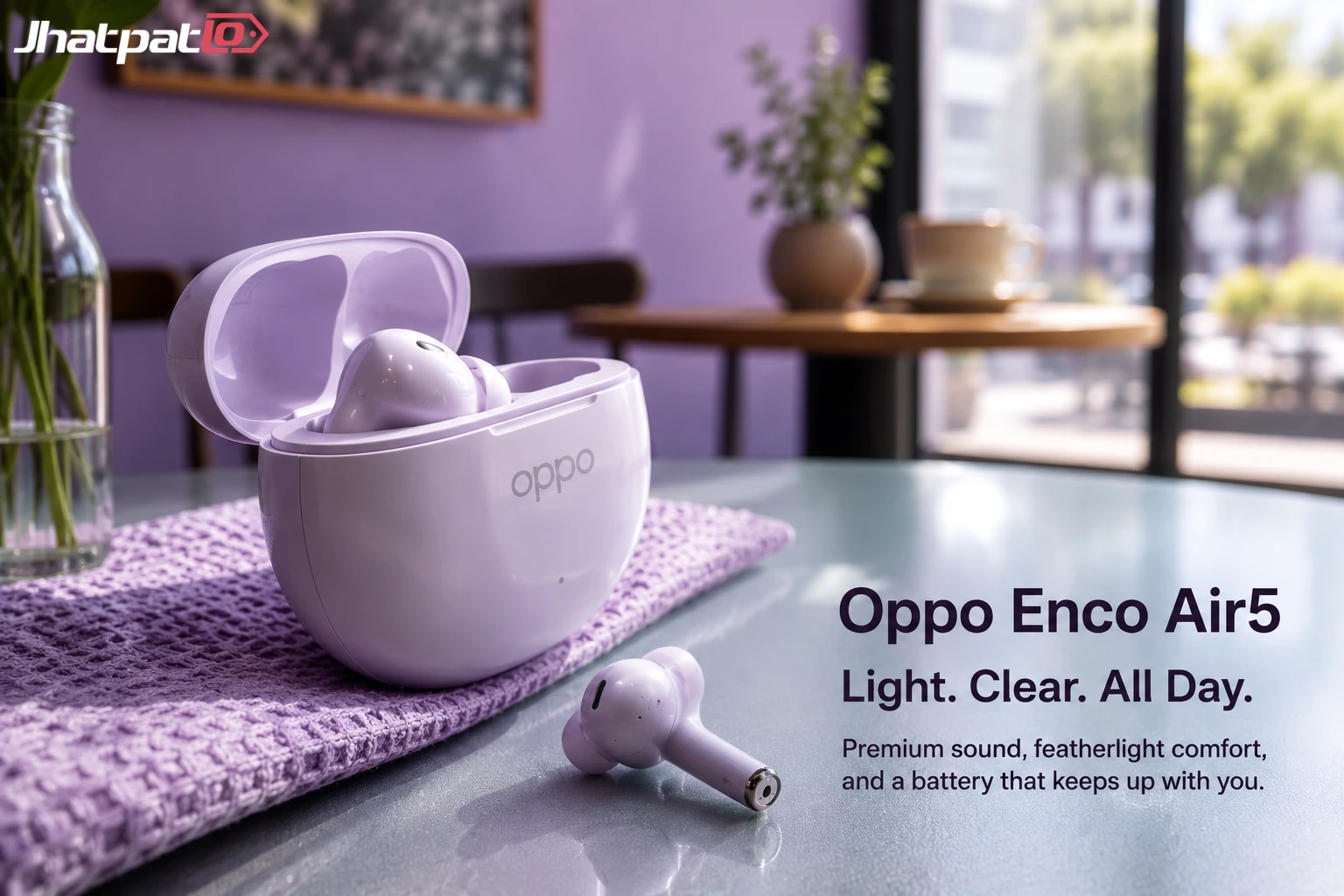
The first thing you notice about the Oppo Enco Air5 is that it doesn’t try too hard. That might sound like a downside, but in the budget TWS world, it can actually be a relief. The design is safe in a way that makes sense: stem-style earbuds, a soft-touch case, and a compact shape that disappears into a pocket without making you think about it twice.
The earbuds themselves are glossy, so yes, they pick up smudges pretty fast. That’s one of those small annoyances you notice immediately and then slowly stop caring about because the fit is light and secure enough for long walks, desk use, and even workouts. The IP55 rating on the earbuds helps too, especially if you’re the kind of person who ends up using earbuds everywhere except where they’re technically supposed to be used.
So, this isn’t a pair that wins you over with drama. It wins by being easy to live with. And in a category where a lot of products chase attention with weird shapes or flashy trims, that restraint does stand out a little.
What the case and earbud finish actually change
The case does a better job than the earbuds at staying presentable. It resists fingerprints reasonably well, which sounds minor until you’ve carried enough glossy accessories around to know how quickly they start looking tired. The earbuds, on the other hand, can look clean at a glance but won’t stay that way for long.
There’s also an uneven part to the protection story. The earbuds have the IP55 rating, but the charging case doesn’t. That means the bits you wear are protected against sweat and light dust better than the case you toss into a bag. It’s not a dealbreaker, but it’s one of those details that reminds you this is still a budget product with budget compromises.
If you’ve used similarly priced buds before, you’ll probably know the feeling: the hardware is good enough, but the finish doesn’t fully match the promise. The Enco Air5 sits right in that middle ground.
What 52dB ANC and 12mm titanized drivers do in real listening
This is the part that matters most if you’re buying earbuds for daily use rather than just checking boxes. The 52dB ANC headline looks aggressive, but here’s the thing: Oppo doesn’t just throw the number around and hope it sticks. The noise cancellation actually does useful work. It knocks down ambient noise in a way you can hear right away, whether you’re on a bus, in a café, or just trying to focus in a noisy room.
That matters because budget ANC can be weirdly inconsistent. Sometimes it sounds impressive for ten seconds, then falls apart once real-world noise gets involved. The Enco Air5 avoids that trap better than most. It’s not elite-level isolation, obviously, but it gives the earbuds a real reason to exist in this price band.
Oppo pairs the ANC with 12mm titanized dynamic drivers, and that gives the sound a bit more body than you might expect at Rs 3,299. The tuning leans toward bass and vocal clarity, which is probably the safer choice for most people anyway. Casual listeners tend to want a sound that feels full and easy, not clinical.
Bass, vocals, and the one place the tuning softens
Bass has proper weight here. It doesn’t feel thin or artificially boosted in that boomy, messy way some cheap earbuds do. Vocals stay clean too, which makes the Enco Air5 comfortable for music, podcasts, movies, and shows. If you’re watching a lot of dialogue-heavy content, that clarity helps more than you’d think.
But there is a small catch. In instrumental tracks, some parts can sound a little flat. Not bad, just less textured than you’d want if you’re paying close attention to layers and separation. That’s why the sound feels good rather than fully rounded out. It’s enjoyable, but not especially ambitious.
And that’s fine, really. Not every pair of earbuds needs to be a tiny audiophile project. The Enco Air5 seems to understand its audience: people who want reliable sound with a touch of punch, not a long session of critical listening.
Why the “Pure Vocals” mode matters
The Pure Vocals EQ mode is one of those small features that makes more sense the longer you think about it. It pushes voices a bit more to the front, which fits the overall tuning direction of the earbuds. If you listen to a lot of podcasts, YouTube videos, interviews, or talk-heavy content, this mode feels genuinely useful.
It also helps explain how Oppo wants these earbuds to be used. They’re not chasing a giant soundstage or some dramatic “studio” identity. They’re trying to make everyday listening feel clear, pleasant, and low-effort. For a lot of people, that’s actually the better move.
So while Pure Vocals won’t suddenly turn these into an audio nerd’s dream, it does make them a little more practical for the way most of us listen day to day.
Call quality, Bluetooth 6.1, and the codec limits that matter
Bluetooth 6.1 gives the Enco Air5 a modern connection foundation, and in normal use it feels stable enough. Pairing is quick, switching is smooth, and there’s not much drama once you’re connected. But there’s a limitation you should know about early: codec support stops at AAC and SBC.
For most people, that’s perfectly fine. For more demanding listeners, though, it sets a ceiling. You don’t get the codec flexibility or higher-resolution ambitions that some rivals in the larger market offer. In simple terms, the earbuds are built to sound good for common everyday devices, not to chase the most premium wireless audio path available.
Now, the good part is where the Enco Air5 really overdelivers: call quality. Three microphones per earbud, plus AI-based noise reduction, do a strong job in real-world use. Wind noise outdoors is handled well, and calls in crowded places stay more intelligible than you’d expect at this price. That’s a huge practical win, because call quality is one of those things people only fully notice when it’s bad.
What holds it back for audio purists
AAC and SBC are enough for a lot of listeners, especially if your main use case is streaming music, taking calls, and watching videos. But if you’re the kind of person who cares about codec support as a marker of flexibility, this is where the Enco Air5 starts feeling limited.
There’s no shame in that, though. This isn’t pretending to be a hi-res-focused product. It’s aiming at users who want stable performance and dependable everyday sound. If that sounds like you, the codec situation probably won’t bother you much.
If you’re chasing the most technical audio experience possible, you’ll feel the ceiling sooner. But if you value clear calls and a straightforward setup more than spec-sheet bragging rights, the trade-off is easier to accept.
HeyMelody app features, dual-device pairing, and the bits that feel genuinely useful
The HeyMelody app is where the Enco Air5 starts feeling more complete. On Android and iOS, it gives you access to custom EQ, sound presets, Oppo Alive Audio, and BassWave enhancement. That’s already a pretty solid feature set for the price, but Oppo doesn’t stop there.
You also get a fit test, transparency mode, a low-latency gaming mode rated at 47ms, Spotify Tap, wear detection, AI assistant shortcuts, Google Fast Pair, Microsoft Swift Pair, dual-device pairing, and AI translation on supported Oppo phones. That’s a lot. Honestly, more than you might expect from a Rs 3,299 earbud set.
What’s nice is that these aren’t all gimmicks thrown in for a spec sheet. Some of them are genuinely useful in everyday life. Dual-device pairing matters if you bounce between phone and laptop. Wear detection feels natural once you get used to it. And low-latency mode makes the earbuds more workable for casual gaming than most people would guess.
The one control Oppo does not let you change
There is one limitation in the touch controls that stands out a bit. You can remap most gestures, but single-tap play/pause stays fixed. You can’t reassign it.
That’s a small annoyance, but it’s notable because so much else is flexible. When a budget product gives you a broad set of controls, one locked gesture feels more obvious than it would on a simpler pair. Still, it’s a minor frustration rather than a major flaw.
In the bigger picture, the app support makes the Enco Air5 feel more polished than the price suggests. That’s not something every budget earbud can claim.
Battery life is the strongest argument for buying these earbuds
If you’re trying to decide whether the Enco Air5 is actually worth the money, battery life may be the easiest place to land. Oppo rates these earbuds at up to 13 hours on a single charge with ANC off, and up to 54 hours total with the case. Those are strong numbers, especially in this segment.
In real testing at 80% volume, the results came in lower, which is normal enough that it shouldn’t shock anyone. With ANC on, the earbuds lasted about 7 hours. Without ANC, they reached around 10 hours. That’s still very respectable, and in some cases it’s better than what you’ll get from more expensive options that don’t stretch as far as they should.
So even if the claim doesn’t fully match real use, the actual battery story is still a major strength. This is the kind of product you can use through a workday, a commute, or a travel stretch without constantly thinking about the case.
What fast charging adds back quickly
Fast charging makes the battery story feel less stressful. Oppo says a 10-minute top-up can deliver up to 11 hours of combined playback across the earbuds and case with ANC switched off. That’s the kind of claim that changes how you use the product, because it means short charging breaks can be surprisingly effective.
In practice, it makes the lower real-world runtime much easier to live with. You don’t have to wait around for a full recharge every time. A small burst of charging before you leave home or head back out can carry you for quite a while.
That convenience matters more than people sometimes admit. Long battery life is great, but fast top-ups are what make the experience feel flexible instead of fragile.
FAQ
These are the smaller doubts people usually have after the main comparison is done and they’re trying to decide whether the compromise is acceptable.
Q: Is the Oppo Enco Air5 good for calls?
Yes. The three microphones per earbud and AI noise reduction do especially well with wind noise, which makes outdoor and crowded calls noticeably clearer.
Q: Does the Enco Air5 support higher-quality audio codecs?
No. It only supports AAC and SBC, so it is not aimed at listeners who care about wider codec support.
Q: How long does the battery last in real use?
At 80% volume, it lasted roughly 7 hours with ANC on and around 10 hours without ANC in testing.
Q: What features does the HeyMelody app add?
It adds custom EQ, presets, Oppo Alive Audio, BassWave, a 47ms gaming mode, Spotify Tap, wear detection, dual-device pairing earbuds support, and more.
Conclusion
The Oppo Enco Air5 review ends in a pretty direct place: for Rs 3,299, this is a budget pair that gets the important things right more often than it gets them wrong. The 52dB ANC is useful, the battery life is strong, and the call quality is better than you’d expect when you first look at the price.
At the same time, the Enco Air5 doesn’t pretend to be everything. The AAC/SBC codec limits are real, and the instrumental tuning can feel a little flat if you’re paying close attention. But if you want an affordable TWS option that focuses on practical wins rather than flashy promises, the Oppo Enco Air5 makes a very convincing case.
And that, in this price range, is probably what matters most.

Mahi Gupta
✉ mahigupta708076@gmail.comRelated Products




Oppo Enco Air5 unboxing with 53dB ANC 12mm driver and 54 hour battery
Oppo’s Enco Air5 lands as a stripped-back alternative to the Air5 Pro, and that is the main story here. It keeps the 12mm dynamic driver, triple microphones, and a large battery claim, but trims a few features buyers will notice quickly. For anyone comparing mid-range ANC earbuds, the valu...

Oppo Enco Air 5 Pro Debuts in China With 55dB ANC and LHDC 5.0 Hi-Res Audio
Launch Information The Enco Air 5 Pro True Wireless Stereo (TWS) headphones were recently released by Oppo in China, succeeding the previous Enco Air 4 Pro which was launched in 2024. With the all-new design of this version, Oppo has emphasized its improved audio quality and...

OPPO Enco Air 5 price in India starts at ₹3,099 with Bluetooth 6.1
OPPO Enco Air 5 enters India with a launch price of ₹3,099, putting it squarely in the crowded under-₹5,000 TWS segment. The new earbuds lean on Bluetooth 6.1, a 530 mAh charging case, and a familiar spec sheet that is meant to hold up against budget rivals. For buyers comparing value, a f...

OPPO Enco Air 5 India launch teased with in ear design and LED case
OPPO has started teasing the Enco Air 5 in India, and the first Amazon listing gives a clearer idea of what the standard model will look like. It shows a stem-style in-ear design, silicone tips, and a rounded charging case with an LED indicator, but there is still no launch date or price. For...

OPPO Enco Air 5 Pro Brings 55dB ANC to India at Rs 4,999
OPPO Brings Enco Air 5 Pro to India With Premium Audio Features OPPO Enco Air 5 Pro Launches in India at Rs 4,999, placing the earbuds in a crowded budget audio market while adding features usually found at higher price points. The launch comes alongside the Find X9 series, and the earbu...

OnePlus Buds Ace 3 Teased With 55dB ANC And 54 Hour Battery Life
OnePlus Buds Ace 3 Teased Ahead Of China Launch OnePlus has teased the Buds Ace 3 on Weibo, with the earbuds expected to launch this month alongside the OnePlus Ace 6 Ultra in China. The new true wireless earbuds are claimed to bring up to 55dB active noise cancellation and up to 54 hours of...