


Google TV vs Android TV in 2026 What Actually Changes and Which Is Better
Introduction
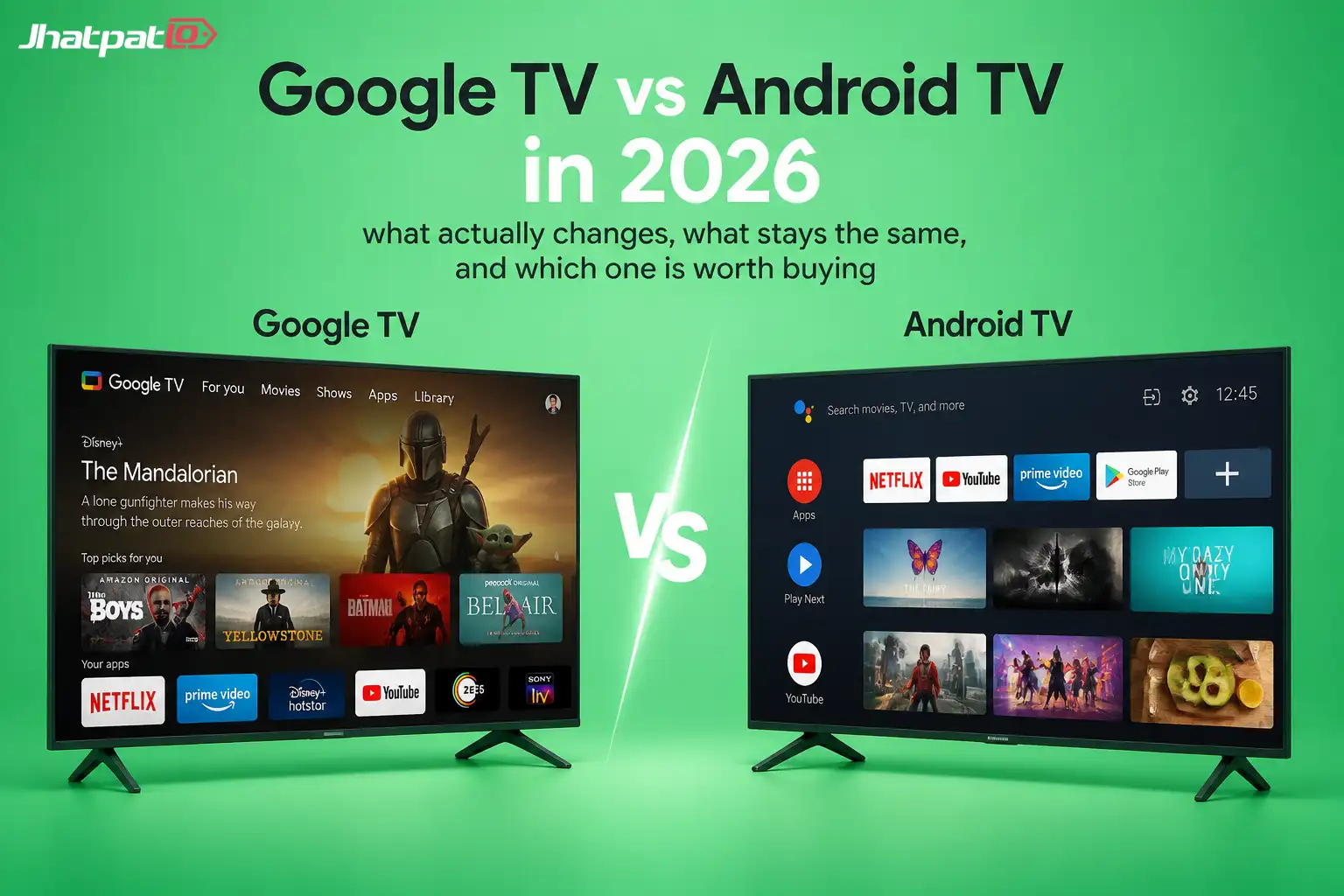
Google TV vs Android TV in 2026 is one of those comparisons that sounds simple until you actually sit down and use both. On paper, they look close. In real life, the difference shows up the moment you turn the TV on and either get a helpful recommendation feed or a plain app grid that makes you do a little more work.
And honestly, that’s what most buyers care about. Not the branding. Not the tech buzz. Just this: does the TV help you find something faster, or does it make you go hunting app by app?
Quick Highlights
- Google TV puts content first, not apps first.
- Android TV still works well for budget buyers.
- Hardware and updates matter more than the name on the box.
- Google TV usually feels smoother for streaming and discovery.
Introduction
Google TV vs Android TV in 2026 is not really a panel question anymore; it starts with how the TV handles your streaming life, your watchlist, and the way the interface reacts when you turn it on.
The gap matters more now because one platform feels built around discovery, while the other still feels like a familiar app grid with useful basics. That sounds subtle, but when you use a smart TV every day, subtle changes become the things you either love or quietly tolerate.
So, if you’ve been trying to decide between the two, the good news is this: the choice is clearer in 2026 than it used to be. The bad news is that the right answer depends a bit on how you watch TV, how many subscriptions you juggle, and how much convenience you want to pay for.
What Android TV still does well in 2026
Android TV still makes sense if you want a straightforward system that gets the job done without much ceremony.
It launched in 2014, runs the Google Play Store, supports Google Assistant and Chromecast Built-in, and shows apps in a simple row-based layout; brands like Xiaomi, Kodak, and Toshiba still use it well on budget and mid-range TVs.
The tradeoff is obvious: you browse each streaming app separately instead of getting one central view of what to watch. For some people, that’s actually a plus. It feels familiar. You know where everything is. There’s less going on, and sometimes less going on is exactly what you want from a TV.
That’s why Android TV still hangs on in the market. It’s not flashy, but it’s dependable. If you’re buying a secondary TV for a bedroom, a guest room, or just want a simple smart TV without paying extra for a fancier interface, Android TV still does the job well enough.
It also helps that the basics are still solid. You get access to the usual streaming apps, voice search, and casting from your phone. If your needs are modest, you might not even notice what you’re missing.
Why Google TV feels like the newer idea
Google TV is the sharper evolution, not a separate universe.
It launched in 2020 with the Chromecast with Google TV and adds the “For You” home screen, which pulls recommendations from Netflix, Prime Video, Disney+ Hotstar, JioCinema, and YouTube into one feed.
The Google TV watchlist feature also lets you save something on your phone and pick it up later on your TV, which is the kind of small convenience that ends up mattering a lot. People underestimate this stuff until they’ve used it for a week. Then suddenly, app-hopping feels old.
Here’s the real difference: Google TV tries to act like a smart assistant for your viewing habits, not just a launcher for apps. It doesn’t change the apps themselves, but it changes the path you take to reach them. That’s why Google TV streaming discovery feels easier for anyone who’s subscribed to more than one service.
The interface difference is really about discovery, not just design
Android TV gives you apps first; Google TV gives you content first. That shift is why Google TV streaming discovery feels easier for anyone juggling multiple subscriptions.
The same apps exist on both platforms through the Google Play Store, but the path to them feels very different.
And that path matters. If you already know exactly what you want to watch, Android TV may be perfectly fine. But if you’re the kind of person who opens a streaming app, scrolls for five minutes, backs out, and opens another app, Google TV is the better fit. It saves a surprising amount of mental effort.
There’s also a nice practical side to it. Instead of checking five apps one by one, you get a more unified picture of what’s available. That may not sound dramatic, but in everyday use, it feels cleaner and faster.
Performance, updates, and the hardware gap behind the software
Google TV has the cleaner software story, but it also tends to land on better hardware in 2026.
Google TV devices get priority updates from Google, while Android TV updates depend on the manufacturer — some brands push patches within weeks, others take 6+ months.
That gap shows up in speed too: one example mentioned is the Amlogic S905X4 running at 1.8GHz quad-core, which helps Google TV feel snappier in daily use.
Now, this is where a lot of buyers get tripped up. They assume the platform alone decides everything. It doesn’t. The hardware underneath matters a lot. RAM, storage, processor speed, and how well the brand has tuned the software all affect how smooth the TV feels after a few months of use.
But the pattern in 2026 is still pretty clear: Google TV devices are more likely to ship with stronger internals and get a more consistent software life. Android TV can still be good, but the experience depends more heavily on the manufacturer’s effort. That’s fine if you know the brand is reliable. Less fine if you’re buying blind.
Android TV updates in India are still uneven
Android TV updates in India can arrive quickly on one brand and painfully late on another, so the experience is less about the platform name and more about the company behind the set.
That makes Google TV feel more predictable for buyers who want features to keep moving forward instead of stalling out.
And predictability matters more than people think. A smart TV isn’t something most of us replace every year. You want it to keep feeling current, or at least not awkwardly outdated after the first major app change or security patch cycle. Google TV has the edge there simply because the update story is cleaner.
Which one is better for gaming, and what the specs actually mean
For gaming, Google TV usually has the edge, but the advantage comes from the hardware it ships with more than the interface itself.
Both platforms support cloud gaming through GeForce NOW and Xbox Cloud Gaming, but Google TV devices typically come with 3–4GB RAM versus 2GB on budget Android TVs, plus faster storage for quicker load times and less choppy play.
Hardcore gamers still need to care about 120Hz refresh rate panels regardless of platform, because that matters more than either TV OS once the game starts.
If you’re mostly playing casually, Android TV can still be fine. You’re not necessarily going to feel held back if you just want to stream a game occasionally and don’t mind a bit of loading lag. But once you start asking more from the TV, the hardware difference becomes obvious pretty quickly.
Google TV gaming performance tends to feel smoother because better-equipped models are more common. Faster storage helps the system respond faster. More RAM helps apps stay open in the background without choking. It’s not magic. It’s just less friction.
Cloud gaming works on both platforms, but the smoother experience usually costs more
That is the real catch: Android TV can still be fine for casual gaming, but Google TV gaming performance tends to improve as soon as you move into better RAM and storage tiers.
So if gaming is a serious priority, don’t stop at the platform label. Check the actual specs. A great interface with weak hardware is still a slow TV. And a modest interface with strong hardware can feel surprisingly good.
Best Google TV and Android TV options in India right now
The price spread makes the decision easier to see in real life.
At Reliance Digital in India, Google TV starts at Rs. 11,499 and Android TV starts at Rs. 7,700, but the better picks sit across a wider range depending on budget and screen size.
| Platform | Model | Size / type / use | Price |
|---|---|---|---|
| Google TV | TCL 43T69D | 43-inch QLED, mid-range pick | Rs. 33,990 |
| Google TV | Sony Bravia 2 K-55S25BM2 | 55-inch 4K, premium pick | Rs. 63,990 |
| Google TV | Philips 43PFT6290/94 | Budget entry | Rs. 19,990 |
| Android TV | Xiaomi Mi 55-inch 5X | Value pick | Rs. 43,300 |
| Android TV | Kodak 43CAPRO5022 | Solid 4K budget pick | Rs. 19,900 |
Prices are subject to change without prior notice, and that matters here because the value case shifts quickly once you move a few thousand rupees up or down.
Looking at those numbers, you can see the real tension. Android TV budget smart TVs still hold the low end, but Google TV in India prices start close enough that the smarter interface often feels worth the extra spend once you cross the mid-range mark.
The India pricing story is mostly about how much convenience you want to pay for
Android TV budget smart TVs still hold the low end, but Google TV in India prices start close enough that the smarter interface often feels worth the extra spend once you cross the mid-range mark.
That’s really the heart of it. If you want the cheapest possible smart TV that still does the basics, Android TV remains a practical pick. If you’re already spending enough that the price gap is no longer painful, Google TV starts to make more sense very quickly.
What to decide before you buy a smart TV in 2026
The right choice depends less on specs in isolation and more on how you actually use the TV.
If you have multiple streaming subscriptions, Google TV is easier to live with because the unified feed reduces app-hopping; if you care more about value and familiarity, Android TV still makes sense.
If you are deep in Google Home, Google TV fits more naturally. If you want stability and a lower entry price, Android TV still has a clear place.
This is the part where a lot of people overthink the decision. They compare processor names, version numbers, and RAM figures for too long. Those things matter, sure, but the everyday experience matters more. Ask yourself what annoys you most: switching between apps, waiting on menus, or spending extra money on convenience features you won’t use very often.
- Multiple streaming subscriptions: Google TV
- Budget-first shopping: Android TV
- Future-proofing: Google TV
- Google Home ecosystem: Google TV
That quick rule of thumb is usually enough for most buyers. If you want the short version, Google TV is the better long-term pick for most people, while Android TV is still the sensible budget choice if you just want a smart TV that behaves like a smart TV and doesn’t try too hard.
FAQ
These are the questions that usually come up after someone understands the basics but still wants a straight answer on upgrade paths, app support, and brand choices.
Q: Is Google TV better than Android TV in 2026?
Yes, for most people. Google TV offers a unified content feed, better Google integration, and more consistent updates, so the everyday experience is usually smoother.
Q: Can an Android TV be upgraded to Google TV?
Sometimes, but not always. Some devices can get the Google TV interface through OTA updates, yet it depends on the manufacturer and the hardware.
Q: Which platform is better for streaming apps?
Both support the same apps through the Google Play Store, but Google TV is better at helping you discover what to watch across them.
Q: Which TV brands use Google TV in India?
Sony Bravia, TCL, Philips, Haier, and Acer are among the brands selling Google TV models at Reliance Digital in India in 2026.
Conclusion
If you are buying above Rs. 25,000 in 2026, Google TV is the better choice for most people because the unified feed, cross-device watchlist, faster updates, and smoother hardware stack up fast.
If your budget is under Rs. 15,000, Android TV still gives you solid app support and a familiar interface without asking you to pay for convenience you may not use.
So, the real answer isn’t that one platform wins in every case. It’s that Google TV is the better everyday experience for most buyers now, while Android TV still survives as the practical value option. If you’re shopping today, that’s probably the cleanest way to think about it.

Mahi Gupta
✉ mahigupta708076@gmail.comRelated Products



Xiaomi Brings Mini LED TVs to India With Fire TV Built In
Xiaomi brings Mini LED TVs to India Xiaomi is bringing its Mini LED TV lineup to India next week, with the FX Mini LED Series set to launch on June 4. The new range comes with Fire TV built in, a 144Hz refresh rate on global variants, and gaming-focused display features. Pricing has not been...
Samsung Brings Vision AI to 72 TVs in India With Micro RGB Debut
Samsung Brings Vision AI to More TV Models Samsung has launched 72 TV models in India for 2026, extending Vision AI across 4K and above models and adding Micro RGB TVs to its lineup. The company said the range starts at Rs 36,990 for UHD models and goes up to its premium Micro RGB offerings....

Sony Bravia 9II 115-inch lands in India at ₹28.99 lakh
Sony Bravia 9II 115-inch is now India’s biggest Sony TV, with a 292 cm panel and a listed best-buy price of ₹28,99,990. The gap between that figure and the ₹45,99,900 MRP makes this a very specific flagship, aimed at luxury buyers, private screening rooms and high-end home-theatre installs...
Amazon Great Summer Sale Teases Smart TV Deals From Samsung, TCL and Xiaomi
Amazon Great Summer Sale begins later this week Amazon Great Summer Sale is scheduled to begin later this week in India, and the company has started teasing smart TV deals from Samsung, TCL, Xiaomi and several other brands. The sale event will also cover electronics across categories, with di...
![Lumio Vision 9 [2026] Teased in India as Amazon Listing Goes Live](https://jhatpatlo.com/storage/photos/uploads/news/2026/04/lumio-vision-9-2026-teased-in-india-as-amazon-listing-goes-live.webp)
Lumio Vision 9 [2026] Teased in India as Amazon Listing Goes Live
Lumio Vision 9 (2026) India launch teased Lumio has teased the 2026 version of the Vision 9 for India, with an Amazon microsite already live for the upcoming TV. The company has not announced a launch date yet, but the listing suggests the model may arrive soon. The tease points to updates over...
Xiaomi X Pro QLED 2026 75-Inch TV India Launch on Feb 19: What to Expect
Launch Date and Availability Xiaomi has announced the India launch date for its X Pro QLED (2026) 75-inch TV. The company posted the date on X and opened a dedicated microsite on the Xiaomi India online store, confirming the model’s availability in the country. The launch is set for Febru...