


Lumio Vision 9 65-inch Review 2026: Big Gaming Energy, But HDR Still Has a Reality Check
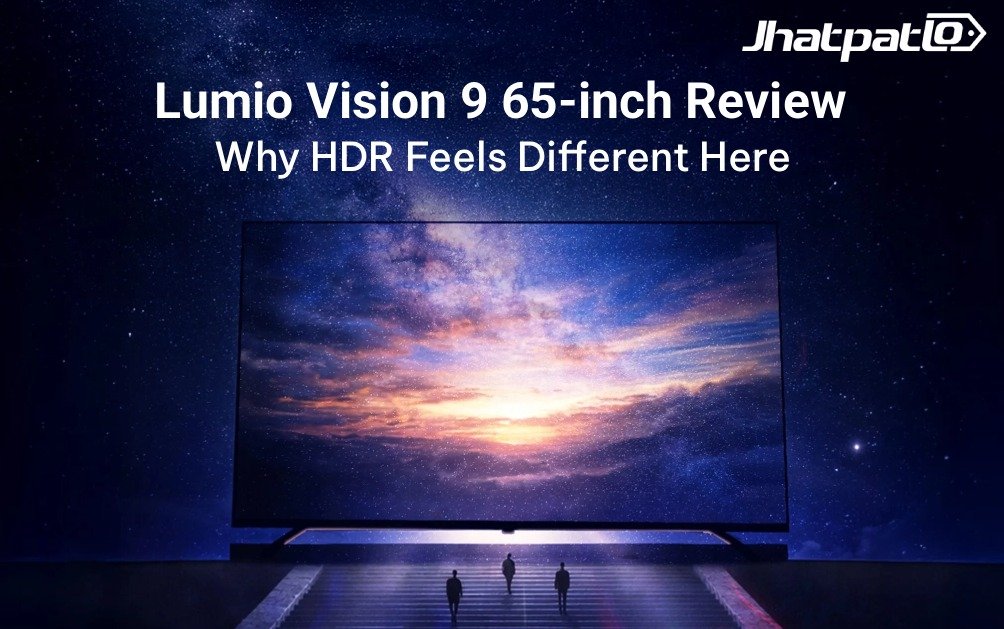
The TV market has become a bit exhausting lately. Every brand promises “mini flagship” performance, every spec sheet sounds heroic, and somehow you still end up wondering if the actual picture will look great once the lights are off and the movie starts. That’s exactly why the Lumio Vision 9 65-inch review is interesting. It’s not trying to win with hype alone. It’s trying to be the kind of premium budget TV that gamers and movie lovers can actually live with.
And honestly, that’s a tougher job than it sounds. A lot of affordable Mini-LED TVs look impressive in a showroom and then get awkward in real homes. Bright highlights can seem uneven, HDR can feel undercooked, and software can be the part that slowly annoys you every day. The Lumio Vision 9 65-inch, though, takes a more practical route. It leans on a native 4K 144Hz panel, dual HDMI 2.1 ports, Google TV, and a 50W audio setup that’s better than most people expect at this price.
Quick Highlights
- Strong gaming support with 4K 144Hz, VRR, ALLM, and 1080p 240Hz PC mode
- SDR picture quality is the real surprise here, not HDR
- 50W speakers and Dolby Atmos tuning make casual audio surprisingly solid
- TLDR + Google TV gives the set a more useful smart TV experience than most budget rivals
- HDR is decent, but you still need realistic expectations at this price
Is the Lumio Vision 9 65-inch the Best Mini-LED TV Under ₹75,000?
At a launch price of ₹72,999, the Lumio Vision 9 65-inch sits right in that dangerous little zone where buyers expect a lot. And fair enough. If you’re spending this much, you’re not looking for “good for the money” in a vague way. You want a TV that can handle PS5 and Xbox Series X gaming, stream movies without looking flat, and not feel cheap three months later.
That’s where Lumio makes its case. It doesn’t just tick spec boxes. It actually feels tuned for the kind of person who notices refresh rate, input lag, picture modes, and whether HDR looks rich or weirdly muted. Compared with bigger names like Sony, Samsung, TCL, and Xiaomi, the Vision 9 is not necessarily trying to beat them in every single category. It’s trying to be more balanced, more usable, and less frustrating.
If you want the short version: this is a premium budget display that makes the most sense for gamers and streaming-heavy households. It’s not a perfect TV, but it feels thoughtfully built in a way that matters more than a flashy spec sheet.
What Makes the Lumio Vision 9 Different From Other Budget TVs?
Most budget TVs chase the loudest headline. Bigger brightness number. More zones. More buzzwords. Then the software lags, the calibration is off, or the experience starts feeling messy after a week. Lumio seems to have approached the Vision 9 differently. The hardware is clearly important, but the brand also cares about the everyday stuff: how the panel behaves in SDR, how gaming actually feels, and whether the smart TV layer is usable without irritation.
That’s the part people often underestimate. A TV is not just a display anymore. It’s your movie launcher, your game switcher, your sports screen, and sometimes your music box. If the interface is clumsy, the whole thing feels more expensive than it should. The TLDR app angle is interesting here because it tries to reduce that app-switching fatigue by pulling content discovery into one place. It’s a bit like having a smarter front desk for your entertainment.
Also, the fact that this isn’t Lumio’s first round matters. There’s already some positive long-term ownership sentiment around the Vision 9 line, and that’s useful because budget TV buyers don’t just care about launch week. They care about whether the TV still feels stable and sensible after months of use.
How Good Is the Lumio Vision 9 Display for Movies and Streaming?
This is where the TV gets a little more interesting than the usual “Mini-LED = awesome” story. For movies and streaming, SDR picture quality is actually a big deal, maybe more than people admit. A huge amount of OTT content still lands in SDR, and a lot of viewers spend their time watching regular shows, YouTube, live TV, sports, and older content that doesn’t lean on HDR at all.
And in SDR, the Lumio Vision 9 does a genuinely strong job. It covers 99.8% of REC.709, and the measured delta error of 5.8 in Movie mode suggests it’s not wildly off in color handling. In plain English, that means colors are fairly well controlled and don’t drift into cartoon territory. The result is a picture that feels clean, balanced, and easier on the eyes than many budget TVs that oversaturate everything just to look exciting in a store.
The panel’s viewing angles are also decent enough for a living room setup, though as with most VA-based displays, you’ll still notice some changes if you sit far off-axis. So yes, center seating is ideal. But the bigger point is this: the TV’s SDR performance is good enough that a lot of everyday watching may actually look better than HDR content, simply because the tuning is more consistent.
That sounds backwards if you’re used to hearing HDR as the “premium” mode. But on budget Mini-LED TVs, that’s often the truth. SDR is the safer bet when you want punchy, predictable image quality.
Is HDR Performance Actually Good on the Lumio Vision 9?
Here’s where the reality check comes in. The Lumio Vision 9’s HDR is usable, and in some scenes it can look quite good, but it’s still limited by panel brightness. Real-world testing landed at roughly 500 nits, which is respectable for this class, just not enough to deliver that dazzling flagship-style HDR pop you get from expensive TVs.
That doesn’t mean HDR is bad. It means HDR is honest. You’ll see stronger contrast than SDR in the right content, and supported formats like Dolby Vision can help with tone mapping. But bright highlights won’t leap off the screen the way they do on pricier panels with much higher peak output. If you’re expecting cinema-grade sparkle on every HDR title, you may end up disappointed.
And this is where a lot of buyers get misled by marketing. HDR isn’t just about turning the mode on. It depends on mastering, panel brightness, tone mapping, and how the TV handles bright scenes without clipping or flattening detail. On the Vision 9, the HDR experience is good enough to enjoy, but not so strong that it should be the main reason you buy the TV.
So the smarter way to look at it is this: SDR is the strength, HDR is the bonus.
Is the Lumio Vision 9 a Good TV for PS5 and Xbox Series X?
This is probably the TV’s most convincing argument. If you’re hunting for an HDMI 2.1 TV for PS5 or a solid TV for Xbox Series X, the Vision 9 brings the right ingredients. You get dual HDMI 2.1 ports, support for 4K 120Hz console gaming, VRR, and ALLM. It also supports 1080p 240Hz for PC gaming, which is a nice extra if you’re using a high-frame-rate desktop setup.
That kind of support matters because gaming on a modern TV isn’t just about image size anymore. It’s about responsiveness. It’s about whether a quick flick in an FPS feels tight, whether motion looks smooth in racing games, and whether the TV actually behaves like a gaming display instead of a pretty box with a few gaming stickers on it.
In practical use, the Lumio Vision 9 does well. The reviewer tested it with both PS5 and Xbox Series X, and the overall impression is that the gaming experience feels properly tuned for the price. If you’re comparing this with the search phrase best gaming TV under 75000, it absolutely belongs in that conversation.
That said, it’s still smart to verify HDMI 2.1 support properly. Not every port on every TV offers the same bandwidth, and buyers often assume “HDMI 2.1” automatically means everything is full-speed. On this model, HDMI 2 and HDMI 3 are the key ports for the full gaming experience. That’s the kind of detail that saves you from frustration later.
| Feature | Lumio Vision 9 | Why it matters |
|---|---|---|
| 4K 144Hz panel | Yes | Smooth motion for gaming and desktop use |
| 1080p 240Hz | Yes | Great for competitive PC gaming |
| VRR and ALLM | Yes | Reduces tearing and improves response |
| HDMI 2.1 ports | 2 | Enough for console + sound system setups |
| HDR brightness | ~500 nits | Good, but not flagship bright |
Why Does PS5 HDR Look Washed Out on Some TVs?
This is one of those annoying things people often blame on the console, when the real issue is usually calibration. If PS5 HDR looks washed out, the TV may be expecting a different brightness range than what the console is sending. That creates a mismatch, and suddenly blacks look gray, highlights feel weak, and everything loses depth.
The good news? It’s usually fixable. The reviewer mentions a 12-click calibration fix, which is exactly the sort of practical advice most reviews skip. Essentially, the PS5 HDR calibration should be set so the TV can map the brightest and darkest points correctly. If you rush it or leave it on the wrong settings, the TV won’t show HDR content the way it should.
So if you buy this TV for gaming, spend a little time in the console settings. It’s not glamorous, but it makes a real difference. And that’s true on plenty of TVs, not just this one. Proper HDR setup is one of those tiny annoyances that pays back every single time you open a game.
How Good Are the Speakers on the Lumio Vision 9?
Audio is another area where people usually lower their expectations too much. Fair enough, TV speakers have a long history of being thin and forgettable. But the Lumio Vision 9’s 50W Hexa Driver setup is noticeably stronger than what you’d usually expect in this segment. Dialogue comes through clearly, and the bass has more weight than the average TV speaker system.
The measured 38Hz low-frequency extension is especially interesting because it hints at a fuller sound than the usual midrange-only approach. No, it won’t replace a proper soundbar for people chasing real home cinema punch. But for casual watching, sports, YouTube, and even gaming, it holds up better than expected.
That matters more than it used to. With modern games, dynamic sound is part of the experience, and with streaming content, clear dialogue can make or break a scene. So while this isn’t a speaker system you buy the TV for, it does reduce the pressure to immediately add external audio.
What Is the TLDR App and Why Does It Matter?
This part is easy to underestimate. The Google TV experience already gives the TV a familiar base, but Lumio’s TLDR layer adds a more guided discovery feel. Think of it as trying to solve the “too many apps, not enough decision-making” problem. Instead of bouncing between streaming services, sports apps, and random menus, TLDR helps pull things together in a way that feels more direct.
That’s a real advantage in 2026, when entertainment is scattered everywhere. Movies are on one service, live sports on another, music somewhere else, and recommendations are often buried under five clicks. A better software layer doesn’t sound exciting on paper, but it changes the everyday feel of a TV more than some hardware specs do.
And yes, smart TV speed matters too. With the MediaTek Pentonic 700 processor and 3GB RAM, the system feels reasonably prepared for the kind of multitasking people actually do. It’s not a luxury flagship brain, but it doesn’t feel stripped down either.
Lumio Vision 9 vs Sony, TCL, Xiaomi, and Samsung TVs
If you’re comparing options, the Lumio Vision 9 sits in a very interesting place. Sony and Samsung may offer stronger overall HDR polish, and TCL has been aggressive in the high refresh-rate TV space, but Lumio brings a surprisingly complete package for the money. Xiaomi remains a value-friendly name too, though its gaming and software balance can feel less focused depending on the model.
| Feature | Lumio Vision 9 | Sony | TCL | Xiaomi | Samsung |
|---|---|---|---|---|---|
| HDMI 2.1 | Yes | Limited | Yes | Partial | Yes |
| 4K 144Hz | Yes | Varies | Yes | No | Yes |
| Audio | 50W | Moderate | Moderate | Average | Moderate |
| Smart UI | TLDR + Google TV | Google TV | Google TV | PatchWall | Tizen |
What stands out here isn’t just the spec count. It’s that Lumio is aiming at actual gaming usability and a more practical software experience, not just “premium” branding. That makes it one of the more compelling choices for buyers looking for a best 65-inch TV for gaming type of option without drifting into flagship pricing.
Final Take: Who Should Buy It?
The Lumio Vision 9 65-inch is not a miracle TV. It won’t suddenly make cheap HDR content look expensive. It won’t outperform every premium rival in every lighting condition. But it does something more useful than that: it gives you a very coherent experience for the price. Gaming is strong. SDR looks better than you might expect. Audio is better than average. The smart TV setup feels more thoughtful than most.
If you’re a PS5 or Xbox Series X owner, this is one of the more convincing premium budget options out there. If you care mainly about dazzling HDR brightness, you may want to stretch higher. But if your priorities are gaming performance, everyday picture quality, and a TV that doesn’t feel dumb to use, the Vision 9 makes a lot of sense.
Maybe that’s the real story here. In a market full of TVs that chase the same headlines, the Lumio Vision 9 feels refreshingly focused on what people actually notice after the first week. And that’s worth something. Would you take slightly weaker HDR if the rest of the experience felt this balanced?
Related Products




![Lumio Vision 9 [2026] Teased in India as Amazon Listing Goes Live](https://jhatpatlo.com/storage/photos/uploads/news/2026/04/lumio-vision-9-2026-teased-in-india-as-amazon-listing-goes-live.webp)
Lumio Vision 9 [2026] Teased in India as Amazon Listing Goes Live
Lumio Vision 9 (2026) India launch teased Lumio has teased the 2026 version of the Vision 9 for India, with an Amazon microsite already live for the upcoming TV. The company has not announced a launch date yet, but the listing suggests the model may arrive soon. The tease points to updates over...
Lumio Vision TVs Get Android 14 Update With 50 Percent Faster Setup and Arc Projector Follow
Android 14 Rollout for Lumio TVs Lumio on Wednesday announced the rollout of the Android 14 update across its Lumio Vision TV lineup, with the Lumio Arc projector set to follow soon. The Bengaluru-based brand says it is the first to deliver a portfolio‑wide Android 14 update across its smart TVs an...

Samsung ISOCELL HPC 200MP sensor could boost Galaxy S27 Ultra
Samsung’s ISOCELL HPC 200MP sensor is already in mass production, and its DeepPix pixel architecture raises full well capacity by 60%. That matters for the Galaxy S27 Ultra camera, where better HDR, cleaner shadows, and stronger light handling can make a real difference in the premium Andr...

Amazon Great Summer Sale Teases Smart TV Deals From Samsung, TCL and Xiaomi
Amazon Great Summer Sale begins later this week Amazon Great Summer Sale is scheduled to begin later this week in India, and the company has started teasing smart TV deals from Samsung, TCL, Xiaomi and several other brands. The sale event will also cover electronics across categories, with di...

Oppo ProXDR camera tech brings 17EV HDR to Find X10
Oppo ProXDR camera tech is built around DeepPix, with the company claiming up to 17EV single-frame dynamic range. That puts its next Find X10 flagships in the fight for cleaner highlights, deeper shadows, and more usable shots in harsh light. ProXDR adds 4K HDR video capture with low...