


Passive vs Active Noise Cancellation: How Each One Handles Real-World Noise
Introduction
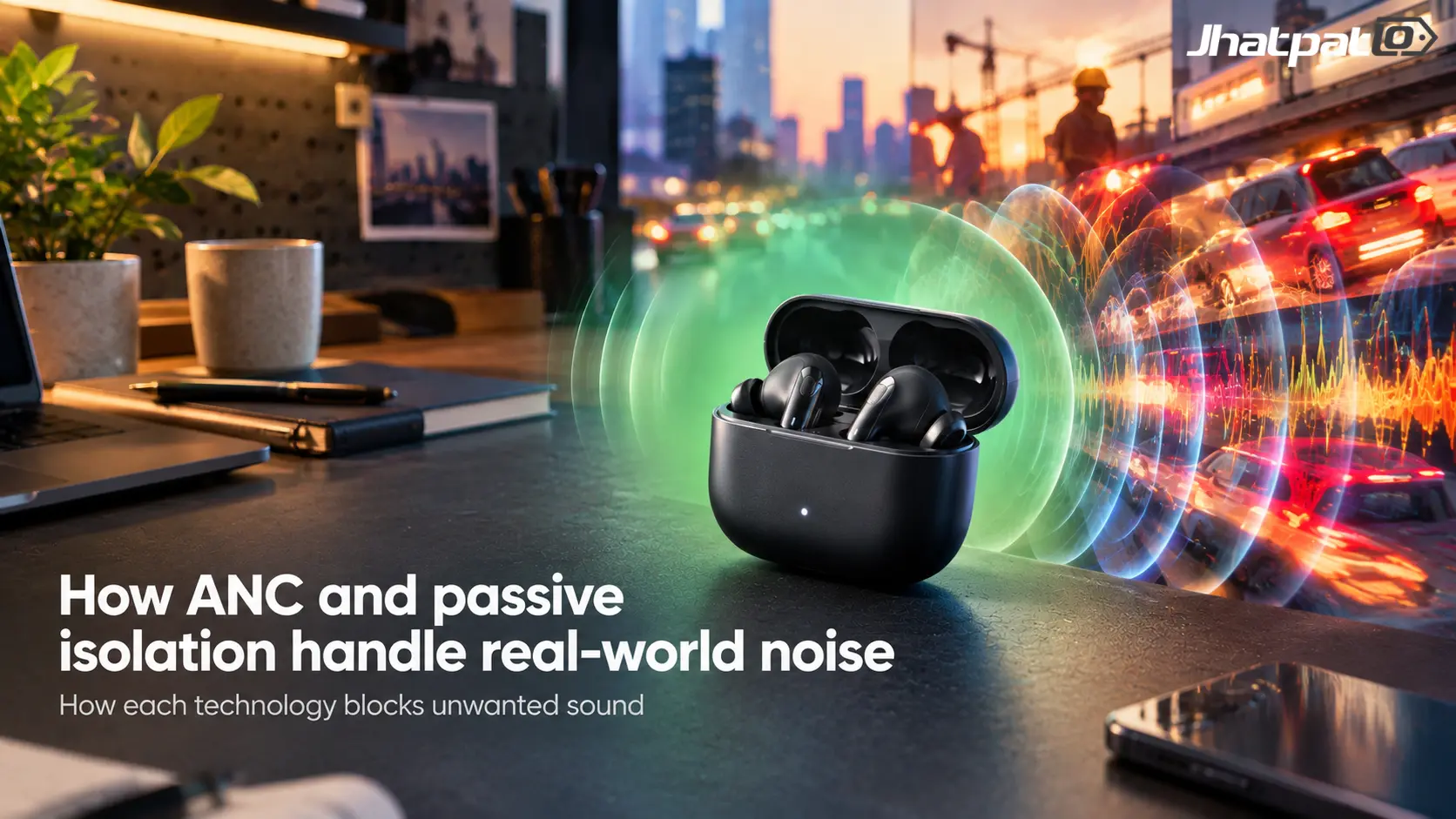
Picture being stuck on the Delhi Metro during peak hours, or trying to think through the constant hum of an AC at home — that is where passive vs active noise cancellation stops being a spec sheet debate.
The question is not whether headphones can block noise, but which kind of noise they block best, and what kind of trade-off you are willing to live with.
- Passive isolation works best on sharp, mid/high sounds.
- ANC shines against low-frequency hum and rumble.
- Battery life and comfort can change the experience a lot.
- Your environment matters more than the box label.
Now, here's the thing: a lot of people assume noise cancelling is one single feature. It isn't. The two approaches solve different problems, and that difference becomes obvious the moment you step into a noisy train, a busy office, or a loud room at home. If you've ever turned the volume up just to beat the background noise, you already know how annoying the wrong kind of sound can be.
What passive noise cancellation actually blocks well
Passive noise cancellation, or noise isolation, depends on the physical build: ear cups, padding, memory foam ear pads, and a tight seal around the ears.
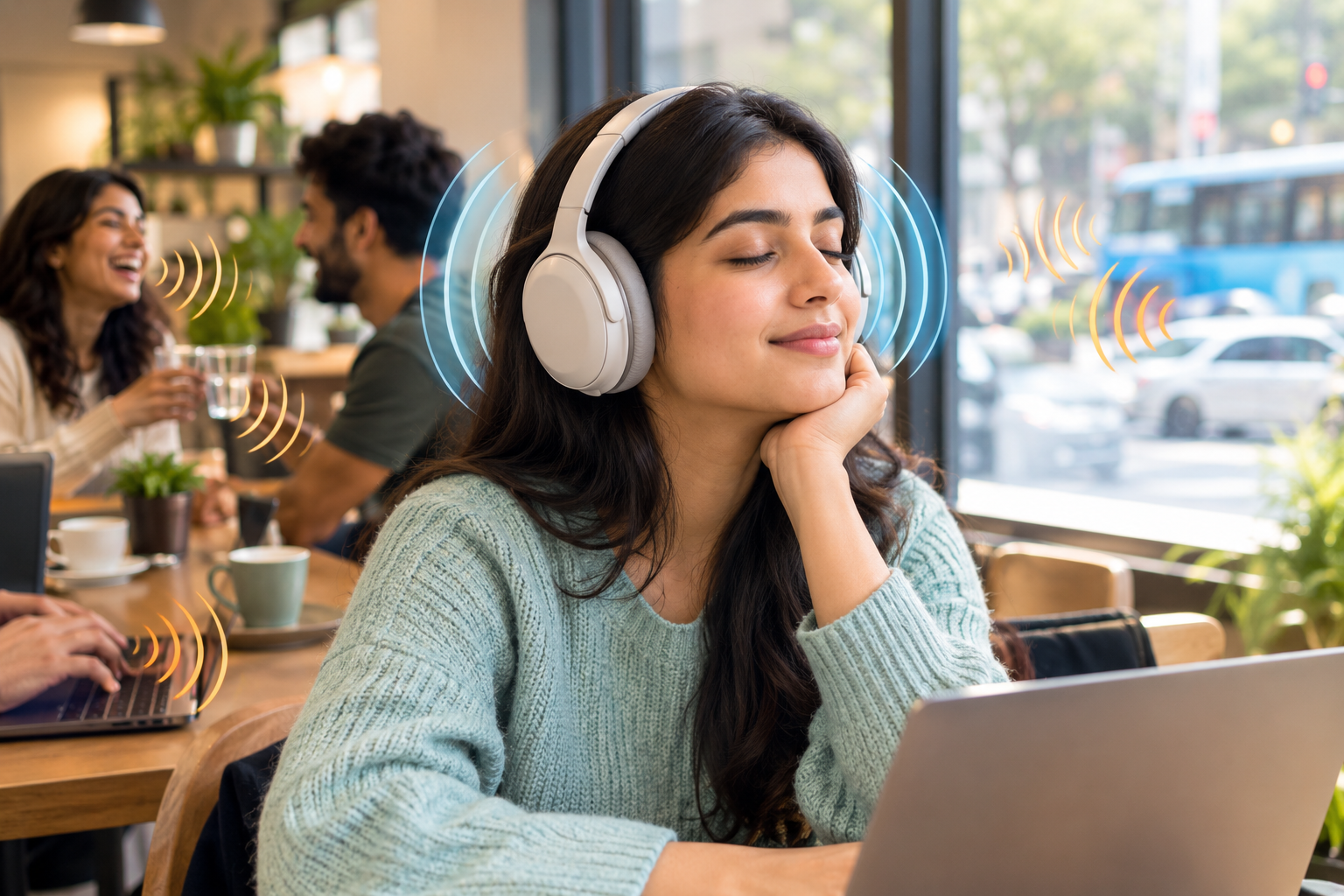
Over-ear headphones with thick memory foam ear pads can reduce ambient sound by roughly 15 to 20 dB, especially in the mid and high frequencies above 1,000 Hz.
That is why it handles sharp sounds better than drone-heavy ones, and why it needs no battery at all.
The kinds of sounds passive isolation handles best
Passive isolation is strongest against sudden, sharp noise like a colleague’s laughter or street traffic noise above 1,000 Hz.
It is the simpler answer when you want no charging hassle, no electronics, and no extra cost built into the headphones.
That simplicity is part of the appeal. A well-sealed pair can be surprisingly effective, especially if your main annoyance is chatter, clinking dishes, keyboard taps, or other quick bursts of sound. It doesn't “think” about the noise the way active systems do. It just physically gets in the way. Think of it like closing a heavy door instead of trying to cancel the sound from the other side.
And because there’s no processing happening, passive isolation doesn’t create the tiny trade-offs that some people notice with ANC. No extra battery drain, no added circuitry, and usually fewer things that can go wrong. For a lot of everyday use, that still makes it a very practical option.
How active noise cancellation removes low-frequency hum
Active noise cancellation uses microphones to listen to outside sound and then creates an anti-noise signal that cancels it through destructive interference.
Modern ANC systems can process that response in under 0.5 milliseconds, and high-end headphones such as the Sony WH-1000XM5 and Bose QuietComfort 45 often use 2 to 8 microphones.
That is what lets ANC reduce low-frequency noise like engine drones, AC hum, and metro noise by up to 30 to 40 dB.
Why microphone placement and processor speed matter
The feedforward mic outside the cup catches ambient sound first, while the feedback mic inside the cup checks the result and fine-tunes it in real time.
Premium chipsets like Qualcomm’s aptX Adaptive can keep latency as low as 50 ms, which is part of why better ANC systems feel more seamless than cheaper ones.
This part is easy to overcomplicate, so let's keep it plain. Active noise cancellation doesn't block sound physically in the same way .
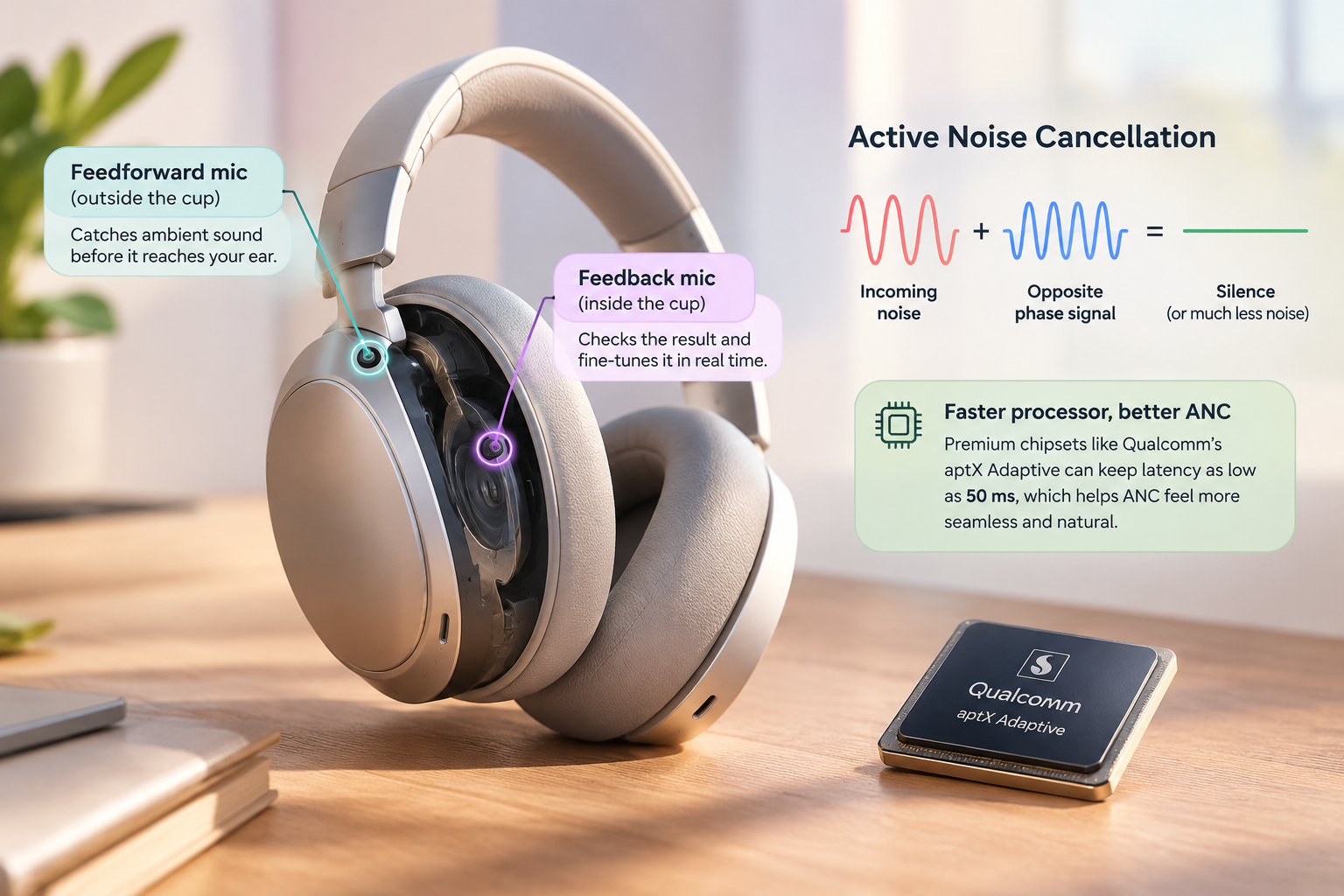
passive isolation does. Instead, it listens to the incoming noise, flips the sound wave, and sends back the opposite signal. When both meet, they cancel each other out. That works especially well when the noise is steady and predictable — the kind of sound that keeps rolling along in the backgroundThat is why ANC feels almost magical on a plane or in a cab. It does not make the world silent, but it can take the edge off the low-end rumble in a way that passive isolation simply can't match on its own. Still, the system has to be fast and smart enough to keep up. If the microphones are poorly placed or the processing is slow, the effect can feel uneven. Better systems just feel calmer. Less effort. Less noise getting through.
Passive vs active noise cancellation: where each one makes more sense
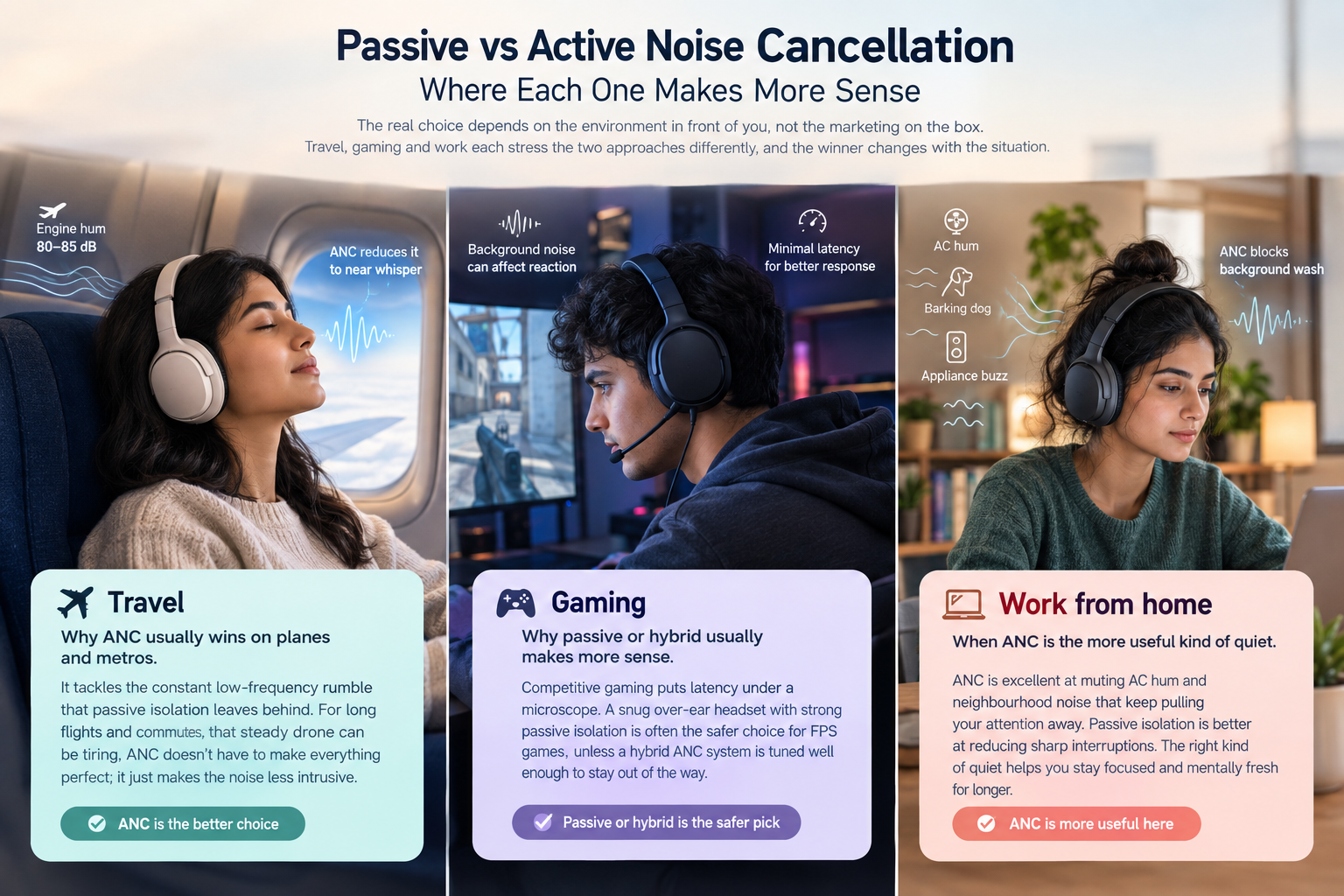
The real choice depends on the environment in front of you, not the marketing on the box.
Travel, gaming, and work each stress the two approaches differently, and the winner changes with the situation.
Travel: why ANC usually wins on planes and metros
For flights and long commutes, ANC is the stronger pick because it attacks the constant low-frequency rumble that passive isolation leaves behind.
Plane engine hum sits around 80 to 85 dB, and good ANC headphones can push that down to near-whisper levels.
If you travel a lot, you start noticing how tiring that steady drone can be. It's not just loudness. It's the persistence. Your brain keeps registering it, even when you're trying to relax or read. That's where ANC earns its keep. It doesn't have to make everything perfect; it just makes the noise less intrusive, and that can be enough to feel like a relief.
Gaming: why passive or hybrid usually makes more sense
Competitive gaming puts latency under a microscope, so even a few milliseconds of ANC processing can matter.
A snug over-ear headset with strong passive isolation is often the safer choice for FPS games, unless a hybrid ANC system is tuned well enough to stay out of the way.
For gamers, this is one of those places where “more features” isn't automatically better. If you're reacting to footsteps, timing, or subtle audio cues, you don't want the headphone to add any weird delay or feel slightly detached. A good seal can do a lot of work without any active electronics getting in the middle. On the other hand, if your room is noisy and you're playing casually, a well-tuned ANC setup may still be worth it. Again, it comes down to what kind of noise is actually bothering you.
Work from home: when ANC is the more useful kind of quiet
For WFH calls and focus sessions, ANC is excellent at muting AC hum and neighbourhood noise that would otherwise keep pulling your attention away.
That is where the difference between active and passive noise cancelling becomes obvious in everyday use.
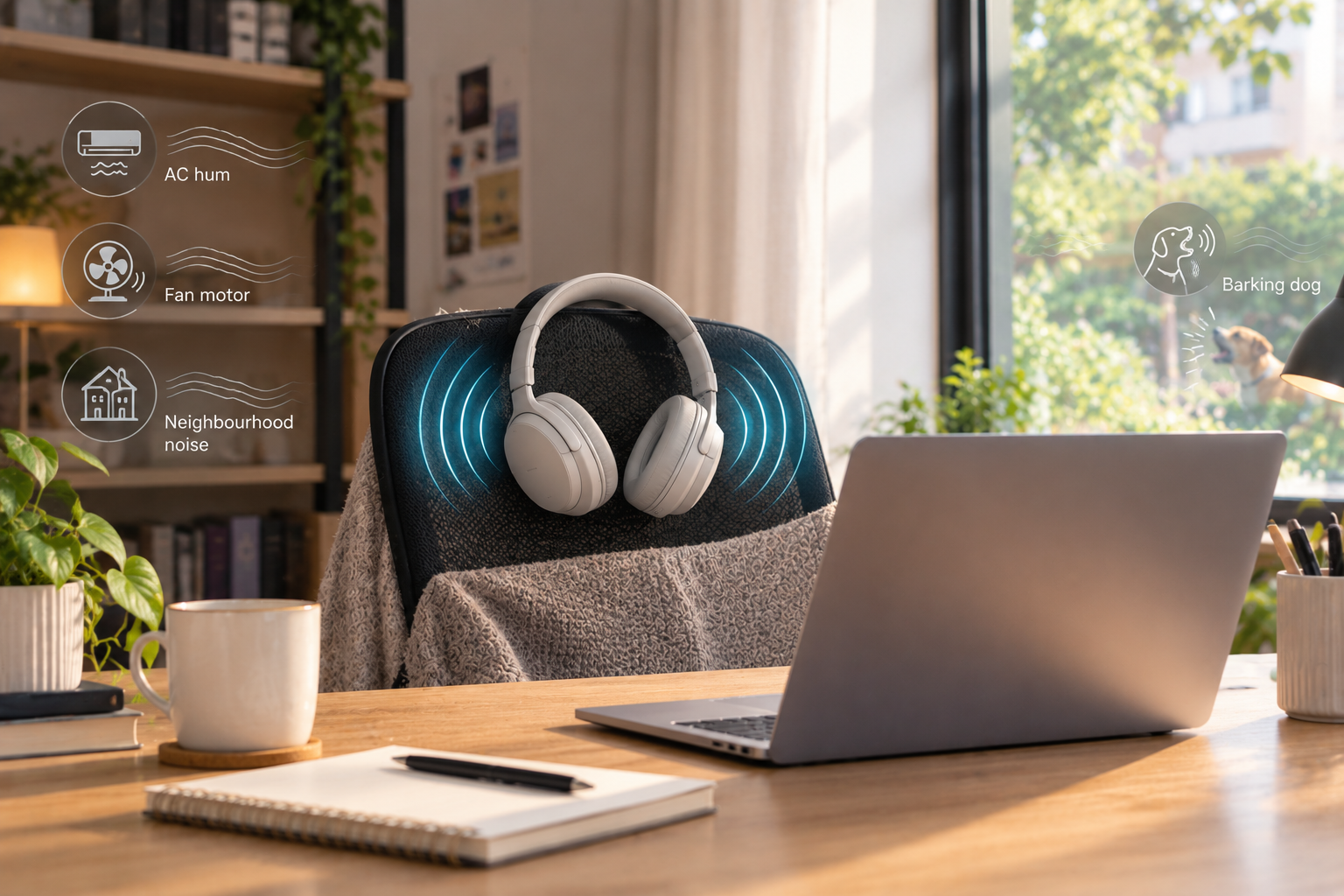
Here's the practical part people often underestimate: focus isn't only about silence. It's about reducing the kind of noise that keeps tugging at your attention. A barking dog outside, a fan motor, the soft buzz from a nearby appliance — those little sounds can feel oddly exhausting. ANC helps more with that kind of background wash, while passive isolation is better at reducing sharp interruptions. If you work from home, having the right kind of quiet can change how long you stay mentally fresh.
What to expect from ANC headphones before you buy
ANC brings real benefits, but it also comes with battery life, comfort, and price trade-offs that are easy to ignore until you own a pair.
Most ANC headphones offer 20 to 30 hours of battery life, and quality models often sit in the Rs. 5,000 to Rs. 35,000 range.
Some users also notice a slight pressure sensation during extended listening, even when the sound reduction is doing its job.
That last point matters more than people expect. A headphone can measure well and still feel a bit strange after two or three hours. The sensation isn't usually painful, just noticeable — like your ears are aware that something is actively working around them. Not everyone feels it, but if you're sensitive to that sort of thing, it is worth trying a pair before buying.
The practical buying cues that matter most
- Flights and metros point you toward ANC headphones for travel.
- Long trips with no charging access make passive isolation easier to live with because it uses no battery.
- Budgets under Rs. 3,000 usually fit passive options better.
- Budgets above Rs. 5,000 open the door to ANC.
- Competitive gaming still favors passive or hybrid setups for low latency.
- A hybrid ANC system, with both feedforward and feedback mics, is usually the best all-rounder.
If you want a simple way to think about it, start with the noise around you, not the headphone features. That's the smarter sequence. A long-haul flyer has very different needs from someone who mostly works at a desk, and both are different again from someone trying to keep game audio crisp. The best choice is the one that matches your daily life without making you manage the headphone more than you enjoy it.
Also, don't ignore fit. Even the best technology struggles if the cups don't sit properly or the seal is weak. Sometimes the difference between “fine” and “wow” is just the shape of the padding around your ears.
FAQ
These are the doubts that come up after the main comparison — the ones people ask when they are trying to decide, not just understand the theory.
Q: Is active noise cancellation better than passive noise isolation?
For low-frequency noise like flights or AC units, yes — ANC can reduce sound by up to 40 dB, compared with passive isolation at roughly 15 to 20 dB. Passive still holds up better for high-frequency noise and when battery life matters more.
Q: Do ANC headphones work without music?
Yes. ANC works independently of playback, so you can use it in silence for focus or sleep.
Q: Can passive noise cancellation block all sounds?
No. It reduces mid- to high-frequency noise well, but low-frequency rumble like engine noise still gets through.
Q: Which is better for gaming: passive or active noise cancellation?
Passive is usually better for competitive gaming because ANC can add slight processing lag. A well-sealed headset with good passive isolation is often the cleaner choice.
Conclusion
If you commute often, fly regularly, or work around constant background noise, ANC is usually the smarter answer. If you want lower cost, no charging, and stronger latency discipline for gaming, passive isolation is the more reliable fit.
The cleanest takeaway is simple: let the noise environment decide, then choose the headphone type that handles that noise without asking you to fight it later.

Mahi Gupta
✉ mahigupta708076@gmail.comRelated Products





Moto Buds 2 Plus Debuts at MWC 2026 With Bose Sound and Dynamic ANC
Motorola unveils two new true wireless headsets, the Moto Buds 2 Plus and Moto Buds 2, at MWC 2026 in Barcelona. The lineup expands Motorola's audio portfolio with two TWS options that share essential features such as Dynamic Active Noise Cancellation, Hi-Res Audio with LHDC, and Spatial Audio, whil...

Beats 360 headphones leak points to IPX4 design and $299.99 price
Beats 360 headphones have surfaced in Brazil’s ANATEL approval filing, backing up earlier retail leaks tied to model number A3577. The filing points to Apple’s first sweat-resistant over-ear pair, with a listed price of $299.99, which would place Beats in direct competition with premium AN...

AirPods 5 with ANC May Debut at Apple’s September 2026 Event
AirPods 5 with ANC is now linked to Apple’s September 2026 event, where the company may split the lineup into a standard model and a pricier version with noise cancellation. If that happens, Apple would give buyers a clearer choice and could strengthen its position in the midrange wireless...

OnePlus Buds Ace 3 Teased With 55dB ANC And 54 Hour Battery Life
OnePlus Buds Ace 3 Teased Ahead Of China Launch OnePlus has teased the Buds Ace 3 on Weibo, with the earbuds expected to launch this month alongside the OnePlus Ace 6 Ultra in China. The new true wireless earbuds are claimed to bring up to 55dB active noise cancellation and up to 54 hours of...
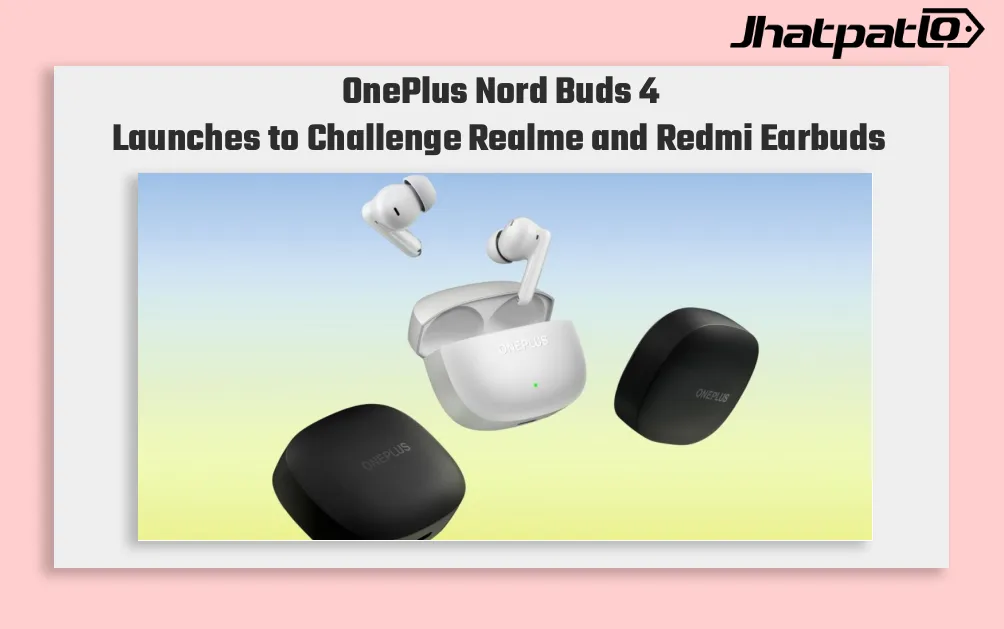
OnePlus Nord Buds 4 Launches in India With 55dB ANC and 54-Hour Battery
OnePlus is preparing to launch the Nord Buds 4 in India on June 25, and the early details make the earbuds easy to place in the under-Rs 5,000 segment. The biggest talking points are 55dB active noise cancellation, a six-mic setup, 12mm titanium-coated drivers and a claimed 54-hour battery...