


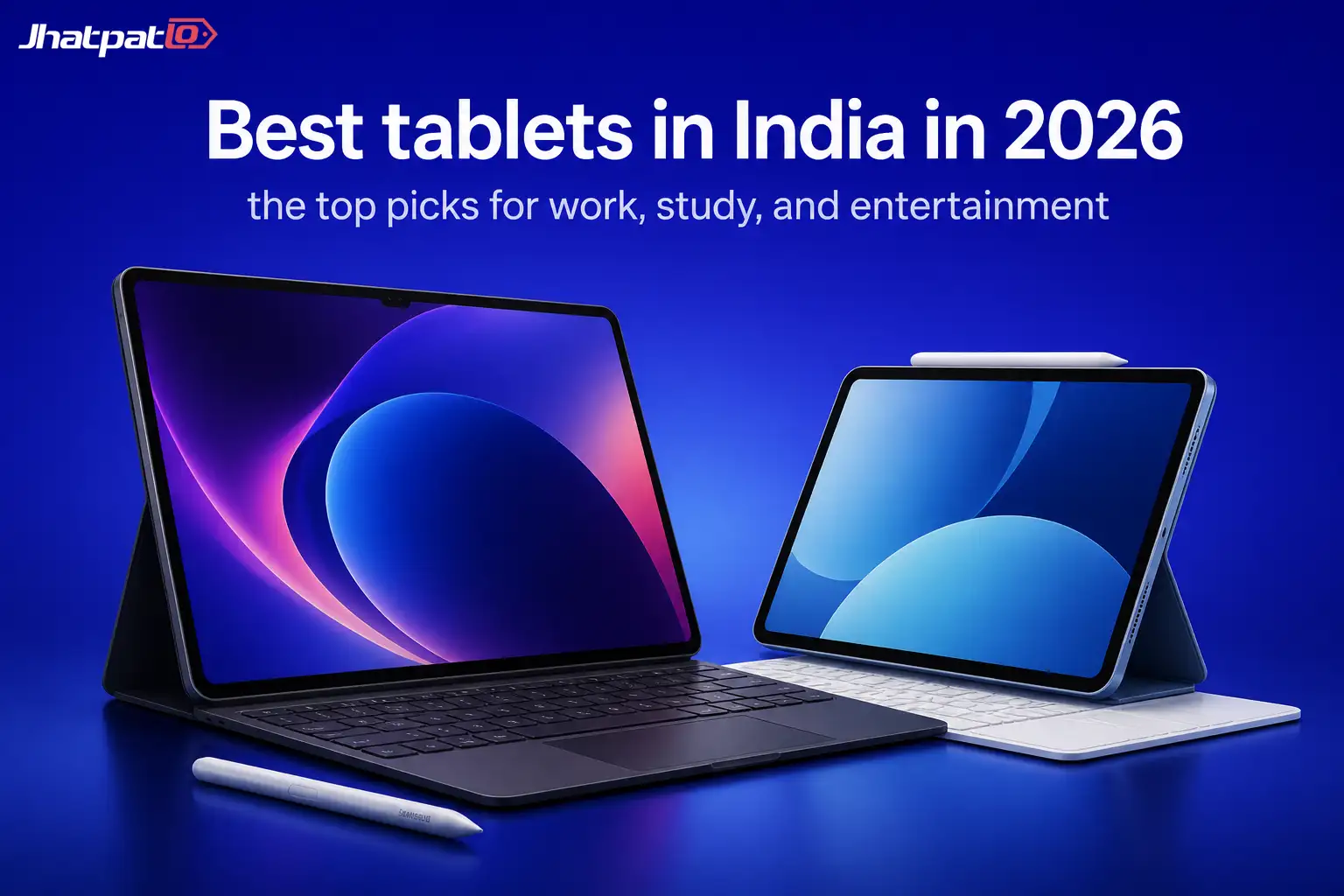
Best tablets in India in 2026: the top picks for work, study, and entertainment
Introduction
The tablet market in India in 2026 feels a bit more serious than it used to. You’re not just choosing something for YouTube and casual browsing anymore. A good tablet can handle notes, classes, office work, sketching, movies, and even a decent chunk of laptop-style multitasking if you pick well.
The Samsung Galaxy Tab S11 Ultra jumps out first because of its 14.6-inch AMOLED panel, 11,600mAh battery, and bundled S Pen. That’s the kind of spec sheet that can make a tablet feel like a real laptop replacement, but the better move is to judge each pick by what it actually does best.
- Samsung Galaxy Tab S11 Ultra is the premium monster.
- OnePlus Pad 4 looks like the value sweet spot.
- Redmi Pad 2 Pro keeps things under Rs 30,000.
- Galaxy Tab S10 FE is the safest pick for students.
- iPad Air 11″ still wins for Apple users.
So, instead of pretending there’s one perfect tablet for everyone, it makes more sense to look at the best tablets in India in 2026 as clear winners in different lanes. That’s really where the buying decision becomes easier. Once you match the tablet to your actual life, the specs start making a lot more sense.
Which tablet is the right pick at each budget?
The India tablet market in 2026 has a few obvious standouts, but only if you separate them by budget and purpose. A huge, expensive Samsung tablet is great if you want maximum screen space and multitasking. An iPad Air is more tempting if you already live inside Apple’s ecosystem. And something like the Redmi Pad 2 Pro can look surprisingly smart once you stop expecting flagship behavior from a budget device.
Here’s the quick list of the six main picks: Samsung Galaxy Tab S11 Ultra at Rs 1,19,999, Apple iPad Air 11″ at Rs 83,900, OnePlus Pad 4 at Rs 59,999, Redmi Pad 2 Pro at Rs 25,999, Galaxy Tab S10 FE at Rs 56,999, and Galaxy Tab S11 at Rs 96,600. That spread matters because value changes quickly once you compare display quality, battery life, software support, and what you’re actually planning to do with the tablet.
- Best ultra-premium tablet: Samsung Galaxy Tab S11 Ultra — Rs 1,19,999
- Best iPad: Apple iPad Air 11″ — Rs 83,900
- Best value tablet: OnePlus Pad 4 — Rs 59,999
- Best budget tablet: Redmi Pad 2 Pro — Rs 25,999
- Best tablet for students: Galaxy Tab S10 FE — Rs 56,999
- Best Android tablet overall: Galaxy Tab S11 — Rs 96,600
That list isn’t about flashy labels. It’s about narrowing down the decision so you don’t waste time comparing a budget tablet with a premium one as if they’re playing the same game. They’re not.
What makes the Samsung Galaxy Tab S11 Ultra the ultra-premium pick?
The Galaxy Tab S11 Ultra is built like a no-compromise tablet. It runs on the MediaTek Dimensity 9400+, uses a 14.6-inch WQXGA+ Dynamic AMOLED 2x display, and packs an 11,600mAh battery. On paper, that already sounds huge. In real life, it feels like a tablet designed for people who want a device that can stretch across work, entertainment, and creative tasks without constantly asking for a charger.
Its 120Hz panel keeps scrolling smooth, 45W wired charging helps it recover quickly, and S Pen support pushes it into serious productivity territory. The listed configurations are 12GB + 256GB and 12GB + 512GB, with a 13MP main camera, 8MP ultrawide, and 12MP selfie camera. That camera setup isn’t the reason to buy it, obviously, but it does show Samsung isn’t treating this like a stripped-down tablet.
The Samsung tablet with the biggest screen and battery
At 14.6 inches and 2960 × 1848 resolution, the Galaxy Tab S11 Ultra is the most expansive option here. The 11,600mAh battery is just as serious. Put those two things together and you get a tablet that feels closer to a portable workstation than a casual media slab.
One UI 8.5 adds split-screen, multi-window controls, and Galaxy AI features, which is where the tablet starts to feel genuinely useful for heavy users. If you’re juggling a browser, notes app, video call, and file manager at the same time, the extra screen space matters a lot more than a raw benchmark number. And the S Pen is not just a bonus here; it’s part of the whole pitch. For note-taking, marking up PDFs, or sketching ideas, it changes the way the tablet behaves.
Where the Apple iPad Air 11″ still holds its ground
The iPad Air 11″ takes a different path. It uses the Apple M4 chip, 12GB of RAM, and a battery rated at 28.93 watt-hours. That’s the kind of hardware combination that feels very fast in everyday use, especially if you already own an iPhone or MacBook. Apple’s ecosystem stuff really does make a difference. Universal Clipboard, Handoff, and Sidecar sound like small conveniences, but they add up fast when you use multiple Apple devices.
The trade-off is easy to spot, though. The 11-inch Liquid Retina IPS display is 2,360 x 1,640 and only 60Hz, which makes it less exciting next to Samsung’s AMOLED panel. The Apple Pencil and Magic Keyboard also cost extra, so the price climbs after the first purchase. Storage options go up to 1TB, with 128GB, 256GB, 512GB, and 1TB variants available. So yes, the iPad Air 11″ is powerful, but it’s not the tablet that tries to give you everything in the box.
That’s the whole Apple vs Samsung story in one sentence: Samsung gives you more hardware flexibility, while Apple gives you a polished ecosystem and excellent performance if you’re already bought into its world.
Why the OnePlus Pad 4 is the best value Android tablet
The OnePlus Pad 4 is probably the easiest tablet to recommend if you want strong performance without paying flagship Samsung money. It pairs the Snapdragon 8 Elite Gen 5 with a 13.2-inch 3.4K 144Hz IPS LCD and a massive 13,380mAh battery. That’s a very loaded spec sheet for a device sitting in the mid-range value conversation.
It also charges at 80W, comes in 8GB + 256GB and 12GB + 512GB variants, and uses a 7:5 aspect ratio that works nicely for reading textbooks, documents, and long articles. That aspect ratio sounds like a small detail, but it’s one of those things you notice the minute you start reading or working on the tablet for more than ten minutes. OxygenOS 16 also adds up to five free-floating windows, which gives it a surprisingly practical multitasking edge. The only catch is that the Stylo Pro stylus is sold separately.
| Value tablet spec | OnePlus Pad 4 | Why it matters |
|---|---|---|
| Chipset | Snapdragon 8 Elite Gen 5 | Flagship-level performance |
| Display | 13.2-inch 3.4K 144Hz IPS LCD | Sharp, fast, and large enough for work |
| Battery | 13,380mAh | Multi-day endurance |
| Charging | 80W wired | Fast top-ups |
| Storage variants | 8GB + 256GB, 12GB + 512GB | Two clear buying tiers |
Now, this is where it gets interesting. A lot of tablets claim to be “good for work,” but then they make you fight with cramped screens or weak battery life. The OnePlus Pad 4 avoids both problems pretty well. If you want an Android tablet that feels quick, modern, and easy to live with, this one is very hard to ignore.
What the Redmi Pad 2 Pro does well under Rs 30,000
The Redmi Pad 2 Pro is the straightforward answer for anyone trying to stay under Rs 30,000. That matters because a lot of people want a tablet for streaming, reading, classes, or light productivity, but they don’t want to spend laptop money. This is one of those rare budget devices that still feels reasonably complete.
Its 12.1-inch 2.5K 120Hz display, Snapdragon 7s Gen 4 chip, and 12,000mAh battery make it genuinely useful for reading, note-taking, streaming, and light work. It can also handle BGMI and COD: Mobile at moderate graphics and frame-rate settings with decent thermal management, which means it’s not just for passive use. HyperOS brings split-screen and floating windows, and the optional Smart Keyboard and Redmi Smart Pen can make it feel a bit more laptop-like. Just keep expectations in check: the stylus is useful, but it’s not as precise as flagship-level options.
The budget tablet that still has usable multitasking
This is a good example of a cheap tablet doing more than the basics. The storage options are 8GB + 128GB and 8GB + 256GB, the charging is 33W wired, and the camera setup is 8MP main plus 8MP selfie. None of that screams luxury, but it doesn’t need to.
What matters is that the Redmi Pad 2 Pro still gives you things that actually improve daily use: a big screen, decent battery life, and enough multitasking to get real work done in short bursts. If you’re buying for a student, a kid, or just yourself as a second screen at home, this one makes sense in a very practical way.
Why the Galaxy Tab S10 FE is the student tablet to beat
The Galaxy Tab S10 FE fits the student brief really well because it focuses on reliability, the S Pen in the box, and enough power for school tasks, assignments, and exam prep. It’s not trying to be the flashiest tablet on the shelf. Instead, it tries to be the one that quietly works for years, which is often more valuable for students than raw top-end performance.
Its 10.9-inch 1.5K IPS LCD, Exynos 1580 processor, and 8,000mAh battery are tuned for long reading sessions, online classes, handwritten notes, and everyday multitasking. The standout detail, though, is seven years of guaranteed software support on Android 16-based One UI 8.5. That’s a big deal. Students usually keep devices for a long time, and software support matters more than people admit at first.
Why seven years of software support matters for students
That long support window is the real differentiator. It means the tablet stays current through future Android releases and security updates, which is a lot more useful than chasing a slightly faster chip on paper. A student doesn’t usually need the absolute fastest tablet. They need something dependable, secure, and unlikely to feel old before graduation.
Storage comes in 8GB + 128GB and 12GB + 256GB versions, with 45W wired charging and a 13MP main camera plus 12MP selfie camera. Again, nothing here is trying to be extravagant. But that’s kind of the point. The Galaxy Tab S10 FE is built to be sensible, and in the student category, sensible usually wins.
Why the Galaxy Tab S11 is the best overall Android tablet
The Galaxy Tab S11 is the cleaner recommendation for most people who want Samsung’s flagship performance without crossing Rs 1 lakh. It uses the same MediaTek Dimensity 9400+ as the Ultra, but in a smaller 11-inch 2x Dynamic AMOLED 2x package. So you still get the premium Samsung feel, but in a size that’s easier to carry around every day.
The trade-offs are pretty manageable: a single 13MP rear camera instead of an ultrawide setup, and an 8,400mAh battery instead of 11,600mAh. Even so, the 120Hz display, 45W charging, 12GB RAM, and storage options up to 512GB make it the strongest all-round Android tablet here. If you want something high-end without going all the way to the Ultra, this is probably the smartest compromise.
| Android flagship comparison | Galaxy Tab S11 | Galaxy Tab S11 Ultra |
|---|---|---|
| Processor | MediaTek Dimensity 9400+ | MediaTek Dimensity 9400+ |
| Display | 11-inch, 2960 × 1848, 120Hz | 14.6-inch WQXGA+, 2960 × 1848, 120Hz |
| Battery | 8,400mAh | 11,600mAh |
| Rear camera | 13MP main | 13MP main + 8MP ultrawide |
| Price | Rs 86,600 | Rs 1,19,999 |
For most Android buyers, that comparison tells the story pretty cleanly. The Ultra is the one for people who want the biggest, best, most dramatic version of the idea. The regular Galaxy Tab S11 is the one for everyone else who still wants premium hardware but doesn’t want to pay for the extra size.
FAQ
These are the follow-up doubts that usually come after the first purchase decision is already made, especially when readers are comparing Samsung, Apple, and budget Android tablets.
Q: Which is the best tablet in India in 2026?
The Samsung Galaxy Tab S11 Ultra is the top overall pick here because of its 14.6-inch AMOLED display, S Pen support, multitasking features, and multi-day battery endurance.
Q: Is the Samsung Galaxy Tab better than the iPad?
Samsung tablets usually include more value extras like an S Pen and AMOLED panels, while the iPad Air 11″ gives you iPadOS, Apple M4 performance, and stronger ecosystem features. The better choice depends on whether you care more about hardware flexibility or app polish.
Q: Which tablet is best around Rs 50,000 in India?
The Samsung Galaxy Tab S10 FE is the cleaner answer if you want the S Pen included, a 10.9-inch display, and enough performance for productivity. The iPad 11th generation is the Apple alternative, but it is a different kind of buy.
Q: Which tablet is best for students in India?
The Galaxy Tab S10 FE is the best fit for students because it balances a 10.9-inch 1.5K display, Exynos 1580 performance, and long-term software support with the S Pen included.
Conclusion
The best tablet choice in India depends less on raw specs and more on what kind of use case you want to live with every day. The Galaxy Tab S11 Ultra is the strongest all-round answer, but the OnePlus Pad 4, Redmi Pad 2 Pro, iPad Air 11″, and Galaxy Tab S10 FE each win in their own lane. That’s really the key idea here: the right tablet is the one that fits your habits, not just your budget ceiling.
If you want the safest buy, match the tablet to the job: ultra-premium power, Apple ecosystem comfort, value Android performance, budget practicality, or a tablet for students. Once you do that, the decision gets a lot less confusing, and honestly, a lot less expensive too.

Mahi Gupta
✉ mahigupta708076@gmail.comRelated Products




Samsung Galaxy Tab S12 Plus Spotted on IMEI Database Ahead of Launch
JhatpatLo reports that Samsung has launched the Galaxy Tab S11 and Galaxy Tab S11 Ultra in India and other global markets in September 2025. The tablets feature 11-inch and 14.6-inch Dynamic AMOLED 2X displays. The company appears to be preparing to unveil the next model, with the purported Samsung...

Amazon Great Freedom Sale 2026 Best Tablet Deals on Samsung OnePlus Xiaomi Lenovo
Amazon Great Freedom Sale 2026 is pushing tablet prices lower across Xiaomi, OnePlus, Samsung, and Redmi, with some of the biggest cuts landing on premium Android models. The Xiaomi Pad 7 Nano Texture drops to an effective ₹26,249, while the OnePlus Pad 2 comes down to ₹30,249 with bank of...

Pixel 10 Series Discounted as OnePlus 15 and Galaxy Tab S11 Ultra Go On Sale
Major discounts across Pixel 10 series and other devices Discounts on Google’s Pixel 10 series continue this week, with price cuts also hitting the OnePlus 15, Redmi Note 15 Pro variants, and Samsung’s Galaxy Tab S11 lineup. Device price cuts in detail The OnePlus 15 is currently available...

Galaxy Tab S12 Ultra Leak Shows Notch and Dimensity 9500 Signs
Fresh Galaxy Tab S12 Ultra leak details point to Samsung keeping the front notch while moving the flagship tablet to MediaTek’s Dimensity 9500. The latest renders and a Geekbench result also suggest an October 7 launch window, with Android 17 and One UI 9 in the mix. Samsung Galaxy Tab S1...

Xiaomi Fan Festival 2026 Offers Discounts on Xiaomi 17 Ultra, Redmi Note 15 Series
Xiaomi Fan Festival 2026 Begins in India Xiaomi Fan Festival 2026 has started in India with offers on smartphones, tablets and smart TVs, the company said on Monday. The event runs from April 6 to April 15 and includes discounts on select Xiaomi and Redmi products, among them the Xiaomi 1...

Samsung Galaxy Tab S12 Ultra Leak Hits Google Play Console
Samsung Galaxy Tab S12 Ultra has appeared in Google Play Console’s supported devices list, with SM-X940 for Wi‑Fi and SM-X946B / SM-X946N for cellular models. That is a strong sign the tablet launch is moving closer, and it also lines up with earlier Samsung Galaxy Tab S12+ and Geekbench l...