


UFS 5.0 Storage for Smartphones Brings Samsung's 10.8GB/s Leap.
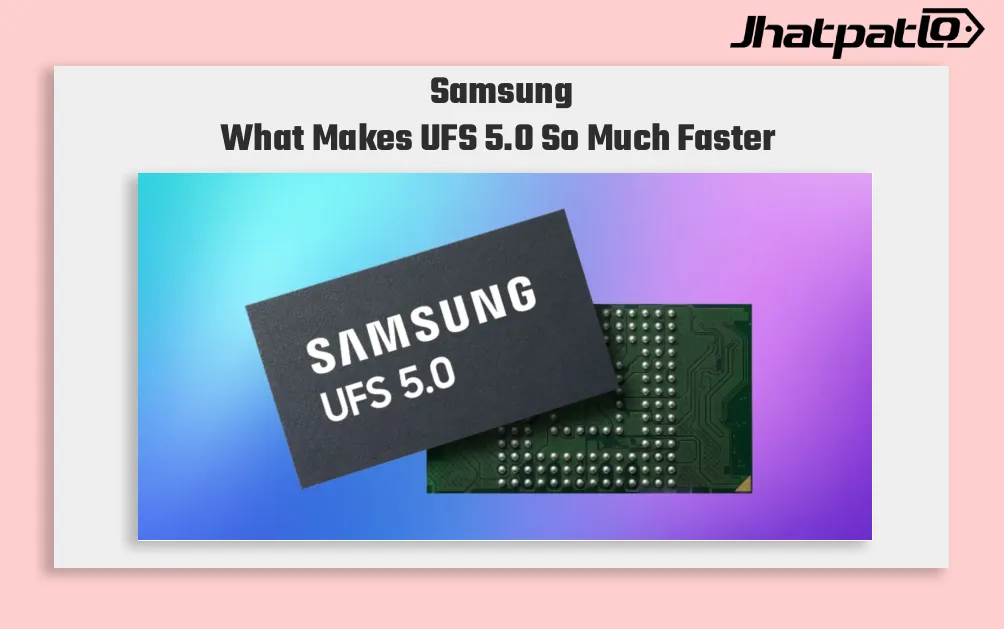
Samsung’s latest UFS 5.0 announcement points to a bigger storage step for premium smartphones, with faster speeds, lower power use, and a clearer fit for on-device AI. The new standard is still some time away from broad availability, but the technical direction is clear: more performance without giving up battery life or internal space.
For phone makers, that mix matters. Storage is no longer just about saving photos and apps. It now affects how quickly large AI tasks run, how hot a device gets, and how much room is left inside the chassis for other components. Samsung says UFS 5.0 is designed around those pressures.
UFS 5.0 on-device AI gets a practical boost from lower latency
Samsung says the new standard is tuned for faster LLM processing, which makes the AI angle hard to miss. In practice, that points to on-device workloads that need quick storage access, especially in flagship phones where local AI features are becoming more common.
The headline figures are strong for a phone storage standard. Samsung is claiming up to 10.8 GB/s sequential write speed and 9.5 GB/s read speed, along with a claimed 40% cut in power use. If those numbers hold up in shipping devices, UFS 5.0 would give premium Android phones a clear lift in throughput while also easing battery drain.
That matters because modern smartphones are doing more at once. Storage speed influences how quickly large models can load, how responsive certain AI tasks feel, and how well a device handles sustained use. Lower latency is not the kind of spec most buyers notice on a box, but it can make a real difference in daily use.
Samsung also says the smaller chip size is part of the benefit. A more compact package can free internal space in thinner designs, which gives manufacturers extra room for other priorities. In ultra-premium phones, that can mean more space for cameras, larger batteries, or better cooling. Those trade-offs are getting tighter every year, so even a small packaging change can matter.
- Up to 10.8 GB/s sequential write speed
- Up to 9.5 GB/s read speed
- Claimed 40% reduction in power use
- Tuned for faster LLM processing
- Smaller chip size for better internal space use
Samsung UFS 5.0 mass production starts in Q4 2026
The timing is important. Samsung says mass production will start in Q4 2026, which means the first phones to use UFS 5.0 will likely arrive before the storage is broadly available at scale. That usually leaves early flagship devices to test the gap between announcement and real-world adoption.
In other words, this is not an immediate change for the wider market. The earliest phones with UFS 5.0 are more likely to be ultra-premium Android models, where manufacturers are willing to use the newest parts first. A few ultra-tier phones launching late this year or early next year may still use it, which would place Samsung’s fastest storage into the hands of the most expensive Android devices first.
That rollout pattern is familiar in the smartphone industry. New hardware often starts at the top of the market and then slowly moves down as supply expands. UFS 5.0 appears to fit that same path. For now, the main takeaway is not that every phone is about to get faster storage. It is that the ceiling is rising again, and Samsung is setting a clearer target for the next wave of premium devices.
For buyers, the practical message is simple. If you care about speed, battery life, and thermal headroom all at once, UFS 5.0 is aimed at that exact intersection. The standard will not reshape every phone right away, but it could become one of the quieter upgrades that helps future flagships feel faster and more efficient over time.

Aman Dixit
✉ aman79dixit@gmail.comRelated Products



Galaxy S27 Ultra Leak Points to UFS 5.0 Storage and Snapdragon 8 Elite Gen 6 Pro
Galaxy S27 Ultra leak outlines early hardware changes Samsung’s Galaxy S27 Ultra has appeared in early leaks that point to changes in storage and chipset, with online details suggesting UFS 5.0 storage and a Snapdragon 8 Elite Gen 6 Pro processor. The report, attributed to YYeux1122 on Naver,...

Samsung Galaxy A27 5G Appears on Geekbench With Snapdragon 6 Gen 3 and 6GB RAM
Samsung Galaxy A27 5G surfaces on Geekbench Samsung’s Galaxy A27 5G has appeared on Geekbench, giving an early look at its processor, RAM and software details. The listing suggests the phone may use an older Snapdragon 6 Gen 3 chipset, support 6GB of RAM and run Android 16 with One UI 8.5. T...

Samsung ISOCELL HPC 200MP sensor could boost Galaxy S27 Ultra
Samsung’s ISOCELL HPC 200MP sensor is already in mass production, and its DeepPix pixel architecture raises full well capacity by 60%. That matters for the Galaxy S27 Ultra camera, where better HDR, cleaner shadows, and stronger light handling can make a real difference in the premium Andr...

Samsung 990 SSD in India Launches With 7250MB/s Speeds and 2TB models
Samsung’s 990 SSD has launched in India as a PCIe 4.0 NVMe drive for buyers who want strong performance without moving all the way up to the 990 Pro. The 1TB model starts at ₹25,649, and a 2TB version is also part of the lineup. For gaming PCs, creator systems, and premium desktops, the fo...

Galaxy S26 Plus shows performance boost in Geekbench and 3C listings
OverviewThe Galaxy Plus has appeared in Geekbench and China's 3C listing, supporting expectations of a performance boost for the mid‑tier flagship. The Geekbench entry shows the model SM-S947N with an octa‑core processor clocking up to 3.80GHz, possibly the Exynos 2600 built on a 2nm GAA process. A...

Qualcomm's Snapdragon 8 Gen 6 Pro Reportedly Priced Higher, Tipster Claims
Primary development A Weibo post by tipster Digital Chat Station claims Qualcomm's next-generation flagship chipset, codenamed SM8975, will be “extremely expensive” and marketed as the Snapdragon 8 Gen 6 Pro. The post says the chip will be built on Taiwan Se...