


Wired vs Wireless Headphones: Price, Sound & Battery Compared
Introduction
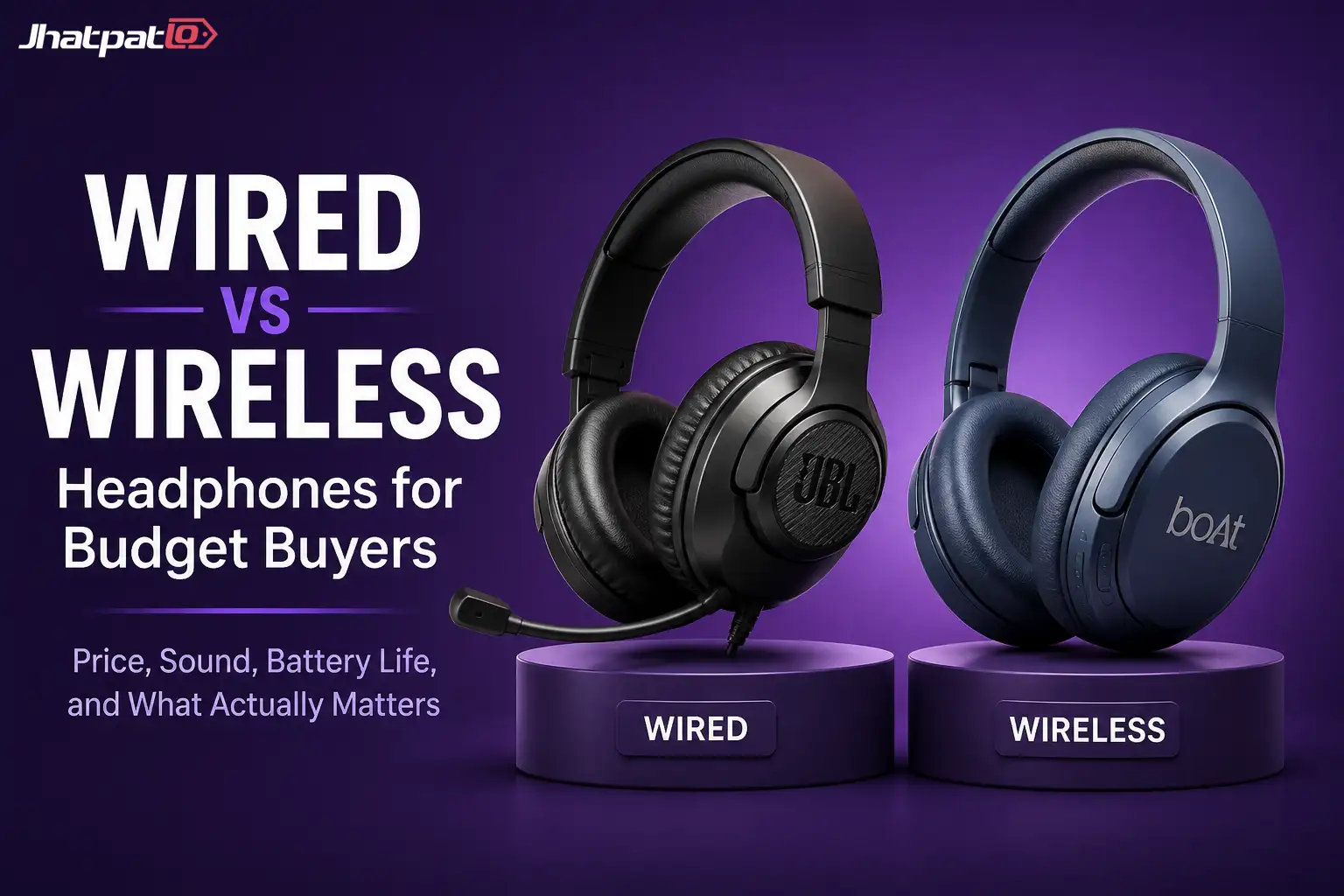
Wired vs wireless headphones gets confusing fast once you stop looking at the box and start thinking about how you actually use them. On paper, both can sound good. In real life, though, the choice usually comes down to something a lot simpler: how much you want to spend, how often you want to charge, and whether you care more about sound purity or movement.
That’s why this isn’t really a spec battle. It’s a budget decision. And if you’ve ever bought the wrong pair, you already know how annoying the wrong choice can feel after the first few days.
Quick Highlights
- Wired usually gives more sound for less money.
- Wireless makes sense when movement matters.
- Battery life is the hidden long-term cost.
- Comfort depends more on usage than the category.
Why wired usually wins on price, sound, and low-maintenance use
For most budget buyers, wired is the easier place to start. There’s a pretty simple reason for that: wired models skip batteries, Bluetooth chips, and charging cases. That keeps the upfront price lower, and it also keeps the whole buying experience less complicated.
And yes, the budget gap is real. You can find solid budget wired headphones under Rs. 1,000, and some of them still sound surprisingly good. That matters more than people admit, because when your use case is basic — music, gaming, desk listening, or just long sessions at home — you often don’t need extra features getting in the way.
Look, if you’re mostly sitting in one place, a cable isn’t the enemy. It’s just a cable. In exchange, you get fewer things to charge and fewer things that can go wrong. That’s a pretty good deal when your budget is tight.
What you get at under Rs. 1,000
Budget wired headphones under Rs. 1,000 are not some sad fallback option. A decent pair can still deliver solid sound, clear enough vocals, and enough bass for casual listening without making you feel like you compromised too hard. They’re not trying to impress with a long feature list. They’re trying to do the job well.
The same logic often applies to wired headphones for gaming headsets. A stable connection matters. You don’t want lag, pairing issues, or battery anxiety in the middle of a session. So, if your priorities are reliability and low cost, wired still makes a lot of sense.
Sound quality still has the cleaner edge with wires
Here’s the thing: wired headphones send audio directly, so there’s no Bluetooth compression, no signal drop worries, and no weird moment when one earbud decides to disconnect at the worst possible time. That direct path is still a big reason wired keeps the edge for pure sound.
Now, wireless has improved a lot. No argument there. But if you’re the kind of person who notices detail in music, or if you care about keeping your gaming audio as clean as possible, wires still feel safer. That’s why music lovers and gamers keep leaning wired even when wireless gets better every year.
Where wireless makes more sense: travel, workouts, and daily convenience
Wireless headphones are less about perfection and more about freedom. That’s really the appeal. No cable tugging at your collar, no wire catching on a bag strap, no awkward moment when you stand up too fast and everything yanks with you.
For wireless headphones for travel workouts, that freedom is the whole point. If you commute, move around a lot, or just like being able to walk from room to room without thinking about your headphones, wireless starts to feel less like a luxury and more like the practical option.
It’s not that wireless is always better. It’s that it fits a different kind of day. When you’re out of the house, or even just moving around your home a lot, convenience starts to matter more than shaving off a few rupees.
Comfort changes once you stop thinking about the cable
Wireless feels freeing because there’s nothing tugging, tangling, or snagging. That sounds small until you’ve used it for a few weeks and realize how often a cable was quietly bothering you.
But wired headphones can still be more comfortable in another way. They can be lighter, simpler, and easier to wear for headphones for long listening sessions at home or work. So comfort really depends on where the headphones live, not just what category they belong to. A good wired pair on a desk can feel better than a heavy wireless one that you’re constantly adjusting.
The hidden cost is not just money — it is battery life and maintenance
This is where wireless starts to get a little less glamorous. Wired headphones don’t need charging at all. That sounds obvious, but it’s a huge convenience once you’ve had a pair that simply works whenever you grab it. No battery checks. No cable to carry for emergencies. No “wait, did I charge these?” moment before leaving the house.
Wireless headphones bring battery wear into the equation, and bluetooth wireless headphones battery life almost always gets worse after a couple of years. That’s just how batteries age. The pair may still sound fine, but the daily experience can change a lot. A headset that once lasted forever can slowly become something you’re charging every day, or even twice a day, which gets old fast.
That’s not a tiny detail. It changes ownership. A headset that was convenient on day one can become a small maintenance habit later on. And if you’ve ever had a perfectly working pair that just needed constant charging, you know how irritating that can be.
Wireless headphones maintenance costs are easy to ignore at first
People usually focus on the sticker price and stop there. That makes sense in the store. It’s easy to compare numbers. But wireless headphones maintenance costs are sneaky because they show up later, not at checkout.
Battery degradation, charging pins, and cases all add points of failure over time. A case gets lost. A charging port starts feeling loose. One side stops holding charge as well as it used to. None of that sounds dramatic in the moment, but it adds up. That’s why wireless can feel more expensive than it looked at first.
Which type fits your routine, and which budget picks are actually worth looking at
The real question isn’t whether wired or wireless has more features. It’s whether you mostly listen at home or on the move, and whether you hate charging devices. That’s the filter that matters. Not the flashy box claim. Not the brand slogan. Just your day-to-day routine.
Wired makes sense for students and professionals who want reliability at the lowest cost. Wireless suits commuters and fitness users who care more about convenience and movement. Neither is wrong. They just solve different problems.
The raw content’s budget model examples show how wide the category spread really is, and that’s useful because it reminds you that “budget” doesn’t mean one fixed style:
- JBL Quantum 100M2 Wired Over-Ear Gaming Headset with JBL QuantumSOUND Signature
- Razer Kaira X for Xbox Wired Headphone with Built-In Mic
- boAt Rockerz 421 Over Ear Bluetooth Wireless Headphones with 60 hours Playback Time, 40 mm Drivers with boAt Signature Sound and Adaptive Fit
- Noise Three Wireless Headphone with up to 70 hrs of playtime, Dual Device Pairing, Gaming Mode, Foldable design, 40mm driver, IPX5 Water Resistance, Bluetooth v5.3, and Charging Indicator
If neither category feels quite right, best budget earbuds for daily use can also be part of the decision tree. Especially if you want something compact and easy to carry, earbuds can be the middle ground between full-size headphones and everyday portability.
| Budget angle | Wired | Wireless |
|---|---|---|
| Upfront cost | Usually lower; examples can start under Rs. 1,000 | Usually higher |
| Sound consistency | Direct signal, no compression or drops | Improved a lot, but still a step behind for pure sound |
| Battery/charging | No charging needed | Battery degrades over time; charging becomes part of ownership |
| Best fit | Home, desk, gaming, long sessions | Travel, workouts, commuting, daily movement |
FAQ
These are the smaller doubts people usually have after they’ve already narrowed the choice down to price, sound, and routine.
Q: Are wired headphones cheaper than wireless ones?
Yes. Wired headphones usually cost less because they don’t include batteries, Bluetooth parts, or charging cases. That simpler build is one of the biggest reasons budget buyers often start there.
Q: Which headphones last longer, wired or wireless?
Wired headphones generally last longer because they don’t depend on batteries that wear down over time. A cable can still wear out eventually, of course, but battery aging is the bigger long-term issue in wireless models.
Q: Are wireless headphones worth it on a budget?
They can be, especially if convenience matters more than saving the last bit of money. Just expect trade-offs in battery life or sound at lower prices. In other words, you’re paying for freedom as much as for audio.
Q: Which is better for daily use: wired or wireless headphones?
Wireless is usually better for commuting and workouts, while wired fits home, office, and long listening sessions better. Daily use really depends on whether your day is mostly movement or mostly sitting still.
Conclusion
The better choice is the one that matches how you actually listen: wired for lower cost, dependable sound, and no charging; wireless for comfort, movement, and easier day-to-day use. It really is that simple once you strip away the marketing noise.
If your budget is tight, start with your routine first and the feature list second. That’s usually where the right answer shows up, even if it’s not the one with the flashiest box.

Mahi Gupta
✉ mahigupta708076@gmail.comRelated Products



OPPO Enco Air 5 Pro Brings 55dB ANC to India at Rs 4,999
OPPO Brings Enco Air 5 Pro to India With Premium Audio Features OPPO Enco Air 5 Pro Launches in India at Rs 4,999, placing the earbuds in a crowded budget audio market while adding features usually found at higher price points. The launch comes alongside the Find X9 series, and the earbu...

Vivo Enters Premium Audio With Its First ANC Headphones Ahead of May 29 Launch
Vivo moves beyond earbuds Vivo has officially confirmed its first wireless over-ear ANC headphones ahead of its May 29 launch event in China, marking a new step for the company’s audio lineup. The headphones will arrive alongside the Vivo S60 series and bring active noise cancellation, triple...

Redmi Headphones Neo Bring 42dB ANC and 72-Hour Battery Life
Redmi has launched its first wireless over-ear headphones in China, and the Redmi Headphones Neo arrive with a mix of budget pricing, 42dB active noise cancellation, and a battery rating that stands out on paper. For buyers comparing entry-level over-ear headphones, the main draw is simple...

Sennheiser CX 80U and HD 400U Launch in India With USB Type-C Audio
Sennheiser launches two USB Type-C wired headphones in India Sennheiser CX 80U Launch in India, with both models using USB Type-C connectivity and support for up to 24-bit and 96kHz digital audio playback. The company has priced the CX 80U at Rs. 1,990 and the HD 400U at Rs. 5,990, with sales...

Realme Launches Buds Air8 Pro and Watch S5 on May 22
Realme widens its ecosystem push Realme Buds Air8 Pro and Watch S5 Launch in India on May 22, alongside the Realme 16T. The new products place the company’s focus on affordable ecosystem devices, with features such as 55dB adaptive ANC in the earbuds and a claimed 20-day battery life for the...

Sony ColleXion Leak Points to Metal Hinge Fix and EUR 629 Price
Sony’s ColleXion Leak Puts Hinge Redesign in Focus Leaked renders of Sony’s upcoming ColleXion headphones point to a redesigned metal hinge and a reported EUR 629 price, putting build quality at the center of the discussion around the brand’s next premium audio product. The leak arrives as Sony...