


Best Mixer Grinder in India 2026 The Models That Actually Worked in Real Kitchens

After testing more than 20 models over a year in Indian kitchens, the best mixer grinder in India is not a one-size-fits-all call — Sujata, Preethi, Bosch, and the smaller budget picks each solve a different problem.
Quick Highlights
- Sujata is the most dependable all-round grinder.
- Preethi makes sense if you want more than grinding.
- 750 watts is the practical sweet spot for many homes.
- Noise, jar design, and heat matter more than spec sheets.
- Budget models can work well if your needs are simple.
Introduction
Tested over a year in Indian kitchens, this best mixer grinder in India review is built around what actually happened with Sujata, Preethi, Bosch, and the rest.
The real question is not which one looks strongest on paper, but which one survives idli batter, turmeric, chutney, noise, heat, and day-to-day use without becoming annoying. And honestly, that last part matters more than people admit. A mixer grinder can sound impressive for a week and still become the machine you start avoiding because the lid wobbles, the jars stain badly, or the motor feels tired when you need it most.
So this isn’t about chasing the flashiest option. It’s about figuring out which machine fits a real kitchen, where someone is making chutney on a rushed morning, grinding masala after work, or trying to get idli batter smooth enough without standing there babysitting it. That’s the kind of test that tells you something useful.
Which mixer grinder makes the most sense for your kitchen?
The shortlist is really about use case, not just power or brand name. A heavy-duty grinder, a food processor combo, a budget pick, and a compact bullet model all belong to different kinds of kitchens.
Sujata Dynamix has a 900 watt motor and was the top performer after more than 20 models were tried; Preethi Zodiac uses a 750 watt motor and adds a 2.2 litre food processor jar; Butterfly Jet Elite comes in at around Rs. 3300; Cookwell Bullet runs on 600 watts and comes in 2, 3, or 5 jar variants.
Now, if you cook often and expect the mixer to handle wet grinding without drama, Sujata starts looking like the safe default. If your kitchen needs one machine to do chopping, mixing, juicing, and grinding, Preethi feels more practical. Butterfly and Philips sit closer to the value side. Cookwell Bullet is the kind of pick that makes sense when you mostly want something compact for smaller everyday jobs. You might notice that none of these are trying to solve the exact same problem, and that’s the point.
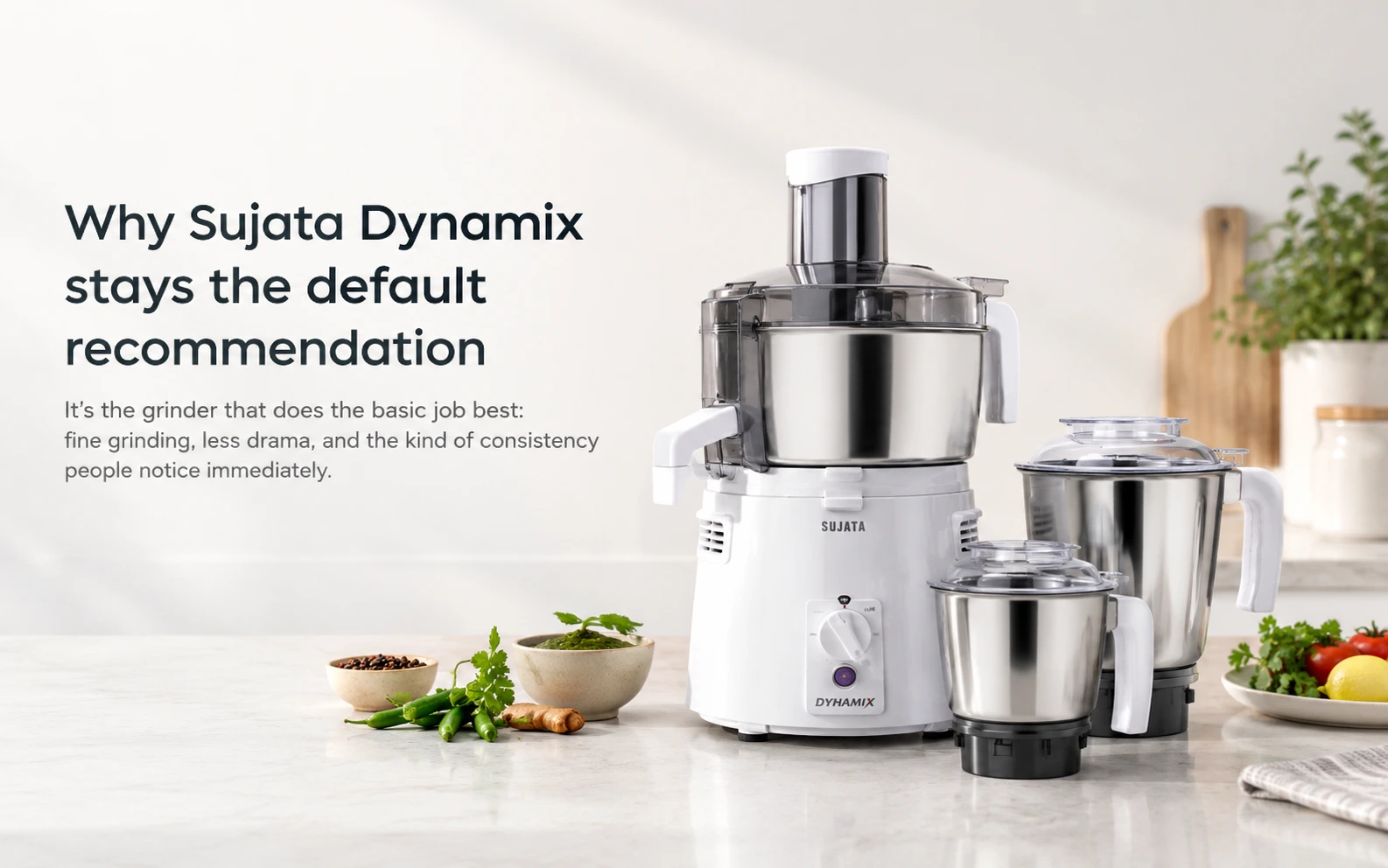
Why Sujata Dynamix stays the default recommendation
It is the grinder that does the basic job best: fine grinding, less drama, and the kind of consistency people notice immediately. The newer Sujata MG03 changes mostly the aesthetics, adds a better handle design, a taper for moving ingredients inside the jar, and an extra transparent polycarbonate jar for milkshakes and juices.
The reason Sujata keeps coming back into the conversation is simple. It doesn’t overcomplicate things. Some machines want attention with extra modes and flashy attachments. Sujata mostly just gets to work. If you’ve ever used a grinder that leaves a slightly uneven chutney or makes you stop midway because the mix has climbed too high on the jar walls, you already know why consistency feels like a bigger deal than it looks on a spec sheet.
When Preethi Zodiac is the better fit
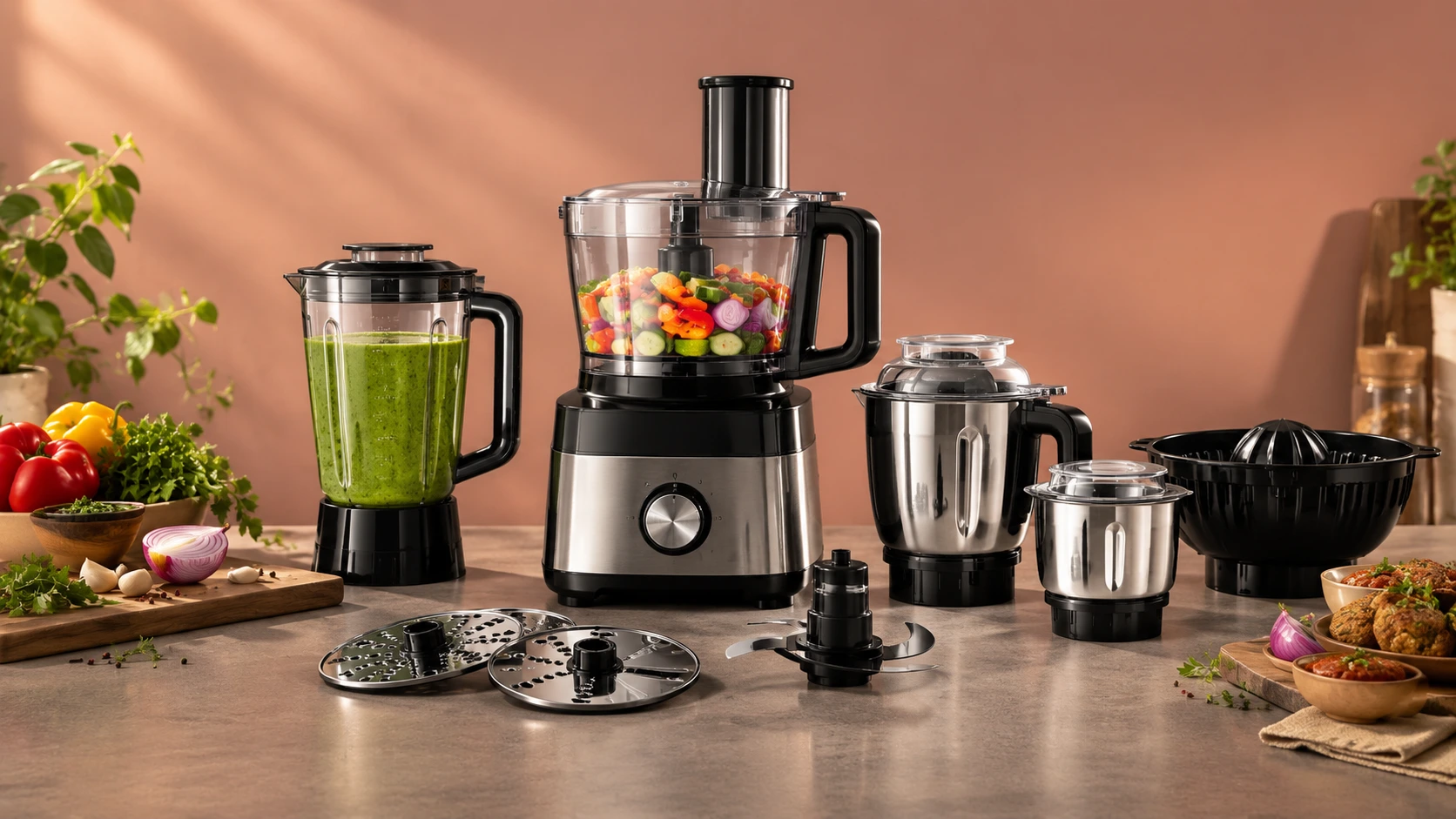
If the mixer grinder has to do more than grind, Preethi Zodiac starts making sense. It comes with 3 regular jars of 500 ml, 1 litre, and 1.5 litres, plus a 1.5 litre juicer jar and a 2.2 litre food processor jar.
That extra flexibility changes the whole experience. Instead of buying one appliance for grinding and another for chopping or kneading, you get a machine that can cover a wider stretch of kitchen work. It is not the simplest option, and it’s not the cheapest either, but for a busy kitchen it can feel like a smarter compromise. The food processor jar especially matters if you’re the kind of person who keeps wishing the mixer could just do a little more.
- Sujata Dynamix: 900 watts, 3 jars, best wet and dry grinding, 90-minute runtime
- Preethi Zodiac MG-218: 750 watts, 5 jars, food processor attachments, better for all-in-one use
- Butterfly Jet Elite: 750 watts, 4 jars, around Rs. 3300, best budget choice
- Cookwell Bullet: 600 watts, 2/3/5 jar variants, compact option for chutneys and soft spices
| Model | Power | Jar count / notable extras |
|---|---|---|
| Preethi Zodiac MG-218 | 750 watts | 5 jars, food processor jar |
| Sujata Dynamix | 900 watts | 3 jars, 90-minute runtime |
| Atomberg Zenova | 550 watts | 4 jars, coarse consistency setting |
| Philips HL7756 | 750 watts | 3 jars, budget-friendly mid-segment |
| Butterfly Jet Elite | 750 watts | 4 jars, around Rs. 3300 |
| Cookwell Bullet | 600 watts | 2, 3, or 5 jar variants |
| Bosch TrueMixx Pro | 1000 watts | 4 jars, hands-free lid locks |
| Panasonic MX-AV425CB | 600 watts | 4 jars, double-lock safety |
| Hamilton Beach Professional Mixer Grinder | 1400 watts | 3 jars, preset functions, dishwasher-safe jars |
| Prestige Iris Plus | 750 watts | 4 jars, basic grinding pick |
What the test results say about grinding, noise, and durability

The useful comparisons come from what these machines did under real load: wet grinding, dry grinding, blade behavior, RPM, and noise. That is where the rankings stop being theoretical.
The tests used idli batter, dry fruit milkshakes, turmeric, and garam masala; noise was measured with a decibel meter; RPM was measured with a tachometer; each model was tested for at least a month in a regular Indian kitchen.
That combination matters because a grinder can behave very differently once it has to deal with everyday cooking, not just a short demo in a store. Turmeric exposes weak motors. Idli batter shows whether the jar and blade setup can create a smooth finish. Dry fruit milkshakes tell you whether the machine is choking or just cruising. In other words, these are the messy, real-life tests that reveal the truth.
Wet and dry grinding are not the same thing
Sujata Dynamix handled turmeric, idli batter, and masala pastes best overall, while Atomberg Zenova used a 5000 RPM coarse setting and still ground most ingredients to a fine consistency in less than a minute. Philips HL7756 was fine for chutney and batter, but not hard spices; Bosch TrueMixx Pro handled turmeric and batter well, though it stayed coarser than Sujata.
This is one of those places where the technical detail actually makes sense in normal language. Wet grinding is about ingredients with water in them, like batter or paste. Dry grinding is for spices and harder ingredients. A machine can be good at one and merely okay at the other, and that’s why some buyers end up frustrated even after spending decent money.
Noise, load behavior, and the stuff that gets annoying later
Noise numbers matter more than marketing claims. Atomberg Zenova came in around 84–86 dB, Sujata around 90 dB, Butterfly Jet Elite at 82–87 dB, Prestige Iris Plus at 89–92 dB, Bosch close to 100 dB, and Hamilton Beach was the noisiest of the lot.
That same section of the test also surfaced the practical quirks: Bosch’s flow breaker gets in the way, Philips jars can rust if not dried, and Hamilton Beach asks for ingredients chopped to about an inch. Those aren’t tiny issues either. They shape the daily experience. A grinder can be powerful and still feel irritating if it forces extra prep steps, makes too much racket, or leaves you with cleaning habits you didn’t ask for.
- Preethi Zodiac: 90–100 dB, good food processor, juicer yield is weak for apples and pomegranates
- Sujata Dynamix: around 90 dB, runs up to 90 minutes, no overload protection switch
- Atomberg Zenova: 84–86 dB, 550 watts, lid locks and reset safety
- Philips HL7756: 4–5 year lifespan expectation, rust risk on rivets if not dried
- Bosch TrueMixx Pro: around 100 dB, 1000 watts, 5-year motor warranty
How to choose the right mixer grinder by power, jars, and safety
The buying logic is simple once the noise around it drops away: power matters, but so does jar shape, blade design, safety features, and whether the machine is meant for a 2-minute task or a 2-year routine.
Domestic mixer grinders commonly sit at 500, 750, 900, or 1000 watts, with prices starting around Rs. 1500 and going up to Rs. 25000; a 750 watt model around Rs. 3.5K–6K is framed as the sweet spot, while food processor combinations move closer to Rs. 8K–10K.
That price spread tells you something useful: the number on the box doesn’t automatically predict whether you’ll be happy. A cheaper model can be perfectly fine for occasional chutney and spice work, while a mid-range one may be the real sweet spot for a family kitchen. Once you get into food processor bundles and premium builds, you’re paying for convenience, extra parts, and usually a better chance of living with the machine longer without getting annoyed.
Why 750 watts is the common middle ground
It is enough for dosa batter, chutney, fried coconut paste, and ginger-garlic paste, and it can occasionally handle turmeric. The caveat is that cheaper 750 watt models often cut too many corners on build quality.
So the wattage is only half the story. A 750 watt mixer grinder can be a lovely sweet spot, but only if the jars, motor housing, switches, and blades are built with some care. If they aren’t, the machine may still work on day one, but it starts feeling fragile much sooner than you’d like.
What jar design and blade shape change in practice
A narrow, deep chutney jar behaves differently from a wide cone-shaped wet grinding jar, and that difference shows up in residue, splashing, and consistency. Preethi Zodiac and Sujata Multimix use extraction blades in their juicer jars, which extract better than ordinary blending blades.
This is one of those details people ignore until they actually own the machine. Jar geometry sounds boring, but it affects how ingredients move. When ingredients circulate properly, you get smoother output and less sticking to the sides. When they don’t, you end up stopping the grinder, scraping things down, and wondering why the result feels uneven. That’s the kind of everyday annoyance that quietly decides whether a purchase feels smart.
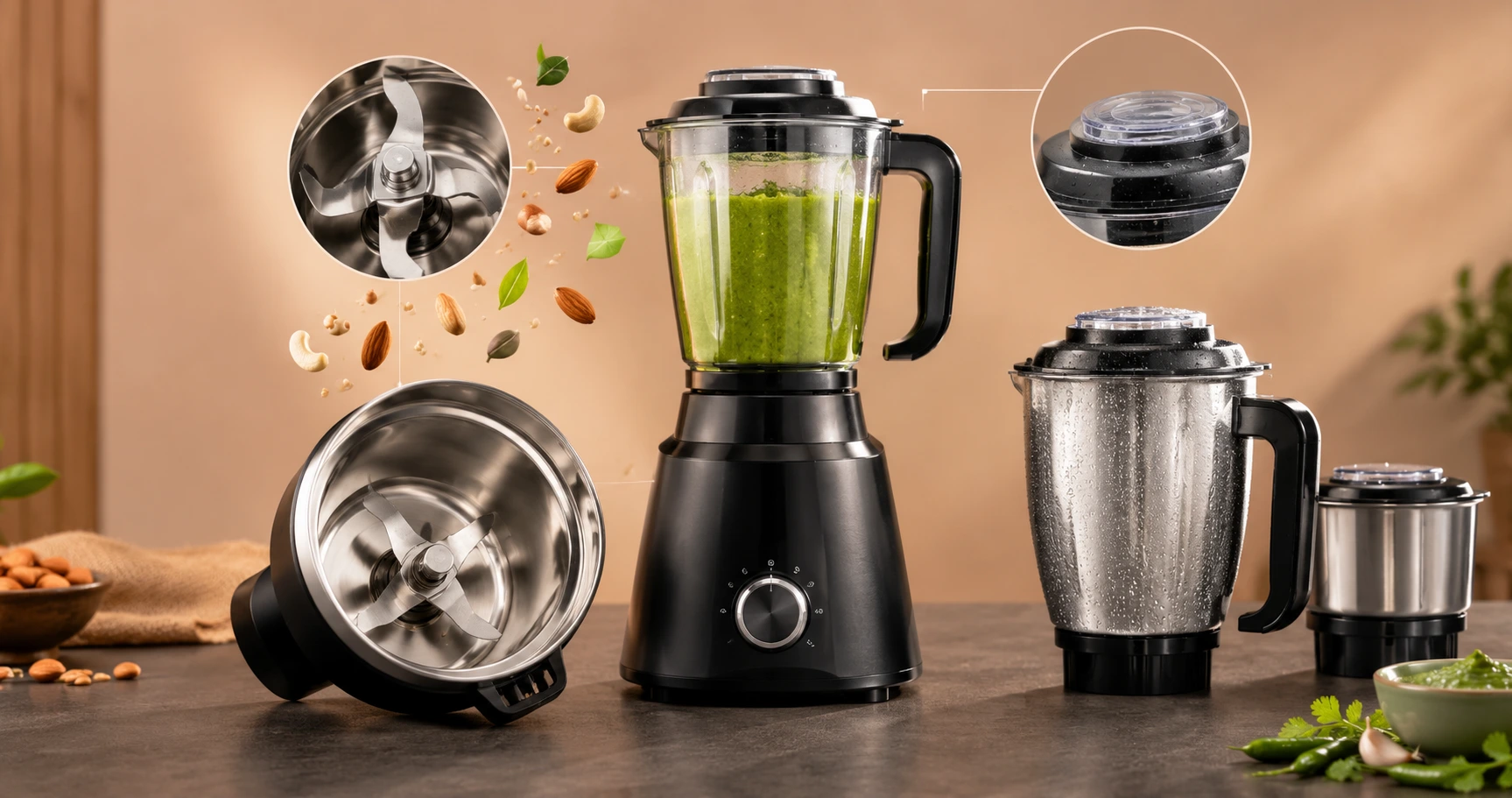
- Safety features to look for: shock-proof ABS body, thick 3-pin power cord, vacuum suction feet, overload protection switch
- Extra safety locks: Panasonic and Hamilton Beach won’t start unless the lid and jar are locked properly
- Power ranges discussed: 500 watts, 550 watts, 600 watts, 750 watts, 900 watts, 1000 watts, 1200–1500 watts
Which brands are safest bets if you care about service and long-term use?
The brand question is less about prestige and more about what happens after the sale. Some brands are stronger on durability, some on service reach, and some on pure grinding behavior.
Sujata is the most durable and powerful but has a limited aftersales network; Preethi is strong on longevity at 5–8 years and has wider service in South India; Philips has a better network across the country; Bosch offers home service and spare replacement; Hamilton Beach gives a 5-year warranty on the entire unit.
If you’re buying for the long haul, this part deserves more attention than it usually gets. A good product with poor service can become a headache the moment a blade dulls or a jar gasket wears out. On the other hand, a decent machine backed by easy support often feels better in real life than a technically stronger one that’s difficult to maintain.
What each brand is really known for
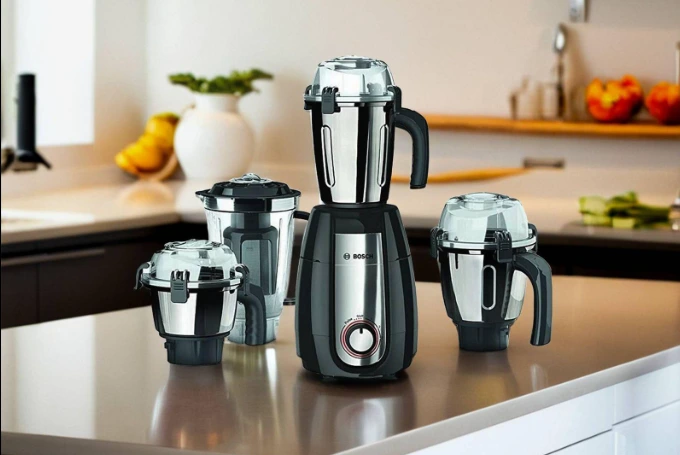
Sujata is the “power first” brand. Preethi is the familiar all-rounder. Philips is widely distributed and shares jar/blade similarities with Preethi because Philips owns Preethi. Bosch is newer in kitchen appliances but has good service. Hamilton Beach stands out for preset functions and full-unit warranty coverage.
That’s basically the personality map. Sujata is for people who want a workhorse. Preethi is for families who want an appliance that does a bit of everything without feeling strange. Philips has the comfort of reach and familiarity. Bosch gives you strong engineering and support. Hamilton Beach is more premium and feature-packed, but it also asks you to live with its noise and prep style.
FAQ
These are the smaller doubts that usually come up after someone has already narrowed the list and wants the awkward details cleared up.
Q: Is 750 watts enough for most Indian kitchens?
Yes, for most homes it is the practical middle ground. It handles idli batter, chutney, and spice grinding well, but the cheaper 750 watt models are where quality usually drops.
Q: Can a mixer grinder make juice well?
Usually not with fruits like apples, pomegranates, mango, beetroot, carrot, or spinach. Water-heavy fruits like watermelon work better, but juice yield is still often disappointing.
Q: Which mixer grinder is best for small quantities?
Atomberg Zenova and the small-chutney-jar setups from Philips and Preethi are the better fits, while Cookwell Bullet is also useful for chutneys, soft spices, and small batches.
Q: Is the noisiest mixer grinder necessarily the most powerful?
No. Bosch TrueMixx Pro and Hamilton Beach are among the loudest, but noise and grinding quality do not move in perfect lockstep.
Conclusion
If you want the best mixer grinder in India for overall performance, Sujata Dynamix is still the cleanest answer; if you need a food processor too, Preethi Zodiac makes more sense, and if budget or compact size matters more, the smaller models are the honest fit.
The better choice is the one that matches how you actually cook — not the one with the longest spec sheet.
So if you’re comparing the 10 best mixer grinders in India 2026, keep it simple: think about how often you grind, what you grind most, how much noise you can tolerate, and whether you want extra kitchen help beyond plain grinding. That’s usually enough to narrow the field fast. And once you do, the right pick tends to feel obvious.

Related Products






Mijia Refrigerator 425L launches with 14 compartments and flexible cooling
Xiaomi has put the Mijia Refrigerator 425L on Youpin for 2,699 yuan, with a 55L flexible temperature zone doing much of the heavy lifting. The new model is designed for buyers who want a large-capacity fridge that can handle everyday food storage, plus items like baby milk, fish, or dry go...

Verizon fiber cable outage disrupts Southern California service
Verizon fiber cable outage hit mobile and internet customers in Southern California after vandals cut multiple cables, and the carrier said service should return within hours. Users checked Verizon network status updates as the disruption affected parts of the region, while law enforcement...

Oppo and MediaTek Preview On-Device AI Omni Model at MWC 2026
MWC 2026 Preview: Oppo and MediaTek unveil on-device AI Oppo and MediaTek announced new on-device artificial intelligence capabilities for future smartphones at the Mobile World Congress (MWC) 2026. The two companies are collaborating to develop and deploy new AI features for Oppo phones...

Xiaomi Mijia Smart Dishwasher launches with 20-set built-in capacity
Xiaomi has launched the Mijia Smart Dishwasher with a 156L cavity, space for 144 pieces, and a 20-set built-in capacity. It also brings 52,000 Pa water pressure, dual rotating spray arms, and a triple-spray setup, making the main selling point simple: one load is meant to handle a lot more...

Xiaomi countertop dishwasher with AI dirt sensing lands in China
Xiaomi has launched a new countertop dishwasher in China with AI dirt sensing, starting at 1,998 yuan. The compact Mijia model is aimed at homes that cannot fit a built-in unit, and it combines a 5-place setting layout with automatic cycle selection to reduce guesswork in small kitchens....