


Redmi M100 launched in China with 7,900mAh battery and 45W charging
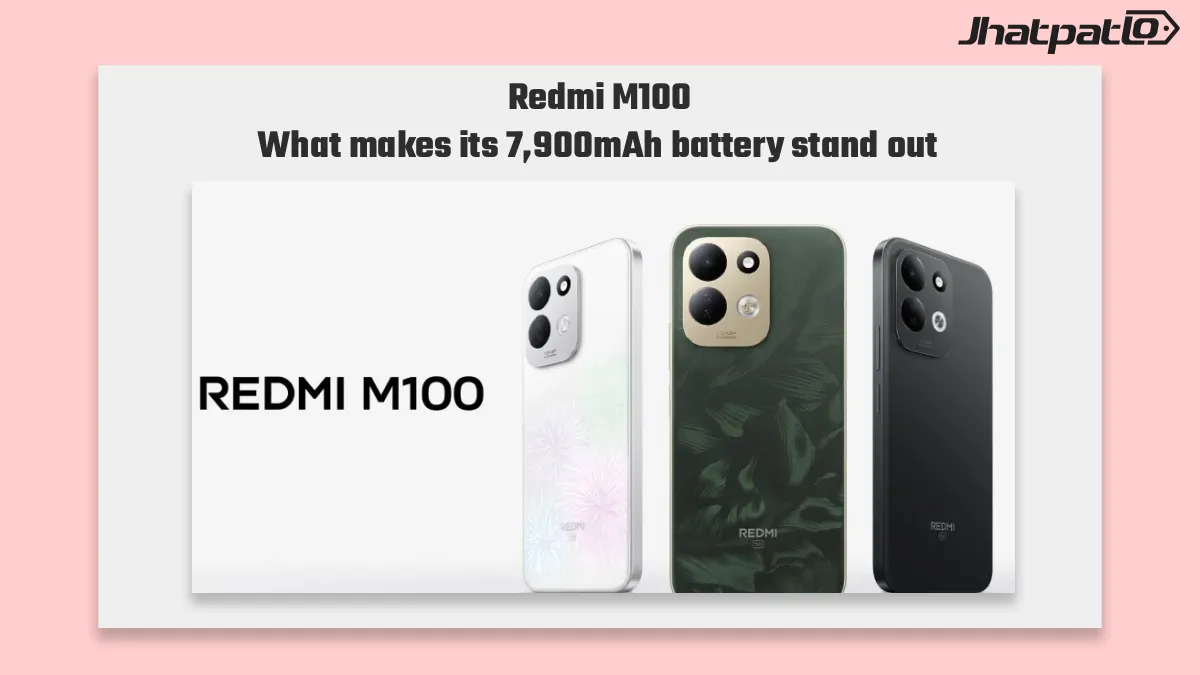
Redmi M100 launched in China with a 7,900mAh battery, Snapdragon 4 Gen 5, and 45W wired charging. The new budget phone also brings 22.5W reverse charging and a 120Hz LCD, making its battery and display specs the main story for buyers looking at value-focused phones in China.
Redmi M100 Snapdragon 4 Gen 5 powers 6.9-inch 120Hz LCD phone
The Redmi M100 is built around Qualcomm’s Snapdragon 4 Gen 5, which keeps it in the entry-level 5G category. It pairs that chip with either 6GB or 8GB of LPDDR4X RAM, so the focus is clearly on basic performance rather than high-end speed. For many buyers, that is enough for everyday apps, messaging, video playback, and general browsing.
The display is a 6.9-inch HD+ LCD panel with 240Hz touch sampling, DC dimming, and brightness levels of up to 825 nits. That combination points to a large-screen phone that is meant to be easy to use for long stretches. The HD+ resolution also helps keep the handset in a lower-cost bracket, which fits the rest of the hardware choice.
In practice, the Redmi M100 is targeting users who want a big screen and 5G basics without stepping up to a more expensive midrange Android device. That positioning is important because the battery size is doing a lot of the work here. A 7,900mAh cell is far larger than what most budget phones usually carry, and that changes how the phone fits into daily use.
- Snapdragon 4 Gen 5 for entry-level 5G performance
- 6GB or 8GB LPDDR4X RAM options
- 6.9-inch HD+ LCD display
- 240Hz touch sampling and DC dimming
- Up to 825 nits brightness
- 7,900mAh battery with 45W charging
Redmi M100 HyperOS 3 adds senior care mode and a 13MP rear camera
Software on the Redmi M100 is based on HyperOS 3 running on Android 16. That gives the phone Xiaomi’s newer system layer, along with features that are meant to make the device easier to use for specific groups. One of the more notable additions is senior care mode, which uses larger text and louder audio. For older users, that kind of setup can make a practical difference, especially on a phone with a large display.
The camera setup is simple. The phone includes a 5MP front camera and a 13MP rear camera. Those numbers are modest, and they match the broader hardware strategy here. This is not being positioned as a camera-first device. Instead, the Redmi M100 puts more weight on battery life, screen size, and everyday convenience.
Other features include NFC, an IR blaster, an IP64 rating, and a side fingerprint reader. None of those are unusual on their own, but together they help round out the phone’s value proposition. NFC adds convenience for supported payments or quick pairing use cases, while the IR blaster remains a familiar Xiaomi touch for users who still want that control option.
The IP64 rating offers a basic level of protection, though it is not the same as a higher waterproofing standard. The side-mounted fingerprint reader keeps the design straightforward and should be easy to reach in normal use. These are the kinds of details that matter in a budget phone, even if they do not get as much attention as the battery spec.
Overall, the Redmi M100 looks designed for a very specific kind of buyer in the mainstream China market. It combines a very large battery, a large LCD, and a few practical extras with a conservative set of cameras and an entry-level chipset. For users who care more about endurance and everyday usability than premium features, that mix is likely to be the main appeal.

Related Products



Redmi K100 Pro Max launch brings 9070mAh battery and Snapdragon 8 Elite Gen 5
Redmi K100 Pro Max launch brings a 6.9-inch 185Hz OLED display, a 9,070mAh battery, and 100W wired plus 50W wireless charging. It also arrives with Snapdragon 8 Elite Gen 5, putting battery life and high-end performance at the center of Redmi’s latest flagship push. Redmi K100 Pro Max add...

Redmi K100 Pro Max launch brings 6.9-inch OLED and 9000mAh battery
Redmi K100 Pro Max launch is set for August 11 in China, and Xiaomi has already revealed the Cabernet Red design and flat OLED panel. The early preview matters because this phone is being positioned as a premium Android flagship, with a large battery, top-end charging, and a heavy focus on...

Redmi K100 Series Teased Ahead of July 31 ChinaJoy Reveal
Redmi K100 series teaser has arrived just ahead of Xiaomi’s July 31 ChinaJoy 2026 event in Shanghai. The brand’s “annual heavyweight product” is widely expected to be the K100 family, and the first hardware leaks point to Snapdragon 8 Elite Gen 5, 100W charging, and a possible premium came...

Redmi K100 Pro Max Chipset and Battery Specs Spotted in Gaming Tests
Redmi K100 Pro Max is drawing attention for a mix of gaming-focused hardware and a large display, with the Snapdragon 8 Elite Gen 5 chipset, a 9,070mAh battery, and a 6.9-inch OLED panel all highlighted in the latest details. The Redmi K100 Pro series also brings 185Hz refresh, 4,800Hz tou...

Redmi K100 Pro Snapdragon 8 Elite Gen 5 and 185Hz AMOLED Specs
Redmi K100 Pro Snapdragon 8 Elite Gen 5 confirmation puts the phone at the center of Redmi’s next flagship push in China. Redmi says the device reaches 4.09 million on AnTuTu and combines that with a 6.59-inch AMOLED display and 185Hz refresh rate, which makes the performance target clear...

Redmi K100 Pro Max battery reveal with 9,070mAh and 100W charging
Redmi K100 Pro Max battery details are now confirmed, with a 9,070mAh cell and 100W wired fast charging ahead of the August 11 launch. The phone also brings 50W wireless fast charging, putting it firmly in oversized-flagship territory without the usual endurance trade-off. That is the mai...