


Xring O100 chip hits 330TPS with 1.22TB/s memory bandwidth
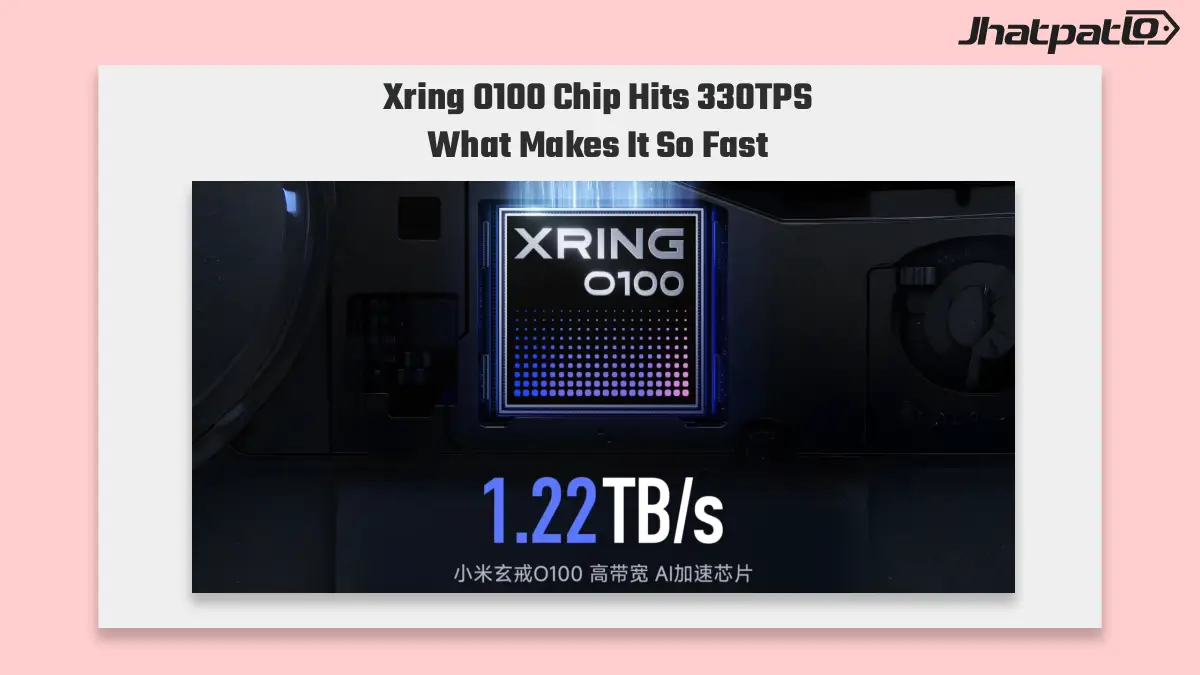
Xiaomi’s Xring O100 AI accelerator chip is designed around memory speed as much as compute, and that is the key detail here. The 6nm part uses 3D wafer-level stacked packaging, and Xiaomi says that helps it reach 330 tokens per second in demo claims while pushing memory bandwidth to 1.22TB/s.
That matters because on-device AI often slows down when data cannot move fast enough between logic and memory. Xiaomi is now pointing to hybrid bonding and wafer-on-wafer stacking as the answer, while also showing how the Xring chip family could extend beyond phones into tablets, mini-PCs and robots.
What You Need to Know
- Xiaomi says the Xring O100 AI accelerator chip reaches 330 tokens per second in demo claims, with 1.22TB/s memory bandwidth as the headline technical figure.
- The 6nm chip uses 3D wafer-level stacked packaging, bringing logic and DRAM dies closer together to reduce the memory bottleneck that can slow on-device AI.
- Xiaomi describes the bonding pitch as close to the physical limit, which suggests the company is leaning heavily on hybrid bonding to improve data transfer efficiency.
- Lei Jun also showed prototypes using other Xring chips in tablet-style devices and the Xiaomi AI Cube mini-PC, with commercial use expected in 2027.
Hybrid bonding process and wafer-on-wafer stacking cut the memory bottleneck
Xiaomi says the bonding pitch is close to the physical limit, which is the point of the hybrid bonding process here. The idea is straightforward even if the engineering is not: reduce the distance between compute and memory so the chip spends less time waiting on data.
For on-device AI, that kind of change can matter as much as raw compute. Large language models need a steady flow of data to stay responsive, and bottlenecks in memory transfer can make them feel slow even when the chip itself is capable. Xiaomi’s pitch is that the Xring O100 is built to avoid that slowdown.
The company’s demo claims also frame the chip as a direct challenge to the edge-AI limits of conventional smartphone SoCs. In practice, that means Xiaomi is not just talking about faster processing, but about a more balanced system where memory architecture helps keep inference moving.
Xring chip family for AI moves beyond phones to tablets, mini-PCs and robots
Lei Jun showed prototypes that pair the accelerator with other Xring chips in tablet-style devices and the Xiaomi AI Cube mini-PC. That makes the announcement bigger than a single chip benchmark, because it suggests Xiaomi is building a broader hardware family around local AI tasks.
The company’s direction appears to be offline generative AI across several device types, not only smartphones. Tablets, mini-PCs and robotics were all part of the demonstration story, which points to a more general push for sustained local inference speed.
Commercial use is expected in 2027, so this is not a near-term consumer launch. Still, the timeline matters because it gives Xiaomi room to turn the Xring concept into a wider platform rather than a one-off silicon experiment.
For now, the main takeaway is simple. Xiaomi is placing memory bandwidth at the center of its AI hardware strategy, and the Xring O100 is the clearest sign yet of that approach. The 330TPS claim is the attention-grabber, but the underlying story is the packaging and memory design that made it possible.

Related Products






Xiaomi 18 Fold AnTuTu Score Tops September Flagship Chart
The Xiaomi 18 Fold AnTuTu score reached 4,620,886 on AnTuTu V12, putting the foldable phone at the top of September’s Android flagship chart. The 16GB RAM and 1TB storage model reportedly outperformed Snapdragon 8 Elite Extreme Gen 6 phones and the only Dimensity 9600 Pro entry on the list...

Xiaomi 18 Fold battery leak points to a massive 6,000mAh cell
Xiaomi 18 Fold battery leak details point to a 6,000mAh battery with 67W wired charging and 50W wireless charging, based on a Weibo report. If accurate, that would give Xiaomi an edge over the Galaxy Z Fold 8 on capacity and put it closer to the Oppo Find N6 in the premium foldable race....
Xiaomi XRING O3 Chip Powers Xiaomi Foldables With 4GHz Boost
Xiaomi XRING O3 processor has crossed a 4GHz peak clock and is now being tied to the Xiaomi 18 Fold launch, along with more than 5 million AnTuTu points. The same chip is also linked to a burgundy Xiaomi MIX Ultra foldable teaser, a 200MP camera, HyperOS 4, and wider use in Xiaomi tablets....

Xiaomi 17 Fold Spotted With XRING O3 Chip Ahead of July 2026 Launch
Xiaomi 17 Fold Appears In Mi Code Xiaomi 17 Fold Spotted in recent reports suggests the device is being prepared for launch with the company’s in-house XRING O3 custom silicon, according...

Xiaomi Pad 9 Pro Max Geekbench Leak Shows XRING O3 and 13,229
The Xiaomi Pad 9 Pro Max has surfaced on Geekbench with 3,474 single-core and 13,229 multi-core scores, pointing to a high-end Android tablet ahead of launch. The listing also ties the device to Xiaomi’s XRING O3 chipset, 16 GB RAM, and Android 17, while separate leak chatter adds a 13.3-i...