


Honor Unveils Humanoid Robot and Blade Battery at MWC 2026
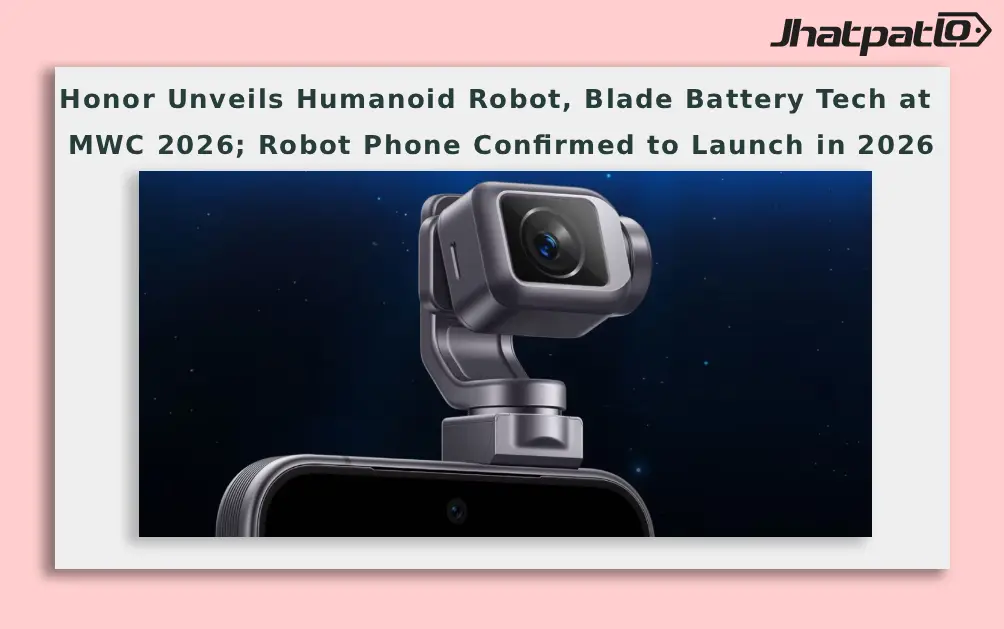
Honor's Robot Phone and Humanoid Robot at MWC 2026
Honor used Mobile World Congress 2026 to outline a broader AI and hardware push, debuting a Robot Phone built around the Magic V6 foldable and the company’s first humanoid robot. The brand also showcased a Silicon-Carbon Blade Battery designed for future foldables and confirmed the Robot Phone will be commercially launched in the second half of 2026, with initial availability limited to China and pricing not disclosed.
Honor said the Robot Phone is anchored by the 200-megapixel camera and an industry‑leading three-axis mechanical gimbal integrated inside a standard smartphone body. The gimbal is driven by a compact four-degrees-of-freedom structure powered by a custom micro motor. The company claims the system is 70 percent smaller than conventional solutions and fits within a chassis built from 2800 MPa high‑strength materials. Officials emphasised that the mechanical gimbal enables advanced stabilization for smoother footage in dynamic shooting scenarios. AI features include real-time object tracking and an AI SpinShot function that enables controlled 90-degree and 180-degree rotations for cinematic transitions. Honor also highlighted a collaboration with ARRI to integrate professional cinema expertise into its mobile imaging solution.
- 200-megapixel camera with a three-axis mechanical gimbal inside the phone
- Compact four-degrees-of-freedom gimbal driven by a micro motor
- 70 percent smaller than conventional gimbals
- Chassis built with 2800 MPa high-strength materials
- Advanced stabilization for dynamic shooting
- AI object tracking and AI SpinShot 90/180-degree rotations
- ARRI collaboration to bring professional cinema features to mobile imaging
- Commercial launch planned for the second half of 2026; initial availability in China; pricing not announced
Honor also presented its first humanoid robot at the event. Officials said the robots are being designed from the outset for consumer environments, not industrial settings, with three core scenarios in mind — shopping assistance, workplace inspections, and supportive companionship. During the presentation, the humanoid demonstrated remote-controlled gestures and poses in front of the audience. The company did not disclose specifications, pricing, or a commercial production timeline for the humanoid robot.
Blade Battery With Silicon-Carbon Technology
In addition to the robots, Honor demonstrated a Silicon-Carbon Blade Battery intended for future foldables. The company stated the battery increases silicon content up to 32 percent, enabling an energy density of over 900 Wh/L. The Blade Battery is described as suitable for foldables that could feature capacities of 7,000 mAh and beyond while maintaining slim profiles. To illustrate thinness and durability, Honor displayed a visual demonstration featuring Guinness World Record holder Rick Smith Jr. throwing a playing card that seemingly passed through the battery, framing the clip as a demonstration of the battery’s rigidity and slim form factor.
- Silicon-Carbon Blade Battery with up to 32% silicon content
- Energy density over 900 Wh/L
- Designed for future foldables with capacities of 7,000 mAh and beyond
- Demonstration using a card trick to highlight slimness and durability
The company did not provide prices or a detailed release timeline for the Blade Battery beyond the general focus on foldables. The event underscored Honor’s broader strategy to push into AI-enabled devices and embodied technology, leveraging its experience in smartphones and connected devices to support future computing experiences in consumer environments.
Related Products



Honor Magic V6 Debuts at MWC 2026 With 6,660mAh Battery
Overview Honor unveiled the Magic V6 at MWC 2026 as the company’s flagship foldable. The device showcases a slimmer foldable design, a 6,660mAh silicon-carbon battery, dual LTPO displays with high brightness, and the Snapdragon 8 Elite Gen 5 chipset. The company also introduced the MagicP...

Honor Magic V6 Design Teased in Red Rabbit Color Ahead of Global Launch
Honor has offered a detailed preview of the Magic V6, the company’s next book-style foldable phone. The company revealed the red colourway, marketed as the Red Rabbit, as part of design teasers ahead of a global unveiling. The launch is scheduled for March 1, 2026, during an event describe...
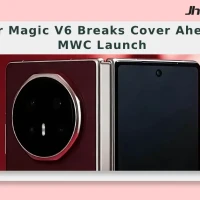
Honor Magic V6 Breaks Cover Ahead of MWC Launch
Honor Magic V6 Breaks Cover Ahead of MWC Debut Honor is actively preparing the teaser campaign for its next flagship foldable, the Magic V6, with the debut planned for MWC Barcelona. The device was spotted in the hands of actor Nicholas Tse, providing the first live look at its design a...
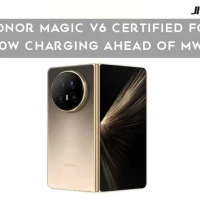
Honor Magic V6 Certified for 120W Charging Ahead of MWC
Honor’s Magic V6 has cleared 3C certification in China ahead of its public unveiling at MWC Barcelona next month. The listing shows two model numbers, PNM-AN10 and PNM-AN20, with the latter linked to satellite connectivity. The certification also confirms 120W wired charging and a 7,150 mAh batt...

Honor wide foldable key specs leak points to bigger battery and 200MP camera
Honor’s wide foldable is starting to look like a serious competitor in the premium book-style category. A new leak points to a 7.6-inch inner display, a 5.5-inch cover screen, a 200MP rear camera, and a battery that may go beyond 7,000mAh. If the report is accurate, the Honor Magic V6 coul...

Motorola Razr Fold Geekbench Listing Ahead of MWC 2026 Reveal
Razr Fold appears on Geekbench ahead of MWC 2026 reveal Ahead of its official reveal at MWC 2026, Motorola is set to unveil the Razr Fold later today after the phone appeared on Geekbench. The listing confirms a Snapdragon 8 Gen 5 processor, 14.90 GB RAM and Android 16, with single-core a...