


Redmi Note 17 Pro vs Pro Max: the real differences in display, camera, battery, and performance

Introduction
The Redmi Note 17 Pro Max comparison gets interesting fast because the biggest upgrades are not cosmetic: a 10,000mAh battery, faster charging, and a better camera setup do the heavy lifting.
Both phones look close on paper, so the real question is which differences matter enough to justify moving up to the Pro Max.
Quick Highlights
- Pro Max brings the bigger battery and faster charging
- Display feels similar, but HDR support is stronger on Pro Max
- Camera and video are the clearest upgrades
- Performance is smoother on the Pro Max for heavier use
If you're trying to choose between the two, the tricky part is that the base experience is already familiar. That means the decision comes down to the stuff you actually notice day to day: how long the phone lasts, how it handles photos, and whether it feels quick when you're jumping between apps. And that's where the Redmi Note 17 Pro vs Pro Max comparison starts to separate itself.
Quick Comparison: At a Glance
| Key Specs | Redmi Note 17 Pro | Redmi Note 17 Pro Max |
|---|---|---|
| Display | 6.83-inch OLED, flat | 6.83-inch OLED, flat |
| Resolution | 1.5K (2772×1280) | 1.5K (2772×1280) |
| Refresh Rate | 120Hz | 120Hz |
| Peak Brightness | ~3,200 nits | ~3,500 nits Higher |
| Chipset | Snapdragon 6s Gen 4 4nm |
Snapdragon 6 Gen 5 4nm + Adreno 812 |
| RAM | 6GB / 8GB / 12GB LPDDR4X |
8GB / 12GB LPDDR5X |
| Storage | 128GB UFS 2.2 256GB / 512GB UFS 3.1 |
128GB UFS 2.2 256GB / 512GB UFS 4.1 |
| Battery | 8,340mAh | 10,000mAh +1,660mAh |
| Charging | 67W wired 22.5W reverse |
100W wired 27W reverse |
| Rear Camera | 50MP OIS (f/1.8) 8MP ultra-wide |
50MP OIS (f/1.5) 8MP ultra-wide |
| Video Recording | Up to 1080p | Up to 4K Upgrade |
| Front Camera | 16MP (f/2.4) 1080p video |
32MP (f/2.2) 4K video |
| Build & Protection | Gorilla Glass Victus 2 IP66/68/69/69K |
Gorilla Glass Victus 2 IP66/68/69/69K |
| Software | Android 16 HyperOS 3 |
Android 16 HyperOS 3 |
| Global Starting Price | USD 399 ~₹38,095 | USD 499 ~₹47,670 |
| India Availability | Not officially confirmed Reported: Sept 15, 2026 | Not officially confirmed Reported: Sept 15, 2026 |
| India Price | Not officially announced | Not officially announced |
Why the two phones look almost identical, but still don’t weigh the same
On design, the Redmi Note 17 Pro vs Pro Max split is small enough to miss at a glance. Both use a plastic back and sides, flat rails, and IP68/69K protection against dust and water.
The Pro Max is 7 grams heavier, and the camera module on the regular Pro sits slightly raised. Color options also differ: the Pro comes in Black, Satin Orange, Purple, and Sky Blue, while the Pro Max comes in Black, Green, Purple, and Cloud Blush.
That weight difference sounds tiny, and honestly, it is. But if you hold both phones back to back, the Pro Max does feel a little denser in the hand. Not in a bad way, just in a way that reminds you there’s more battery packed inside. So, if you care about how a phone feels in the pocket, this is one of those small details that quietly adds up.
Build Comparison at a Glance
Redmi Note 17 Pro
Build: Plastic
Weight: 223g
Colors: Black, Satin Orange, Purple, Sky Blue
Redmi Note 17 Pro Max
Build: Plastic
Weight: 229.5g
Colors: Black, Green, Purple, Cloud Blush
Now, if you expected the Pro Max to look dramatically different, it doesn't. Xiaomi has kept the family resemblance strong here. That can be a good thing if you like consistency, but it also means the real upgrades are hidden under the surface rather than showing off from across the room.
Display differences are smaller than they look, except for HDR and outdoor brightness
The Redmi Note 17 Pro display and the Pro Max panel are essentially the same in size and sharpness: both use a 6.83-inch 1.5K AMOLED screen with a 120 Hz refresh rate, 441 PPI, 3,500 nits peak brightness, 240 Hz touch sampling, and Corning Gorilla Glass Victus
The Pro Max pulls ahead with HDR10+, Dolby Vision, and a 2,000-nit high-brightness mode versus 1,800 nits on the regular Pro. That makes it the better pick for HDR content and stronger sustained outdoor use.
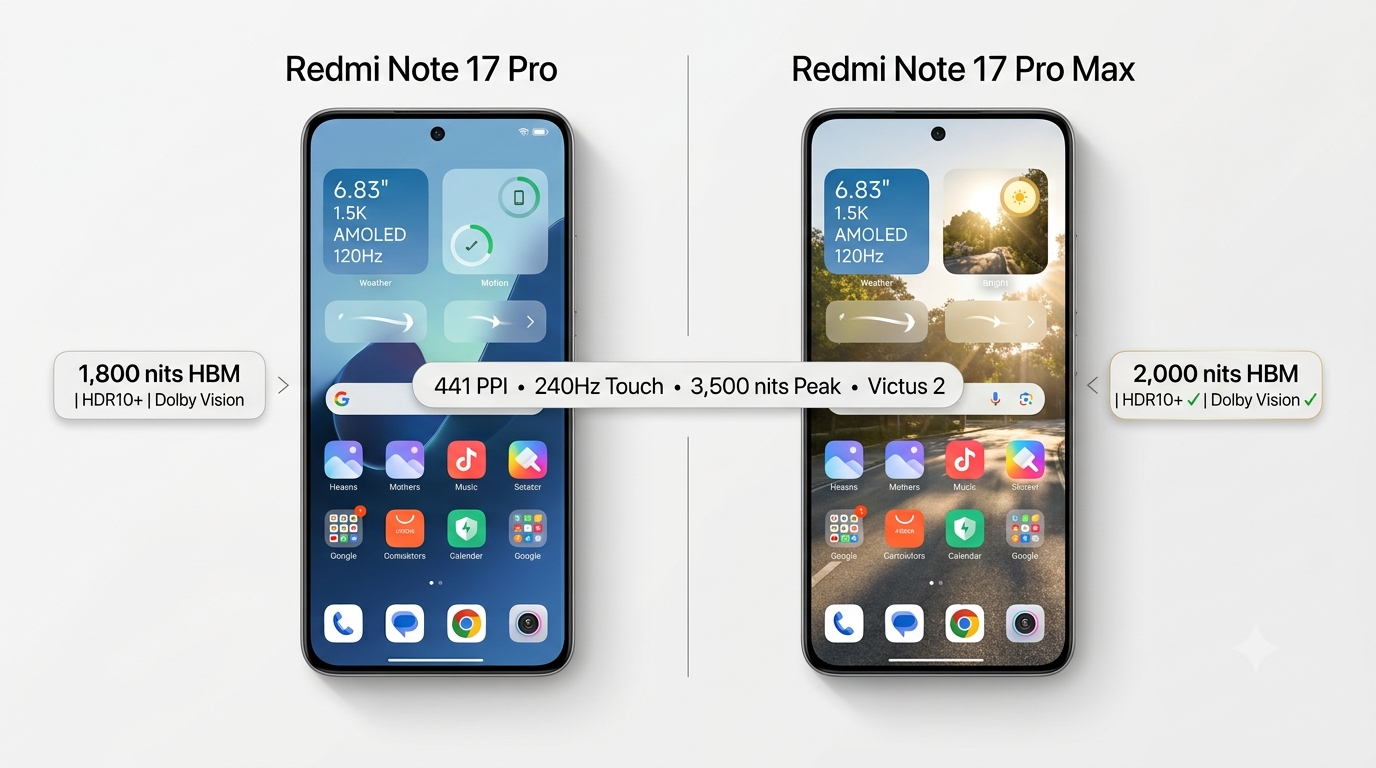
What is actually different between the two displays?
The raw panel specs are close enough that most people will see the same basic experience. The extra HDR support and brightness headroom are what separate the Pro Max.
Here's the thing: when a phone display is this close on paper, the real-world difference usually shows up in edge cases. Watching a dark movie scene outside, scrolling under bright sunlight, or just noticing that one phone holds its punch a little better during long screen-on sessions. That's where the Pro Max earns its name more than on the spec sheet.
For everyday use, both displays sound excellent. So if you're mostly using your phone indoors for messaging, browsing, and social apps, you may not feel much difference at all. But if you watch a lot of video, move between indoor and outdoor settings often, or just want the more premium-feeling panel, the Pro Max is the safer bet.
Where the Redmi Note 17 Pro Max chipset starts to matter
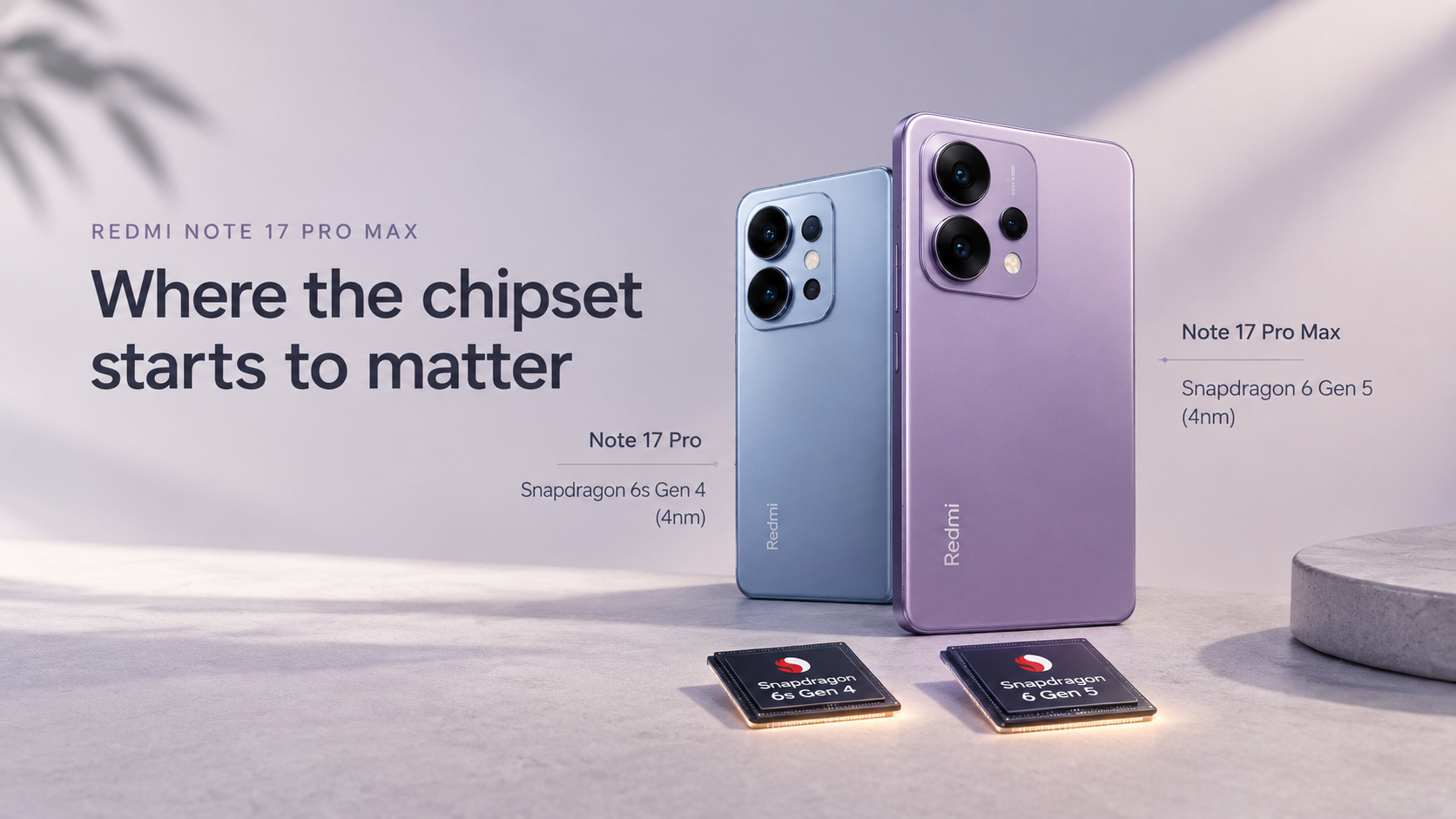
This is the clearest hardware gap in the Redmi Note 17 Pro Max comparison. The Pro uses the Snapdragon 6s Gen 4, while the Pro Max moves to the Snapdragon 6 Gen 5, both on 4nm.
The memory and storage stack also shifts up: LPDDR4X and UFS 3.1 on the Pro, LPDDR5X and UFS 4.1 on the Pro Max. The Pro Max’s 256GB variants use UFS 4.1, which Xiaomi says is twice as fast as the UFS 3.1 storage in the regular Pro.
That doesn't mean the Pro is slow. It isn't. For normal stuff like messaging, social media, calls, and even a fair bit of multitasking, both phones should feel responsive. But the Pro Max has more headroom, and that matters if you tend to keep lots of apps open, switch between heavier workloads, or want a phone that feels a bit less strained over time.
Performance and memory comparison
- Redmi Note 17 Pro: Snapdragon 6s Gen 4, LPDDR4X, UFS 3.1
- Redmi Note 17 Pro Max: Snapdragon 6 Gen 5, LPDDR5X, UFS 4.1 on 256GB variants
- Practical result: little difference in basic use, but better gaming and heavier workloads on the Pro Max
If you game casually, the regular Pro will probably do just fine. But if you want the phone that feels more future-proof, the Pro Max is the one with the stronger foundation. It's a bit like choosing a car with the same shape but a better engine and transmission. Most of the time both get you there, but one does it with less effort.
Camera upgrades are where the Pro Max makes the strongest case
Both phones share a 50 MP main camera with OIS and an 8 MP ultrawide lens, but the Pro Max uses a larger f/1.5 sensor, while the Pro uses a smaller f/1.8 setup. That should help the Pro Max in low light.
The selfie camera jump is even more obvious: 16 MP on the Redmi Note 17 Pro, 32 MP on the Pro Max. Video is the bigger split, though — the Pro stops at 1080p @ 30 FPS, while the Pro Max supports 4K @ 30 FPS and 1080p @ 60 FPS from the main and front cameras.
Why the camera difference is bigger than the spec sheet makes it look
The Pro Max is the one that can actually stretch into better detail, better low-light shooting, and stronger front-camera video. If camera quality is the deciding factor, the answer is already leaning hard one way.
And that's important because a lot of phones claim camera upgrades that sound exciting but don't change much in practice. This one is different. A larger sensor opening, a much better selfie camera, and 4K recording together create a more noticeable jump than you'd expect. If you shoot a lot of videos for work, family, or social content, the Pro Max doesn't just sound better. It is better in ways you'll keep noticing.
- Rear camera system on both: 50 MP main with OIS + 8 MP ultrawide
- Redmi Note 17 Pro: 16 MP selfie camera, 1080p @ 30 FPS
- Redmi Note 17 Pro Max: 32 MP selfie camera, 4K @ 30 FPS, 1080p @ 60 FPS
Look, if you only take the occasional photo in good light, the regular Pro still gives you a respectable setup. But if you've ever been frustrated by grainy indoor shots or weak front-camera video, the Pro Max solves those pain points in a more obvious way.
Battery life is the other place where the gap gets hard to ignore
The Redmi Note 17 Pro battery life story is good, but the Pro Max pushes into a different bracket. The Pro carries an 8,340mAh battery with 67W wired charging.
The Pro Max goes to a 10,000mAh battery with 100W wired charging, and both phones include their full-rated charger in the box plus wired reverse charging support. The Pro Max is also compared here with the Realme P4 Power, another 10,000mAh phone that managed about two days in testing.
That kind of battery size changes your habits. You stop checking the percentage as often. You stop carrying a charger around like a security blanket. And for a lot of people, that alone may be the biggest reason to move up. The bigger battery doesn't just mean longer screen time; it means a calmer phone experience overall.
Battery comparison in real use
- Redmi Note 17 Pro: 8,340mAh, 67W wired charging
- Redmi Note 17 Pro Max: 10,000mAh, 100W wired charging
- Both: charger in the box, wired reverse charging
- Reference point: Realme P4 Power also uses a 10,000mAh battery and was expected to last around 2 days
The charging speed matters too. A huge battery is great, but only if it doesn't turn into a waiting game. The Pro Max handles that better with 100W charging, which helps offset the larger capacity. So even though it's carrying more battery, it doesn't feel like a compromise. It feels like a deliberate upgrade.
HyperOS 3 on Redmi Note 17 is the same base experience, with a few AI extras on the Pro Max
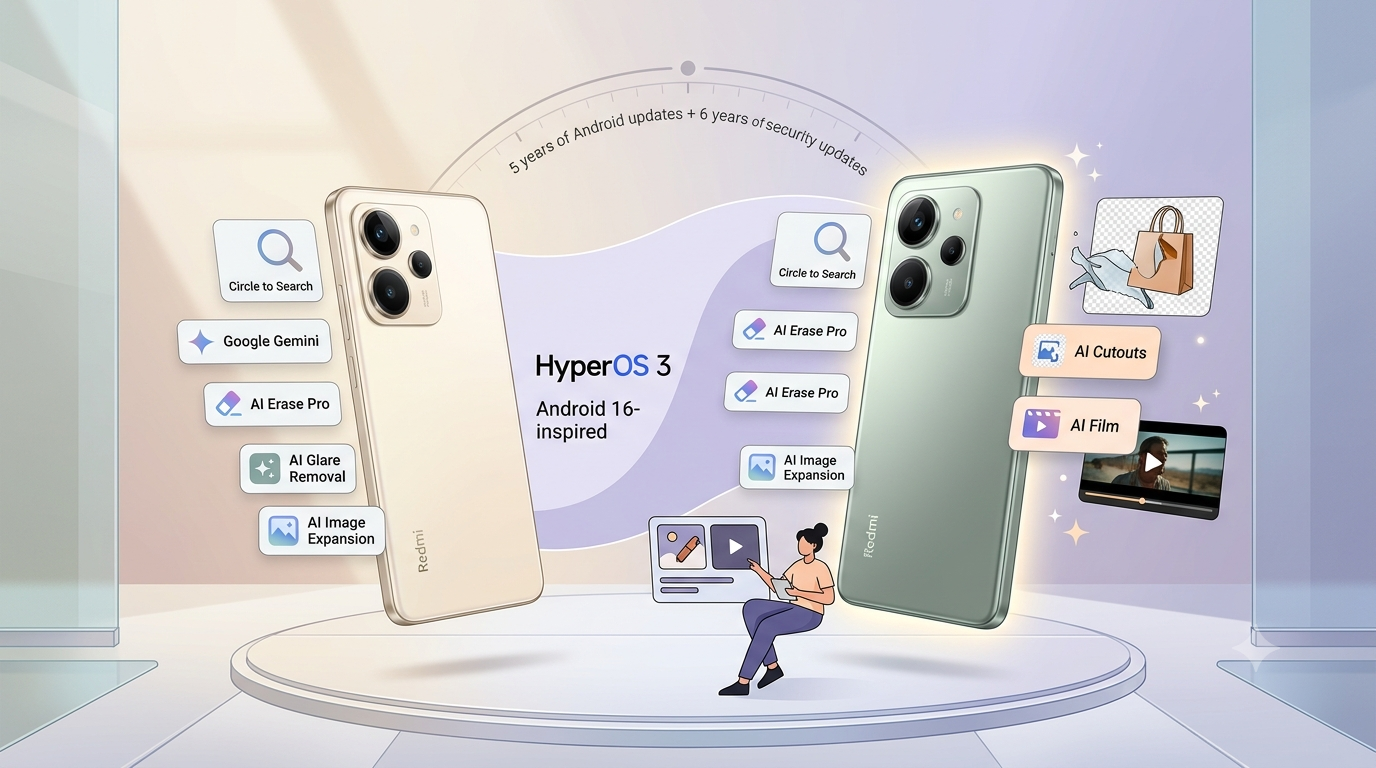
Both phones ship with HyperOS 3 based on Android 16 out of the box, and both promise 5 years of Android updates plus 6 years of security patches. Core AI tools like Circle to Search and Google Gemini are on both models.
The Pro Max gets two extra AI features that the Pro misses: AI Cutouts and AI Film. The shared Xiaomi AI stack also includes AI Erase Pro, AI Glare Removal, AI Image Expansion, AI Sky, AI Bokeh, AI Image Enhancement, and AI Beautify.
In plain English, the software story is mostly a tie. You won't buy one and feel like the other is missing the whole modern Android experience. The Pro Max just gets a couple of extras that may matter if you like editing photos and clips directly on the phone. For everyone else, the shared software support is the reassuring part.
That long update promise is worth mentioning because it gives both phones a longer shelf life. Even the cheaper model doesn't feel like a short-term device. But if you're planning to keep your phone for years, the Pro Max's stronger hardware makes that update window more valuable in practice.
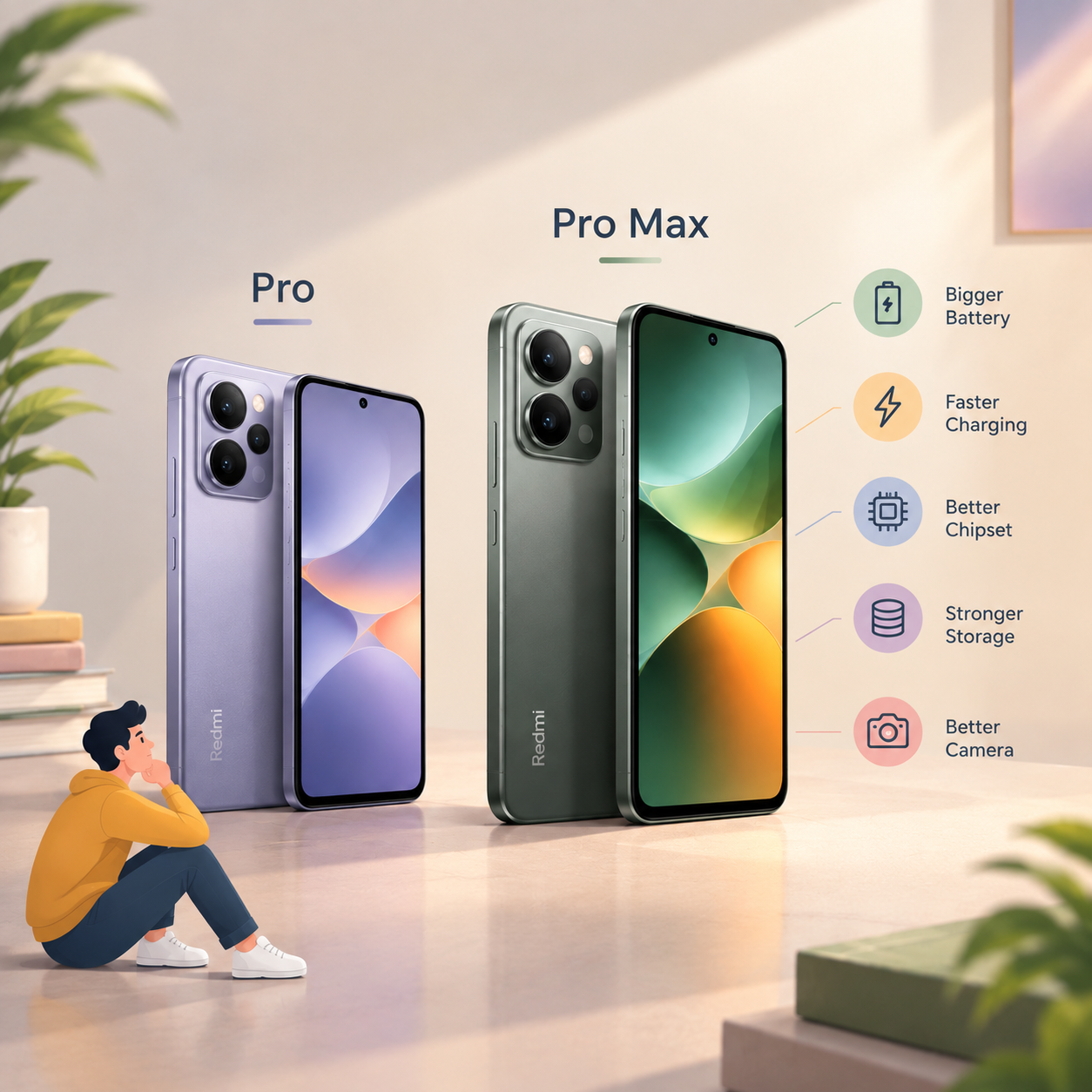
Which one is worth buying if you want the better phone, not just the cheaper one?
The Redmi Note 17 Pro display and the Pro Max panel are essentially the same in size and sharpness: both use a 6.83-inch 1.5K AMOLED screen with a 120 Hz refresh rate, 441 PPI, 3,500 nits peak brightness, 240 Hz touch sampling, and Corning Gorilla Glass Victus
The Pro Max pulls ahead with HDR10+, Dolby Vision, and a 2,000-nit high-brightness mode versus 1,800 nits on the regular Pro. That makes it the better pick for HDR content and stronger sustained outdoor use.
FAQ
Q: Is the Redmi Note 17 Pro Max worth the extra money?
Yes, if you care about battery life, camera quality, gaming, or 4K video. The Pro Max upgrades those areas in a way that changes real use, not just benchmark bragging.
Q: Does the Redmi Note 17 Pro have good battery life?
Yes. Its 8,340mAh battery is still huge, and 67W charging is fast enough for most people. It just does not reach the same endurance level as the 10,000mAh Pro Max.
Q: Can both phones record 4K video?
No. 4K @ 30 FPS is a Pro Max feature, while the regular Pro is limited to 1080p @ 30 FPS.
Q: Which phone is better for outdoor use?
The Pro Max, mainly because of its 2,000-nit high-brightness mode and Dolby Vision / HDR10+ support.
Conclusion
If you want the cleaner answer in this Redmi Note 17 Pro Max comparison, buy the Pro Max unless your budget is the main constraint.
The Pro is fine for basic use, but the Pro Max is the one that actually justifies itself with better battery life, stronger cameras, faster performance, and 4K video.
So, in the end, this isn't really a mystery. It's a choice between a good phone and the one that feels more complete. If you want fewer compromises and more staying power, the Pro Max is the smarter pick.

Mahi Gupta
✉ mahigupta708076@gmail.comRelated Products







Redmi Note 17 Pro Max launch brings 10,000mAh battery and 100W charging
Redmi Note 17 Pro Max launch centers on battery life first, with a 10,000mAh battery, 100W wired charging and 27W reverse wired charging. The phone also gets a 6.83-inch 1.5K AMOLED display and Snapdragon 6 Gen 5, which puts it firmly in the upper end of the mid-range battery-focused segme...

Redmi Note 17 Pro Max Specs Leak Point to 9,210mAh Battery
The Redmi Note 17 Pro Max leak points to a 9,210mAh battery, a 32MP selfie camera, and a Snapdragon 6 Gen 4 chipset. Those details suggest Xiaomi is pushing its upper-end Note model into rare battery territory for the midrange, while the global Redmi Note 17 lineup appears to be split acro...

Redmi Price Hike Pushes Entry Models Up to Rs 4,500 Higher
Redmi Price Hike Reshapes Xiaomi’s Budget Lineup Xiaomi has raised prices on multiple Redmi smartphones again, with some models now costing up to Rs 4,500 more than at launch. The latest revision takes effect from June 1 and affects several devices across the Redmi range, including the Redmi...

Redmi Note 17 5G launch brings 8,000mAh battery and Snapdragon 4 Gen 4
Redmi Note 17 5G launch brings an 8,000mAh battery, Snapdragon 4 Gen 4 and a 6.9-inch AMOLED 120Hz display to India. The phone starts at Rs. 27,999 and runs Android 16-based HyperOS 3, making battery life and day-to-day value the main talking points for buyers in the mid-range 5G segment....

Redmi Note 17 Pro India launch leak points to 9,000mAh battery
Redmi Note 17 Pro India launch details now point to a September 15 reveal, with pricing rumored to land at least Rs 8,000 above the last model. The leaked setup also ties the phone to a 6.8-inch OLED screen with 120Hz and 100W wired charging, which puts Redmi in direct play against bigger-...