


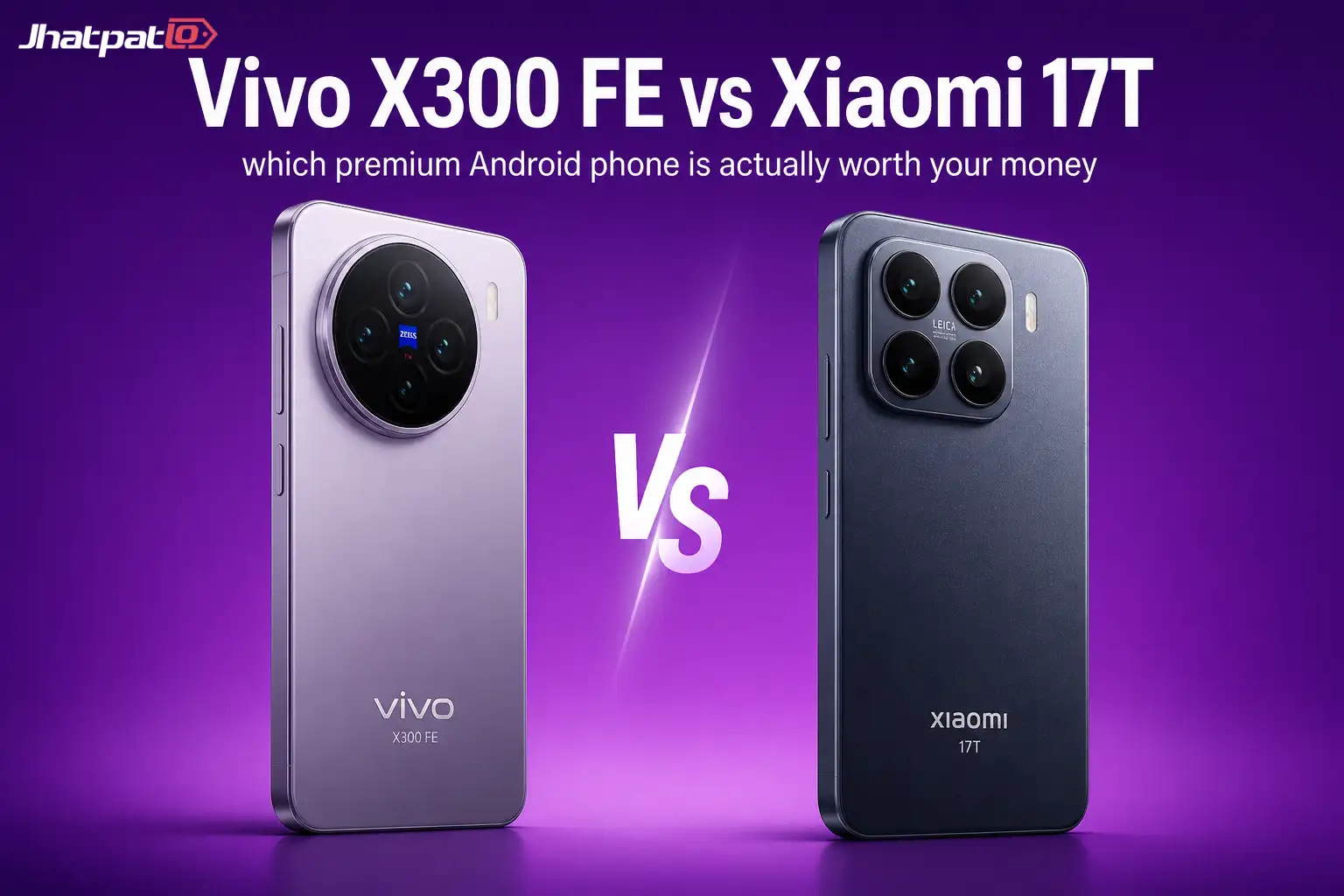
Vivo X300 FE vs Xiaomi 17T: which premium Android phone is actually worth your money
Introduction
Two flagship-leaning Android phones can make a pretty simple question feel weirdly complicated. That’s exactly what happens with Vivo X300 FE vs Xiaomi 17T. One sits around $950/₹80,000, the other around $700/₹60,000, and suddenly you’re not just comparing specs — you’re deciding what kind of compromise you can actually live with.
See how Vivo X300 FE vs Xiaomi 17T compare on Snapdragon 8 Gen 5, 6,500mAh battery, Zeiss/Leica cameras, charging, and price. The real question is whether the extra money buys you a meaningfully better phone, or just a different set of compromises.
Quick Highlights
- Vivo is the more complete flagship experience.
- Xiaomi is the better value without feeling stripped down.
- Zoom goes to Xiaomi; video and selfies go to Vivo.
- Wireless charging and faster wired charging make Vivo feel pricier in the right way.
- Display size and multimedia perks give Xiaomi a real edge for everyday viewing.
Why the Xiaomi 17T looks cheaper without feeling basic
The price gap is the first thing that matters. The Vivo X300 FE sits around $950 (₹80,000), while the Xiaomi 17T lands around $700 (₹60,000). That $250 (₹20,000) difference is not just cosmetic. It changes the whole tone of the comparison, because Xiaomi doesn’t arrive looking like some watered-down budget alternative.
It still brings a 6.59-inch AMOLED display, a 50MP Leica-tuned main camera, a 5x periscope zoom lens, Dolby Vision, Hi-Res Audio, and Bluetooth 6.0. So, even before you dig into the deeper stuff, the Xiaomi 17T already feels like a serious phone for people who care more about what it does than how fancy it feels in the hand.
That’s the interesting part. A lot of cheaper phones save money by cutting obvious corners. This one doesn’t really do that. Instead, it trims just enough to make the price feel sane while keeping the important flagship-adjacent stuff intact.
What Xiaomi keeps while cutting the price
The Xiaomi 17T still looks like a serious upper-midrange to flagship-adjacent phone: 12GB/512GB, UFS 4.1 storage, a 6,500mAh battery globally, and 67W wired charging. That’s already a strong everyday package. You’re not staring at a device that feels half-finished. You’re looking at something that covers the fundamentals in a pretty confident way.
In China, it also gets a 7,000mAh battery, which makes the Xiaomi 17T battery comparison more interesting than the global spec sheet alone suggests. And honestly, that matters because battery spec sheets can be a bit slippery. The number on paper is one thing. What you actually get in your region can be another.
For most buyers, the takeaway is simple: Xiaomi is trying to make the lower price feel like a clever win, not a compromise you’ll notice every day.
Where the Vivo X300 FE earns its higher price
Vivo’s edge is not subtle. You get Snapdragon 8 Gen 5, Oryon cores, an Adreno 829 GPU, 90W wired charging, 40W wireless charging, reverse wireless charging, reverse wired charging, and bypass charging. That’s a stacked list, and it’s the kind of thing that makes the phone feel more complete before you even touch the camera app.
It also pairs a glass back and aluminum frame with IP68/IP69 protection, which is a more premium durability story than Xiaomi’s glass build and plastic frame. Now, this doesn’t mean the Xiaomi feels cheap in the hand. It just means Vivo is clearly aiming higher in the small details that add up over time.
This is the phone for buyers who want the more complete flagship experience, not just the better deal. If you’re the kind of person who notices charging speed, sensor quality, frame materials, and protection ratings, the extra money starts to make more sense pretty quickly.
The hardware differences that show up every day
Vivo uses an ultrasonic fingerprint scanner, which should feel faster and more reliable than Xiaomi’s optical sensor. That’s the sort of thing you don’t obsess over on a spec sheet, but you absolutely notice after a week of unlocking the phone a dozen times a day.
On software support, Vivo promises 5 major Android updates, while Xiaomi runs Android 16 with HyperOS 3. That gives both phones a fairly modern software base, but Vivo’s commitment is the more straightforward long-term promise.
| Category | Vivo X300 FE | Xiaomi 17T |
|---|---|---|
| Build | Glass back, aluminum frame, IP68/IP69 | Glass build, plastic frame, IP68 |
| Chipset | Snapdragon 8 Gen 5 | Dimensity 8500 Ultra |
| Charging | 90W wired, 40W wireless, reverse wireless, reverse wired, bypass charging | 67W wired, reverse wired |
| Price | About $950 / ₹80,000 | About $700 / ₹60,000 |
Camera, zoom, and video are where the split gets obvious
Both phones use a triple-camera setup built around a 50MP main camera with OIS, but they lean in different directions. And that’s where the comparison gets genuinely interesting, because the difference isn’t just about megapixels. It’s about what kind of shooter you are.
Vivo combines a 50MP main sensor, 50MP 3x periscope telephoto, and 8MP ultrawide with Zeiss optics and optional external zoom lenses; Xiaomi answers with a 50MP main sensor, 50MP 5x periscope telephoto, and 12MP ultrawide tuned by Leica. So, yes, both sound premium. But they’re chasing different priorities.
X300 FE camera comparison here is really a question of whether you care more about zoom reach or video muscle. That’s the simplest way to think about it, and it’s probably the most useful too.
Zoom favors Xiaomi, video favors Vivo
The Xiaomi 17T has the longer 5x optical zoom, so it is the stronger pick for distant subjects. If you like shooting concerts, buildings, sports, or just random things from across the street, Xiaomi’s extra reach is the practical advantage.
Vivo counters with up to 8K video and 4K at 120fps, which is a bigger deal if recording quality matters more than zoom distance. That kind of video spec usually tells you the company is thinking more seriously about creator-friendly performance, even if you’re just someone who likes smooth footage and more editing flexibility later.
Selfies push the balance back toward Vivo
Vivo’s 50MP autofocus front camera should produce sharper portraits and more consistent focus than Xiaomi’s 32MP selfie camera. This is one of those details that sounds small until you use the phone daily and realize your front camera is basically part of your personality at this point.
Both can shoot 4K video from the front, but Vivo’s higher-resolution AF setup is the one that sounds more useful in real use. If you’re often on video calls, recording short clips, or just care that your selfies look clean without much effort, Vivo has the more reassuring setup.
- Vivo X300 FE: 50MP + 50MP + 8MP rear cameras, Zeiss optics, 50MP AF selfie camera, 4K front video, up to 8K rear video, 4K 120fps
- Xiaomi 17T: 50MP + 50MP + 12MP rear cameras, Leica tuning, 32MP selfie camera, 4K front video, up to 4K 60fps
- Winner split: Xiaomi for 5x periscope zoom, Vivo for selfies and video
Display quality is a trade between size, brightness, and multimedia features
Vivo goes smaller and sharper-feeling with a 6.31-inch LTPO AMOLED panel, adaptive 120Hz refresh rate, HDR10+, and 5,000 nits peak brightness. That is a very polished display recipe, especially if you care about smoothness and efficiency in day-to-day use.
Xiaomi stretches out to a 6.59-inch AMOLED with Dolby Vision, HDR10+, 3,840Hz PWM dimming, and 68 billion colors. So the Xiaomi 17T display quality argument is about richer playback and eye comfort, while Vivo’s display is the more premium-feeling panel for adaptive behavior and power efficiency.
In plain English, Vivo feels more like the phone that quietly manages itself better. Xiaomi feels more like the phone that leans into big-screen entertainment. Neither answer is wrong. It just depends on whether you watch more videos or appreciate a more compact, premium-feeling handset in daily use.
FAQ
These are the smaller buyer doubts that usually show up after the main comparison: price, battery, zoom, charging, and whether the camera difference is really worth paying for.
Q: Is the Vivo X300 FE worth $250 more than the Xiaomi 17T?
If you want Snapdragon 8 Gen 5 performance, wireless charging, a better selfie camera, 8K video, and 5 major Android updates, the Vivo has a real case. If not, the Xiaomi 17T looks like the smarter buy.
Q: Which phone has the better battery in real life?
Both have a 6,500mAh battery globally, so the bigger difference is charging. Xiaomi offers a 7,000mAh China variant, but Vivo gives you 90W wired plus 40W wireless charging, which is the more complete setup.
Q: Does the Xiaomi 17T have better zoom than the Vivo X300 FE?
Yes. Xiaomi’s 5x periscope lens reaches farther than Vivo’s 3x periscope, so it is the better pick for long-range photos.
Q: Which phone is better for video recording?
Vivo wins here because it goes up to 8K and 4K at 120fps, while Xiaomi tops out at 4K 60fps.
Conclusion
The Vivo X300 FE vs Xiaomi 17T decision comes down to whether you want the more complete flagship or the better value phone. That sounds simple, but it’s really the whole story here.
Pick Vivo if Snapdragon 8 Gen 5 performance, 90W charging, wireless charging, ultrasonic unlocking, Zeiss imaging, and 5-year Android support matter most; pick Xiaomi if you want a $700 phone with a 6.59-inch Dolby Vision display, 5x periscope zoom, Leica cameras, and strong overall value. If you’ve been weighing premium phones without wanting to overspend, this is one of those matchups where your priorities decide everything.
And honestly, that’s the best kind of phone comparison. Not the one with a fake winner. The one where both choices make sense, just for different people.

Mahi Gupta
✉ mahigupta708076@gmail.comRelated Products


Xiaomi 17T vs Vivo X200T: The Real Difference Isn't the Price
In India’s premium sub-flagship segment, Xiaomi 17T and Vivo X200T arrive at the same starting price but solve different buyer needs. Xiaomi focuses on battery life, storage value and zoom, while Vivo leans on faster performance, quicker charging and longer software support.Xiaomi 17T vs Vivo X200T...

Vivo X300 Ultra and Oppo Find X9 Ultra Prices Leaked Ahead of March 30 China Launch
Price Leaks Ahead of China Launch The pricing details for the Vivo X300 Ultra and the Oppo Find X9 Ultra have surfaced ahead of their official launch in China next week. A post from a Weibo user named Experience More claims the two ultra flagships will command higher price tags than the Xiaom...

Vivo X500 Leak Points to 6.59 Inch Display and 7,500mAh Battery
Vivo X500 leaks suggest a compact flagship with a 6.59-inch display, a 7,500mAh battery, and MediaTek’s Dimensity 9500. The rumor also points to a 50MP main camera, periscope telephoto, and a more measured position in Vivo’s 2026 lineup. Vivo X500 Expected to Use Dimensity 9500 Instead of 960...

Oppo Find X9 Ultra and Vivo X300 Ultra Leak 200MP Cameras
Oppo Find X9 Ultra is set to be launched soon, a company executive recently confirmed, with the phone positioned as a rival to the Vivo X300 Ultra. The two brands are expected to reveal their flagships in China next month, after the Chinese New Year celebrations in March. Weeks ahead of de...

Xiaomi 17T India Launch Puts Camera Focus Above Raw Value
Xiaomi confirms June 4 India launch for 17T Xiaomi 17T India Launch on June 4, and the phone is already drawing attention for the gap between its premium positioning and its chipset choice. The device is expected to use the Dimensity 8500 Ultra, the same processor already seen in lower-priced...
Xiaomi 17T Launches in India With 5x Leica Periscope Camera
Xiaomi 17T Launches in India with a clear focus on zoom photography, premium hardware, and launch pricing that includes bank offers and buyback support. The phone brings a 5x Leica periscope camera, Dimensity 8500-Ultra chip, and a 6,500mAh battery for buyers comparing it with othe...