


Samsung Galaxy S26 review: Better in the ways that stay with you
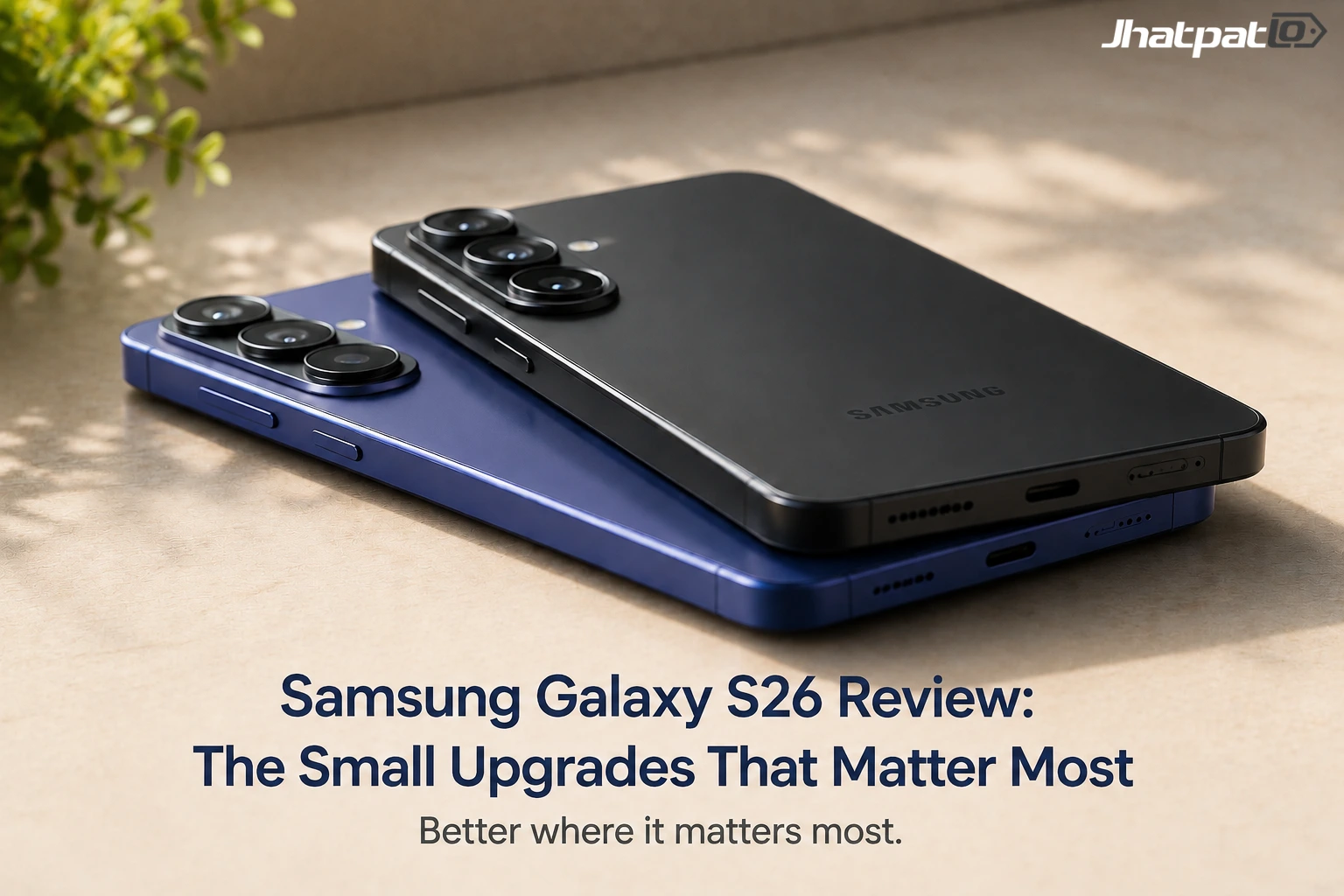
Galaxy S26 review in India: the upgrades you feel after a week, not on day one
Samsung’s Rs 1,08,999 Galaxy S26 doesn’t walk in wearing a brand-new face. That’s the first thing you notice, or maybe the first thing you don’t notice, which is kind of the point. It adds an Exynos 2600, a 4,300mAh battery, and smarter AI, but from the outside it still feels very much like a Galaxy S phone.
And honestly, that’s where this phone gets interesting. The Galaxy S26 review in India isn’t really about a dramatic redesign or a flashy spec-sheet shock. It’s about the kind of improvements that creep up on you after a few days: a smoother experience, a little more battery comfort, slightly better camera confidence, and software that feels more useful than noisy.
Quick Highlights
- Feels familiar, but the day-to-day polish is better
- Exynos 2600 finally handles heavy use more confidently
- Battery life improves, though charging still lags
- AI features are actually useful in small, everyday ways
- Camera hardware is old, but the results still hold up well
Introduction
The Galaxy S26 review in India starts with a simple fact: Samsung’s Rs 1,08,999 phone does not look like a big redesign, but the changes are meant to matter in daily use. That can sound underwhelming at first, especially when you’re used to launches that shout about every tiny cosmetic tweak. But look a little closer, and the logic becomes clearer.
The familiar shape stays, while the practical upgrades show up in performance, battery life, camera use, and AI features. So if you were hoping for a phone that changes your habits rather than your first impression, the S26 is trying to do exactly that. It’s less about wow and more about living with it.
What changed from the S25, and what stayed almost identical
The S26 is the kind of upgrade you notice over several days instead of in a quick spec-sheet glance. That matters because a lot of phones look different on paper but feel the same in your hand. Here, Samsung has gone the other way: the improvements are practical, while the core shape stays almost untouched.
It costs Rs 8,000 more than the S25, yet the body is still 149.6 x 71.7 x 7.2mm, the weight is 167 grams, and the rear cameras are still the same 50MP main, 12MP ultrawide, and 10MP telephoto trio carried over from the S22. That old-school consistency may sound boring, but if you already liked the Galaxy S formula, it’s also reassuring. There’s no awkward reinvention here.
The visible changes are smaller: a cleaner circular camera housing, tighter bezels, and a 6.3-inch display that does not make the phone feel larger. In your pocket, on a desk, and especially in one-handed use, the S26 behaves like a compact flagship that knows exactly what its audience wants.
The small design changes are easier to live with than to notice
The aluminium frame still has a matte finish, the back glass stays flat, Gorilla Armor covers the front, and IP68 resistance is standard. Nothing here is trying to reinvent premium smartphone design. Instead, it’s doing the quiet stuff well, which is often what actually ages better.
Colour options are Cobalt Violet, Sky Blue, Black, White, Silver Shadow, and Pink Gold, with the review unit in Sky Blue. It’s a clean finish, understated without being dull. That feels very Samsung, in a good way.
The compact size still matters more than Samsung says it does
For anyone coming from an S24, the S26 remains easy to use with one hand. That might sound minor, but if you’ve ever tried living with a big slab phone for months, you know how much this matters.
It is only marginally larger, and the standard Galaxy S shape still feels like the real draw for people who never wanted Ultra-sized hardware in the first place. Some phones impress you on a launch stage. This one makes more sense on the commute, while replying to messages, or when you’re trying to use it without shifting your grip every ten seconds.
Is the 6.3-inch AMOLED display actually better to use?
Yes, mostly because it improves the small things that add up: reading, scrolling, and outdoor visibility. That’s the thing about good displays. You don’t always sit there thinking, “Wow, what a display.” You just stop fighting it.
The 6.3-inch Dynamic AMOLED 2X panel is slightly larger than the S25’s 6.2-inch screen, runs at FHD+ resolution (2340 x 1080 pixels), reaches 409 ppi, and supports a 120Hz adaptive refresh rate that can drop to 1Hz. Those numbers tell part of the story, but the lived experience is simpler: it feels sharp, fast, and easy to trust in almost every situation.
Peak brightness goes up to 2,600 nits, and harsh afternoon sun never really became a problem in testing. That’s one of those upgrades you only appreciate once you’ve stood outdoors trying to read a WhatsApp message and not squinting your way through it.
Where the screen feels especially strong
Text stays sharp, colours are vivid without looking too pushed, and the compact size makes browsing and scrolling feel unusually comfortable. It’s the kind of screen that doesn’t ask for attention, which often means it’s doing its job well.
HDR playback looks rich, the AKG-tuned stereo speakers hold up well, and it remains a phone you can happily watch video on for a while. Not every compact flagship is pleasant for entertainment, but the S26 doesn’t feel cramped in the way some smaller phones do.
What Samsung still keeps back for the Ultra
The standard S26 does not get the Ultra’s Privacy Display electrochromic layer, and it also misses the anti-reflective coating. Both of those are premium touches that reinforce the gap between Samsung’s standard and Ultra lines.
The first omission is easy to understand; the second feels harder to defend, especially when it has already been on the Ultra for two years. Still, for most people, the regular display is more than good enough. It just doesn’t quite get the fancy extras reserved for the top-end crowd.
Can the Exynos 2600 finally fix Samsung’s old performance problem?
Mostly, yes — and that matters more than benchmark talk. Because for years, performance on Samsung’s non-Ultra models has sometimes come with an annoying asterisk. Fast at first, warm later. Smooth in bursts, uneven under pressure. The S26 tries to break that pattern properly.
In India and a few other regions, the S26 runs on the Exynos 2600, while the US gets the Snapdragon 8 Elite Gen 5. It is Samsung’s first 2nm chip, and it handled long camera sessions, navigation, high-settings gaming, and aggressive multitasking without the old Exynos heat-and-drain story showing up again.
That doesn’t mean it’s magically perfect, but it does mean the phone feels more settled. More confident. Less like it’s constantly negotiating with itself in the background.
The one place it still leaves you wanting more
Battery life is better than on the S25, but the 4,300mAh cell still only gets through a full day comfortably. That’s fine. It’s genuinely fine. Yet when a brand-new flagship talks up efficiency and AI smarts, you do hope for a little more breathing room than just “comfortable.”
Charging remains limited to 25W wired and 15W wireless, which keeps the phone from feeling fully modern on the power side. So even though the battery story is improved, the recharge story still feels conservative.
Storage finally starts where it should have ages ago
The base model now starts at 256GB instead of 128GB, and all configurations get 12GB of RAM. That removes one of the most annoying compromises from the old lineup.
This is one of those changes that sounds small until you remember how many people fill phones with photos, videos, downloads, offline music, and a hundred apps they swear they’ll clean up later. Starting higher just makes more sense in 2026.
Are Samsung’s new AI features actually useful, or just more menu noise?
The useful ones are quietly useful, which is the better outcome. That’s the difference between feature-bloat and something that actually improves daily life. You don’t need AI to throw fireworks at you. You need it to save a few seconds when you’re busy.
Now Brief is more personal on the S26, surfacing things like a friend’s birthday, booking confirmations, and a morning summary that feels less generic than before — especially when paired with a Galaxy Watch. It’s not trying to be clever for the sake of it. It’s trying to be timely.
Now Nudge is even subtler, stepping in with directions or a calendar shortcut only when something on screen seems actionable. That kind of restraint is refreshing. It doesn’t pester you, and that alone makes it more useful than plenty of louder features out there.
The assistants are better, but the whole setup is still messy
Gemini is more reliable than it was on the S25, but it still needs verification for important tasks after its old habit of making things up. That’s a real improvement, just not a complete fix. In other words, trust it, but don’t blindly hand it the keys.
Bixby now handles simple device-level tasks like Do Not Disturb or quick settings changes better than before, while Perplexity has arrived half-finished, with announced browser integration not available and voice commands going unanswered. So yes, the AI story is more capable. It’s also a little uneven, which feels very Samsung in a “the ecosystem is still figuring itself out” kind of way.
Scam Detection is the AI feature that feels easiest to trust
It runs fully on-device, listens for suspicious patterns during calls, and responds with haptic and audio alerts without sending anything away. That’s important, because security features can easily become marketing wallpaper if they don’t feel immediate and practical.
This one does. It’s the least showy Galaxy AI feature here — and probably the most useful. If you’ve ever dealt with spam calls, scam attempts, or that weird split second where you’re not sure if the person on the line sounds legitimate, you’ll understand why this matters.
One UI 8.5 adds the small quality-of-life changes that stick
Vertical sliders in Quick Settings, tighter animations, better-organised notifications, and more lock screen options all make the phone feel calmer to use. None of that sounds dramatic. That’s exactly why it works.
Samsung is also promising seven years of OS and security updates, which gives the software story more weight than the spec sheet suggests. Long support doesn’t make headlines the way a new chip does, but it absolutely affects whether a phone feels like a smart purchase.
Can the Galaxy S26 camera setup still hold up after four generations?
Surprisingly, it can — even though the hardware has not moved since the S22. That’s a pretty long time in smartphone years, and on paper it sounds like the sort of thing that should age poorly. Yet Samsung has kept tuning the system in ways that still matter.
The camera array is still a 50MP main at f/1.8, 12MP ultrawide at f/2.2, and 10MP telephoto with 3x optical zoom, while the S26 Ultra sits far ahead with a 200MP main and 50MP ultrawide. The gap is real, and it shows when you compare side by side. But the standard model still turns out dependable photos more often than not.
That’s probably the fairest way to describe it: dependable rather than dazzling, but with enough consistency that most people won’t feel shortchanged.
Why the photos still work
The main camera keeps colours punchy without overdoing them, dynamic range holds up in difficult light, and the ultrawide matches the main sensor’s colour science well. You don’t get that awkward switch from one lens to another where everything suddenly looks like it came from a different phone.
The 3x telephoto is solid up to its optical limit, and low-light shots come out clean enough that they do not feel heavily processed. That balance is important. A lot of phones can brighten a dark scene; fewer can do it without making the image look fake.
The front camera and video changes are more noticeable than expected
The 12MP autofocus selfie camera handles skin tones well, keeps portrait edges clean, and benefits from Samsung’s Object Aware Engine for hair detail. If you take a lot of selfies or use the front camera for video calls, this is the kind of refinement you’ll probably notice sooner than you expect.
Video also looks more natural now, and Horizontal Lock keeps footage level while walking or moving quickly — though it has to be turned back on every time you re-enter video mode. That part is a little annoying, sure, but the feature itself is genuinely helpful when you’re shooting on the move.
Photo Assist is no longer just a gimmick
You can describe an edit in plain language and let Samsung’s large language model try it in the Gallery after the fact. That sounds gimmicky on the surface, but in practice it can save you from opening a separate editing app for simple fixes.
Cleaning a cluttered background and evening out exposure both worked on the first try, and edited images carry a watermark noting that AI was used. That watermark matters. It keeps the feature honest, which is a nice change in a world where AI tools often try to hide the fact that they helped.
FAQ
These are the doubts that usually come up once the main review leaves a few practical questions hanging. And fair enough — with a phone like this, the real buying decision usually comes down to a handful of practical things, not the whole spec sheet.
Q: Is the Galaxy S26 worth buying over the S25?
For most S25 owners, probably not. The changes are real but incremental, so the upgrade makes more sense if you want the better chip, battery, storage, and AI rather than a new design.
Q: How good is the Galaxy S26 battery life?
It is comfortably a full-day phone thanks to the 4,300mAh battery, but it does not feel exceptional for a brand-new 2nm chip.
Q: Does the Galaxy S26 still have 25W charging?
Yes. Wired charging is still capped at 25W, with 15W wireless charging as well.
Q: Is the Galaxy S26 camera good enough compared with the Ultra?
It is not as ambitious as the Ultra, but it is still dependable, especially for daylight, low light, selfies, and casual video.
Conclusion
The Galaxy S26 is a better phone than the S25 in the ways that linger: Exynos 2600 performance, smarter AI, better battery life, and more polish in everyday use. That’s the kind of improvement that doesn’t always show up in the first five minutes, but it absolutely shows up once you start relying on the phone for real life.
If you are coming from an S24 or older, the upgrade makes sense; if you already own an S25, the Rs 8,000 price jump is harder to justify. So the S26 ends up in a very specific place: not the most exciting Samsung flagship, but maybe one of the more sensible ones.

Mahi Gupta
✉ mahigupta708076@gmail.comRelated Products






iQOO Z11 India launch soon with Dimensity 7500 Turbo chipset
iQOO Z11 India launch soon, and the phone is tipped to arrive in August as the first model in India with MediaTek’s Dimensity 7500 Turbo. That puts the Z11 directly into a performance-led midrange fight, especially if iQOO keeps the curved-screen hardware intact for the local version. The iQOO...

Moto Edge 70 Max price in India starts at Rs 49,999 with Snapdragon 8 Gen 5
Moto Edge 70 Max price in India starts at Rs 49,999, and that puts Motorola’s latest flagship into a crowded premium Android segment. The phone focuses on high-end performance, a large AMOLED display, strong battery life and durability features. Here is a clear look at the launch details,...

Xiaomi 18 series India launch date tipped should you wait
Leaks around the Xiaomi 18 series suggest the brand may move its India flagship launch to early December, with a smaller lineup and a limited Pro Max model. Here is what the latest reports point to, what is still unclear, and why the launch matters beyond just phones. Xiaomi 18 Ultra canc...

Motorola Edge 70 Max update policy clarified with 3 OS upgrades and 5 years of SMR
Motorola has clarified the Edge 70 Max software update policy, setting it at up to 3 Android OS upgrades and up to 5 years of SMR. The update matters because buyers had been left with mixed signals across regional product pages, and software support is now a major part of how people compar...

Lava Virat V1 5G launch brings 120Hz display and 6000mAh battery
Lava Virat V1 5G launch lands in India with a July 24 date and a clear budget focus. The phone is being positioned under ₹10,000, with a 6.75-inch 120Hz display, a UNISOC T8200 chipset, and 4GB RAM virtual expansion. For buyers looking at the entry 5G segment, the bigger story is practical...

Edifier R1000TC II Bluetooth 6.0 Brings 42W Desktop Audio
Edifier has launched the R1000TC II in China with Bluetooth 6.0, dual-device pairing, and a 42W output rating. For desktop users, the more practical detail is the mix of wireless convenience, USB sound card support, and RCA input in one active bookshelf speaker pair. It is a fairly direct...