


Samsung Galaxy S26 review feels compact but the real story is in what it still misses
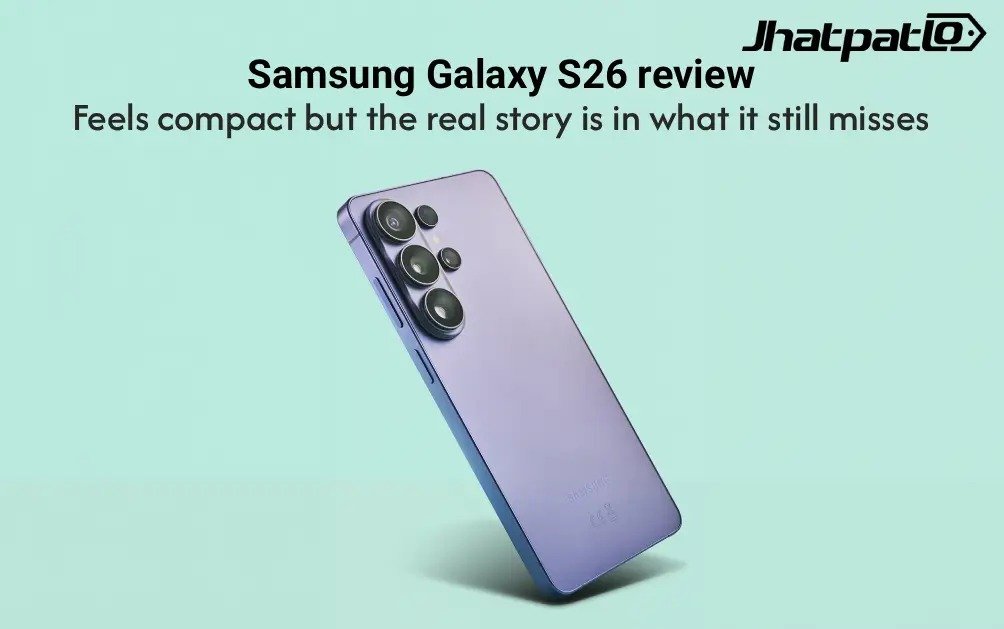
There’s something quietly refreshing about a flagship phone that doesn’t try to be a mini tablet. The Samsung Galaxy S26 keeps that idea alive in 2026, and honestly, that alone makes it stand out more than Samsung probably intended. While the big names in the premium space keep getting larger, heavier, and more dramatic, the Galaxy S26 sticks to a compact shape that feels easier to live with day after day. It’s the kind of phone you notice less in your pocket and more in your hand, which is usually a good thing.
But of course, Samsung didn’t just make it small and call it a day. The Galaxy S26 brings the new 2nm Exynos 2600, a brighter sense of polish, and the usual Samsung mix of strong display tech and deep software customization. The result is a phone that feels balanced in a way a lot of compact flagships don’t. It doesn’t chase hype in every category, and that’s part of its appeal.
Quick Highlights
- Compact size makes one handed use genuinely easy
- Exynos 2600 brings a big jump in smoothness and efficiency
- Display remains one of the best in the compact flagship segment
- Battery is decent, but charging still feels slow in 2026
- One UI 8.5 adds strong customization and long software support
Compact, clean, and easier to like than it looks on paper
The Samsung Galaxy S26 is the sort of phone that makes sense the moment you pick it up. It’s slim, light, and comfortable in a way that’s becoming rare among premium smartphones. If you’ve spent months handling big glass slabs, this feels like a relief. It slides into a pocket easily, sits well in the hand, and doesn’t need constant readjusting just to send a message with one thumb.
Samsung has also changed the camera design this year, moving to a pill shaped module instead of individual camera rings. It’s a small visual change, but it helps the Galaxy S26 line look more unified. There’s a bit of practical downside, though. The camera bump is thick enough to make the phone wobble on a flat table, and that’s one of those little annoyances that’s hard to ignore once you notice it.
The color options are tasteful rather than loud, which fits the phone’s personality. Our Cobalt Violet unit leans closer to a deep blue, and it looks premium without begging for attention. If you prefer something quieter, there’s Black. If you want a bit more personality, Sky Blue and Pink Gold give you softer choices. It’s nice when a phone doesn’t make all its personality decisions for you.
The display still does the heavy lifting
Samsung continues to be one of the safest bets if display quality matters to you. The Galaxy S26 uses a 6.3 inch Dynamic AMOLED 2X LTPO panel with a 120Hz adaptive refresh rate, HDR10+ support, peak brightness up to 2,600 nits, and Gorilla Glass Victus 2 protection. On paper, it’s familiar. In real use, that familiarity is exactly the point. It looks excellent.
Colors are rich, movement feels fluid, and the slim bezels make the screen feel larger than it really is. That matters a lot on a compact phone, because a small display can start feeling like a compromise fast. Here, it doesn’t. Browsing, reading, streaming, and gaming all feel properly premium. The panel gives you that familiar Samsung punch without going overboard into cartoonish saturation.
Still, it’s not flawless. Outdoor readability could be a little stronger under harsh sunlight. It’s not bad, just not quite best in class when you’re standing outside on a bright afternoon trying to answer a text. Other flagships may edge ahead on raw brightness or resolution, but the Galaxy S26 remains one of the best compact flagship phones if display quality is high on your list.
Camera performance is dependable, if not especially adventurous
The camera setup stays the same as before: a 50MP main camera, 12MP ultra-wide, 10MP telephoto with 3x optical zoom, and a 12MP front camera. That may sound a little conservative in a year when rivals are throwing around fancier sensors and bigger numbers, and yes, it is. But Samsung’s approach here is more about consistency than chasing headlines.
For everyday photography, that’s not a bad strategy. The main camera produces attractive, social media friendly photos with slightly saturated colors and pleasing skin tones. Pictures look ready to share without much editing, which is exactly what a lot of people want. Low light shots are decent, though not extraordinary, and the selfie camera works well in most situations but can struggle a bit when the lighting gets messy.
Compared with the iPhone 17, the Galaxy S26 takes a more vibrant approach. In daylight, its photos often look richer and more visually appealing, even if the iPhone sometimes preserves a little more detail. The ultra-wide camera is solid, with controlled distortion and good dynamic range, though the iPhone 17 can still produce slightly sharper images.
Portraits are where the Galaxy S26 starts to feel a bit more confident. The dedicated 3x telephoto lens helps with subject separation and detail, and the results look cleaner than you might expect from a compact device. Skin tones are a little more polished than natural, but many people will actually prefer that. It’s the kind of camera tuning that makes normal photos look a touch better than normal, and there’s value in that.
In low light, the Galaxy S26 does a decent job with light flares and balanced exposure. The iPhone 17 still has a slight edge in detail and noise control, but Samsung’s output is dependable enough that most users won’t feel shortchanged. The front camera also benefits from strong dynamic range, which helps keep selfies from looking blown out or too dark.
Performance is where the Galaxy S26 finally feels like a real step forward
This is probably the part that will matter most to a lot of Samsung fans. The Galaxy S26 ships with the Exynos 2600, and this isn’t just another small internal tweak. It’s Samsung’s first 2nm smartphone chipset, and that’s a big deal. It’s designed to be faster, more efficient, and better at managing heat, while also improving on device AI handling.
Numbers help tell part of the story. The Galaxy S26 scores 3,113,347 on AnTuTu, which puts it close behind Snapdragon 8 Elite Gen 5 rivals like the Xiaomi 17. On Geekbench multi core, though, it does very well with a score of 11,249, which is actually ahead of some of the competition. Benchmarks are one thing, but daily use is where the phone really impresses.
It feels fast. More importantly, it feels stable.
That may not sound dramatic, but with Samsung phones, it’s worth saying out loud. Apps open quickly, multitasking is smooth, and even Instagram behaves better than you’d usually expect on Android. Gaming is handled well too, with titles like Call of Duty Mobile and Battlegrounds Mobile India running smoothly without making the phone uncomfortably hot. It does warm up a little under prolonged stress, like a long hotspot session, but in normal use, the thermal behavior is noticeably improved.
That’s what makes the Galaxy S26 such a good everyday flagship. It doesn’t just post strong benchmark numbers. It feels properly tuned. You can use it all day without thinking about performance, which is kind of the best compliment a phone can get.
One UI 8.5 is still one of Samsung’s biggest advantages
Samsung’s software has become one of the main reasons people stay in the ecosystem, and the Galaxy S26 makes that pretty obvious. It runs One UI 8.5 based on Android 16, and the experience is smooth, familiar, and packed with useful extras without feeling overloaded.
There’s a refreshed visual style with floating elements, pill shaped tabs, and slightly updated icons. Nothing here feels revolutionary, but the refinement is easy to appreciate. The Quick Panel can now be customized more deeply, with tiles that can be resized and rearranged. That sounds small until you actually use it, and then it starts to feel like the kind of control Android users quietly love.
Samsung’s AI tools also show up in useful ways. Photo Assist helps edit images, Creative Studio can generate stickers and wallpapers, and features like real time call transcription and translation add a genuinely modern layer to the experience. Not every AI feature will matter to every user, but a few of them are the sort you try once and then keep using.
What really holds everything together is the consistency of the interface. The bottom placed search bar makes navigation more natural on a compact display, and Samsung’s own keyboard and dialer help the phone feel more cohesive than Android phones that rely too heavily on Google defaults. If you enjoy making your phone feel like yours, Good Lock and Theme Park open the door even wider.
And then there’s the big long term promise: seven years of software and security updates. That changes the conversation a bit. The Galaxy S26 isn’t just a phone you buy for this year. It’s a device that’s built to stay relevant for a long time, which is becoming more important than people used to think.
Battery life is okay, but charging is the part that stings
Here’s where the Galaxy S26 loses a bit of momentum. The battery is 4,300mAh, which is an improvement over the Galaxy S25’s 4,000mAh cell, but in a market where some rivals are pushing much larger batteries, it doesn’t feel especially ambitious. In PCMark testing, it lasts around 11.4 hours, which is decent rather than impressive.
| Phone | Battery | PCMark battery score | Charging speed |
|---|---|---|---|
| Samsung Galaxy S26 | 4,300mAh | 11.4 hours | 25W |
| Vivo X300 | 6,040mAh | 15.5 hours | Faster than S26 |
In normal use, the Galaxy S26 can comfortably make it through a day if you’re not being too aggressive with gaming, hotspot use, or navigation. Social media, streaming, calls, messaging, and a bit of camera use are all fine. But if you’re a heavy user, you may need a top up before the day ends. That’s not a disaster. It just feels less impressive in 2026 than it should.
The bigger frustration is charging. Samsung sticks with 25W charging, which means a little over an hour to go from 20 to 100 percent. It works, sure. But compared with phones that charge much faster, it feels stubbornly old school. This is the one area where the Galaxy S26 most clearly refuses to follow the market’s pace.
So, is the Galaxy S26 worth buying?
The Samsung Galaxy S26 is not the loudest flagship, and it doesn’t try to be. That’s probably why it works. It gives you a compact design, an excellent display, smooth performance, strong software support, and a camera system that’s dependable in everyday life. Those are the kinds of strengths that matter long after the launch buzz fades.
It also has real weaknesses, and they’re not tiny ones. Battery life is only okay, and 25W charging feels behind the times. If you care a lot about battery endurance or fast top ups, competitors like the Xiaomi 17 or Vivo X300 may make more sense.
But if you want a compact flagship that feels premium without being exhausting to carry around, the Galaxy S26 hits a very appealing middle ground. It’s polished, practical, and easier to live with than many larger alternatives. That’s not a dramatic sales pitch. It’s just the truth, and sometimes that’s enough.
Editor’s rating: 8.3/10
Reasons to buy:
- Lightweight and compact enough for easy one handed use
- Vivid 6.3 inch display with excellent overall quality
- Smooth everyday performance and improved thermals
- Seven years of OS and security updates
Reasons to skip:
- 25W charging is slow for a 2026 flagship
- Battery life is decent, but not class leading
At the end of the day, the Galaxy S26 feels like Samsung doing what Samsung does best, just a little more carefully this time. It doesn’t chase every trend, and maybe that’s why it comes across as so easy to recommend to the right kind of user. If you’ve been waiting for a compact Android flagship that feels genuinely refined, this is probably one of the strongest answers right now. And if not, well, it still makes you think maybe smaller phones deserve a little more respect than they get.
Related Products





iQOO Z11 India launch soon with Dimensity 7500 Turbo chipset
iQOO Z11 India launch soon, and the phone is tipped to arrive in August as the first model in India with MediaTek’s Dimensity 7500 Turbo. That puts the Z11 directly into a performance-led midrange fight, especially if iQOO keeps the curved-screen hardware intact for the local version. The iQOO...

Moto Edge 70 Max price in India starts at Rs 49,999 with Snapdragon 8 Gen 5
Moto Edge 70 Max price in India starts at Rs 49,999, and that puts Motorola’s latest flagship into a crowded premium Android segment. The phone focuses on high-end performance, a large AMOLED display, strong battery life and durability features. Here is a clear look at the launch details,...
Xiaomi 18 series India launch date tipped should you wait
Leaks around the Xiaomi 18 series suggest the brand may move its India flagship launch to early December, with a smaller lineup and a limited Pro Max model. Here is what the latest reports point to, what is still unclear, and why the launch matters beyond just phones. Xiaomi 18 Ultra canc...

Motorola Edge 70 Max update policy clarified with 3 OS upgrades and 5 years of SMR
Motorola has clarified the Edge 70 Max software update policy, setting it at up to 3 Android OS upgrades and up to 5 years of SMR. The update matters because buyers had been left with mixed signals across regional product pages, and software support is now a major part of how people compar...

Lava Virat V1 5G launch brings 120Hz display and 6000mAh battery
Lava Virat V1 5G launch lands in India with a July 24 date and a clear budget focus. The phone is being positioned under ₹10,000, with a 6.75-inch 120Hz display, a UNISOC T8200 chipset, and 4GB RAM virtual expansion. For buyers looking at the entry 5G segment, the bigger story is practical...

Edifier R1000TC II Bluetooth 6.0 Brings 42W Desktop Audio
Edifier has launched the R1000TC II in China with Bluetooth 6.0, dual-device pairing, and a 42W output rating. For desktop users, the more practical detail is the mix of wireless convenience, USB sound card support, and RCA input in one active bookshelf speaker pair. It is a fairly direct...