


Semi Automatic vs Fully Automatic Washing Machines: What Actually Matters Before You Buy
Introduction
Choosing a washing machine looks simple at first. Then you start comparing prices, water use, space, and repairs, and suddenly the decision feels a lot less obvious. That’s the real story here. It’s not about the shiny front panel or the brand name in big letters. It’s about what actually works in your home, week after week.
The semi automatic washing machine only makes sense if your setup supports it. And the same goes for a fully automatic washing machine, too. A machine can look perfect on paper, but if your water pressure is unreliable, your laundry corner is cramped, or you don’t want high service costs later, that “perfect” model can become annoying very quickly.
Quick Highlights
- Semi automatics are cheaper and more hands-on.
- Fully automatics save effort, especially front-load models.
- Water supply and floor space matter more than ads.
- Repairs can change the real cost of ownership.
So, instead of asking which machine is “better,” it helps to ask which one will be less inconvenient for your home. That’s where the real trade-offs show up: water pressure, floor space, electricity bills, and how much effort you want laundry to demand every single week.
What a Semi Automatic Machine Gives You That a Fully Automatic One Does Not
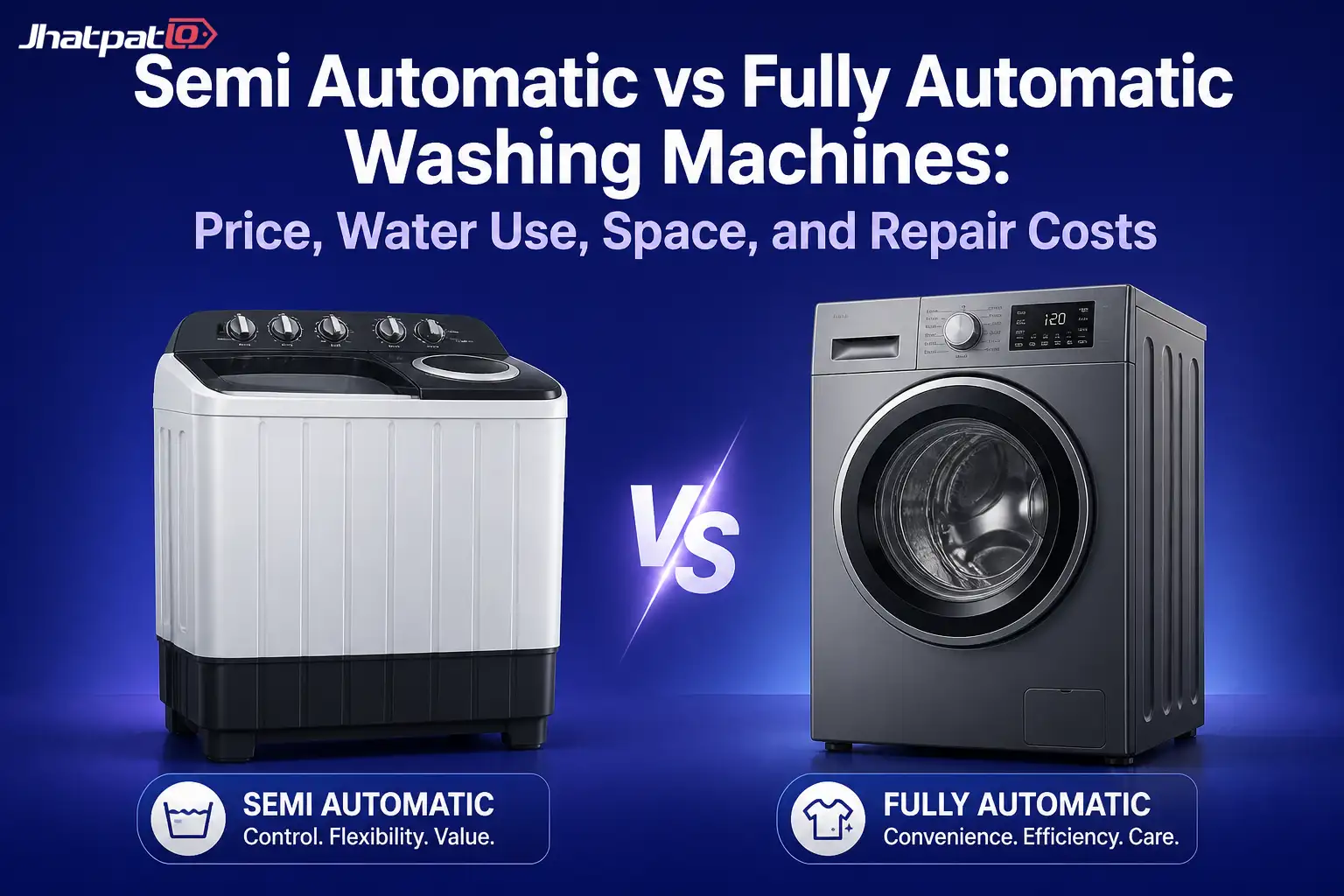
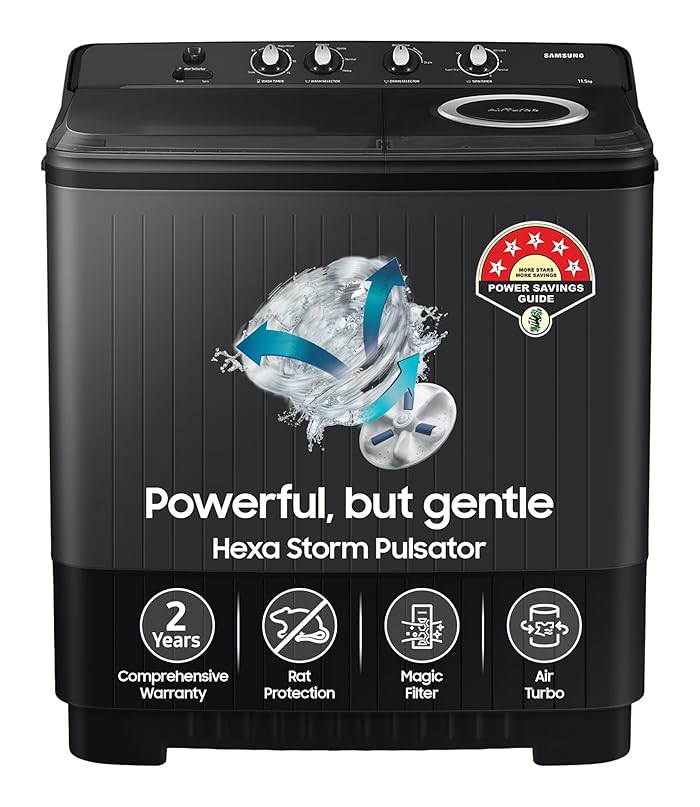
A semi automatic washing machine is basically a two-tub setup, and that manual control is the whole point. You fill the water yourself, move clothes from the wash tub to the spin tub, and decide how long to soak things. If you’ve ever wanted more control over a stubborn pile of muddy clothes, this design makes a lot of sense.
It also sits on the cheaper side of the market, with prices from Rs. 4,990 to Rs. 23,090. That’s a big reason people still buy it. It works well in homes with irregular water supply, and the dual tub washing machine layout even lets one batch spin while another is washing. That’s not fancy, but it is practical.
The flexibility is the main appeal. You get more control, more hands-on work, and less dependence on perfect plumbing. In other words, it’s not trying to do everything for you. It’s trying to be useful when your home doesn’t always behave nicely.
Why the dual-tub layout still makes sense in real homes
The two-tub setup becomes genuinely helpful when a household needs to manage large loads, wash heavily soiled clothes for longer, or work around inconsistent water availability. That manual effort buys flexibility, and sometimes that’s more valuable than convenience.
That’s why this machine often fits larger families and smaller cities better than a fully hands-off model. If your laundry routine is a little unpredictable, the semi automatic design can feel less fragile than a more automated option.
| Feature | Semi automatic washing machine | Why it matters |
|---|---|---|
| Design | Dual-tub | Separate wash and spin tubs |
| Price range | Rs. 4,990 to Rs. 23,090 | Lower entry cost |
| Spin speed | 1300 RPM | Strong spin performance |
| Best fit | Irregular water supply | Works when supply is unreliable |
Why Fully Automatic Machines Feel Easier, and Where the Catch Is
A fully automatic washing machine does the entire wash-rinse-spin cycle in one tub, so you load it, choose a program, and leave it alone. That’s the appeal. Once it starts, you’re not hovering around the machine, checking water levels or shifting clothes back and forth. For busy homes, that feels like a real upgrade.
Top load washing machine models usually spin at 750-800 RPM, while front load washing machine models are more efficient and use around 7.2 litres per kg per cycle versus 17L/kg for top-loaders. Front-loaders are also gentler on fabrics, which matters more than people expect if they wash sarees, delicates, or clothes they don’t want wearing out too fast.
The convenience is real, but so is the price. Fully automatic machines can start around Rs. 9,990, and premium models can climb well above Rs. 1,72,990. So yes, they save effort. But they can also ask for a much bigger upfront commitment.
Top-load and front-load models solve different problems
Top-load machines are usually the simpler automatic option. They’re easier to get used to and often feel familiar if you’ve always had a straightforward laundry routine. Front-load machines, though, are the stronger pick for water savings, delicate clothes, and long-term efficiency.
That’s the real split inside the fully automatic category. It’s not just “more expensive versus less expensive.” It’s about what problem you’re trying to solve. If your main issue is effort, top-load may be enough. If your concern is washing machine water usage and gentle cleaning, front-load is usually the smarter direction.
| Type | Spin speed / water use | Price range |
|---|---|---|
| Top-load washing machine | 750-800 RPM, 17L/kg/cycle | From Rs. 9,990 |
| Front-load washing machine | 7.2L/kg/cycle | Up to Rs. 1,72,990+ |
The Four Differences That Decide the Sale: Effort, Water, Space, and Repairs
This is where the choice stops being abstract. Once you live with the machine, the comparison comes down to daily effort, space in the home, water usage, and what repairs might cost later. Those are the things that matter after the excitement of buying fades.
Semi-automatic machines are wider because of the dual tub design, while fully automatic machines run independently and many modern models include delay start. That sounds like a small detail, but in compact apartments, it really isn’t. A few extra inches can make laundry feel either manageable or awkward.
On water, semi-automatic machines and fully automatic top-loaders are similar at 17L/cycle, so the real savings show up with front-loaders, which use up to 57% less water. That can be a big deal in places where water is costly, limited, or simply annoying to manage every day.
Repairs are usually cheaper on the simpler machine
Semi automatic washing machine servicing is usually cheaper and faster because the mechanism is simpler. That matters more in Tier-2 and Tier-3 cities, where service centres may be fewer and waiting for a part can take longer than you’d like.
A small repair bill on a simple machine often feels better than a discount on a model that’s expensive to service later. That’s one of those boring truths people only learn after they’ve already bought the machine, and by then it’s too late to care about the sticker price.
- Effort: semi automatic needs manual filling and load transfer; fully automatic runs on its own.
- Space: semi automatic machines are wider because of the dual-tub design.
- Water: top-load automatic machines use about 17L/kg/cycle; front-loaders use about 7.2L/kg/cycle and can cut usage by up to 57%.
- Repairs: simpler semi automatic machines usually cost less to service.
When Buyers Make the Wrong Call, It Usually Comes Down to One of Three Mistakes
The wrong purchase usually starts with one number: price. People buy the cheapest model they can find and ignore whether it matches water pressure, space, or service access. That’s understandable, of course. Everyone wants to save money. But the cheapest machine isn’t always the cheapest choice.
A budget fully automatic machine can struggle in a low-water-pressure home, and a semi automatic machine can be awkward in a high-rise flat with no space for the extra tub. These aren’t rare edge cases. They’re the kind of everyday mismatches that turn into frustration after a few weeks of use.
Star ratings matter too. A 5-star semi automatic vs fully automatic washing machine can save enough electricity over five years to beat the sale discount you thought you won. So, the deal that looks better at checkout may not actually be the better deal over time.
Why a Rs. 3,000 discount can be a bad deal
If a repair callout costs Rs. 4,000, the discount is gone before the problem is fixed. That’s the part people forget when they’re comparing only the front-end price. Service availability matters as much as sticker price, maybe more.
And that is the mistake people notice only after the machine is already in the house. By then, you’re not thinking about savings anymore. You’re thinking about inconvenience.
Which Washing Machine Fits Which Kind of Home
The decision gets a lot easier once you match it to real living conditions. A semi automatic washing machine makes sense when water is irregular, your budget stays under Rs. 15,000, and simple repairability matters to you. In that kind of setup, the extra manual work is a fair trade.
Fully automatic top-load makes sense when you want zero involvement and can spend around Rs. 18,000 to Rs. 25,000. Fully automatic front-load makes sense when washing machine water usage, fabric care, and energy savings matter more than the upfront cost. That’s the important part: different homes need different kinds of convenience.
So the cleanest way to read the market is not best versus worst. It’s compatible versus inconvenient. Once you look at it that way, the choice feels much less stressful.
FAQ
These are the smaller doubts people still have after they understand the basic trade-offs.
Q: Which type of washing machine is best for most homes?
There isn’t one single winner. Front-load fully automatic machines are strongest on efficiency, but semi automatics are often the more practical choice for irregular water supply and tighter budgets.
Q: What is the main difference between semi automatic and fully automatic washing machines?
The semi automatic machine needs manual water filling and load transfer between two tubs. The fully automatic machine does everything in one tub with no extra handling after the cycle starts.
Q: Does a semi automatic washing machine clean clothes as well as a fully automatic one?
For everyday cotton and heavy loads, yes. Front-load machines have the edge for delicates and sarees, but semi automatic models clean regular laundry well.
Conclusion
The real answer is about lifestyle, not spec sheets. Water supply, space, budget, and how much laundry time you actually want to spend all matter more than a glossy brochure ever will. That’s what decides between a semi automatic washing machine and a fully automatic washing machine.
If you match the machine to those four realities, the choice gets easier and a lot less expensive to regret later. And honestly, that’s the kind of buying decision that feels good long after the delivery box is gone.

Mahi Gupta
✉ mahigupta708076@gmail.comRelated Products

Mijia Washing Machine Pro brings Super Electrolysis tech to Xiaomi’s 10kg washer
Xiaomi has introduced a new 10kg washer in China under the Mijia name, and the main story is the cleaning system. The Mijia Washing Machine Pro combines Super Electrolysis tech, automatic detergent dosing, and AI-assisted wash control in a model priced below premium smart appliances. Here’...

Amazon Great Freedom Sale 2026 refrigerator deals slash prices on Haier LG Samsung
Amazon Great Freedom Sale 2026 is pushing large refrigerators into a sharper price band, with Samsung’s 653L side-by-side model listed at Rs. 67,990, down from Rs. 1,13,000. The sale also brings LG, Haier and Godrej models into view, along with bank discounts, Amazon Pay rewards and no-cos...

Samsung Galaxy A27 Clears BIS and Moves Closer to India Launch
Samsung Galaxy A27’s BIS Listing Signals India Launch Is Close Samsung Galaxy A27 has appeared on BIS with model number SM-A276B/DS, pointing to an India launch that is moving closer. The listing follows the phone’s recent appearance on Samsung Brazil’s website and adds to the signs that the...

Boat Launches Storm Call 4 and Ultima Vogue 2 With USB-C Charging
Boat Shifts Budget Smartwatch Talk to USB-C Charging Boat Launches Storm Call 4 and Ultima Vogue 2 in India, and the company says the two budget smartwatches are the first in the country with direct USB Type-C charging. The models are priced at Rs 1,599 and Rs 2,799, and they remove the need...
Philips Expands India Audio Push With Soundbars Starting at Rs 3,499
Philips Broadens Soundbar Range In India Philips Soundbar Launch in India, with prices starting at Rs 3,499 and going up to Rs 11,999 online. The lineup spans entry-level 2.1 systems and a 600W 5.1 setup, giving the company a wider push across affordable home audio categories. The compa...
Moto G37 Power Launches in India With 7000mAh Battery and Dimensity 6400
Moto G37 Power arrives with battery first focus Moto G37 Power Launch in India, putting a 7,000mAh battery at the center of its latest budget phone push. The device starts at Rs 14,999 and will go on sale from May 25 through Flipkart. The phone runs on the MediaTek Dimensity 6400 chipset and sh...