


Fastrack vs Samsung Smartwatches for First-Time Users: Battery Life, ECG, LTE, and Daily Use
Introduction
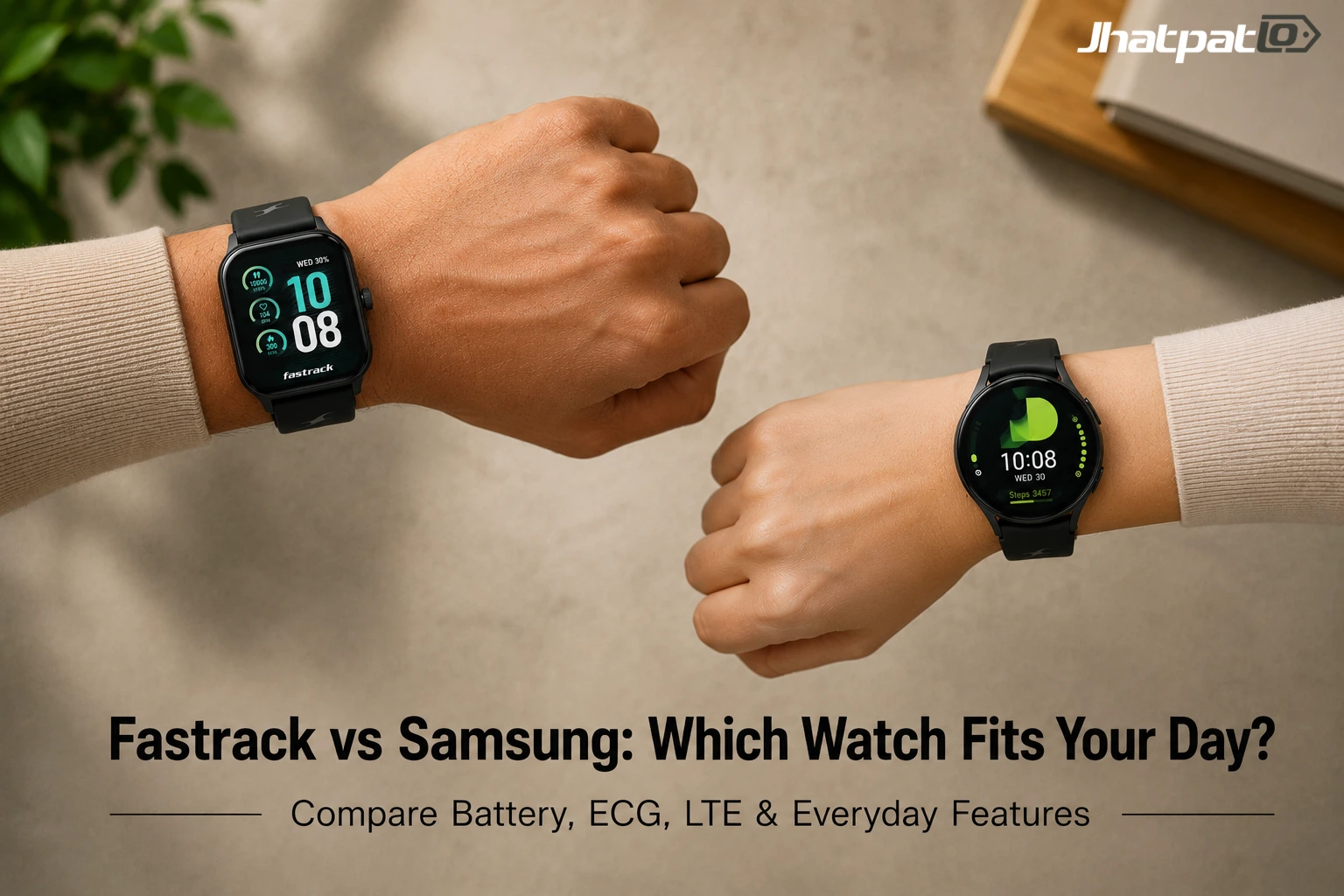
Choosing a first smartwatch sounds simple until you actually start comparing them. Then the questions pile up fast. Do you want something that feels easy from day one, or are you tempted by the bigger health features and the nicer software? That’s really the heart of the Fastrack vs Samsung smartwatches debate for beginners.
Samsung’s premium watches bring ECG, LTE, and advanced health tracking, but the trade-off is daily charging and a lot more to learn. That tension is the whole point here: a first-time buyer usually wants something simple enough to wear without thinking, not a feature set that starts behaving like homework.
Quick Highlights
- Samsung is stronger for health data and advanced features.
- Fastrack is easier to live with on a budget.
- Battery life matters more than people expect at first.
- ECG and LTE are useful, but not for everyone.
- For beginners, simplicity usually wins on day one.
What first-time smartwatch buyers actually need
The real question is not which watch looks better on a spec sheet, but which one stays easy after the novelty wears off. That part gets missed a lot. A smartwatch can look amazing in a store or on a product page, then start feeling annoying after a week if it needs too much charging or has too many menus to poke through.
For beginners, the priorities are simplicity, comfort, 24/7 heart rate monitoring, step tracking, basic sleep analysis, and battery life that doesn’t turn charging into a routine. Quick notifications for calls and messages matter too, because a watch should reduce friction, not add another screen to manage. If you’ve ever owned a gadget that looked fun but slowly became one more thing to babysit, you already know why this matters.
Why battery life and a clean interface matter more than extra sensors
A clutter-free UI avoids technical frustration, especially for someone buying their first smartwatch. It sounds like a small thing, but it really isn’t. The first few days with a new watch are when people decide whether they like it, and if the interface feels confusing, that excitement drops off quickly.
That is why long battery life and simple navigation keep coming up before the fancy stuff; a watch that lasts up to a week feels easier to live with than one that needs constant attention. You notice it in little ways. Less charging. Fewer settings. Less second-guessing. That can be the difference between “I wear this every day” and “I forgot it in a drawer.”
Which watches make the most sense on paper, and where the paper starts lying
The standout models here split into two camps: Samsung for richer health data and Fastrack for easier, cheaper daily wear. On paper, both sides look convincing. But paper doesn’t tell you what it feels like to charge a watch every night, or how much you’ll actually use ECG after the novelty wears off.
The quick takeaway also points to the best overall health tracking as the Galaxy Watch 7 (44mm, LTE), best everyday fitness band as the Galaxy Fit3, best budget smartwatch as the Fastrack Limitless Glide X, best classic design and calibrated health sensors as the Galaxy Watch 6 Classic, and cheapest entry point as the Fastrack Jupitor R2.
Samsung Galaxy Watch6 Classic vs Fastrack Astor FS1 Pro
The Watch6 Classic is the more serious health watch, while the Astor FS1 Pro is the more forgiving buy if price matters more than precision. That’s a pretty fair way to think about it. One is built to feel premium and capable; the other is built to feel approachable and less expensive to own.
Samsung Galaxy Watch6 Classic: rotating physical bezel, BP and ECG readings, up to 40 hours of battery life, stainless steel build, but BP/ECG need recalibration every 4 weeks and the readings are not approved for clinical diagnosis.
Fastrack Astor FS1 Pro: 1.97-inch AMOLED display, functional rotating crown, SpO2, heart rate and women’s health tracking, 100+ sports modes, and up to 5 days battery life with NitroFast charging — though buyer reviews say Bluetooth calling and continuous heart-rate tracking can cut that to 2 days, and some units reportedly stop working within a few months.
Brand details matter too: Samsung, 1-year warranty, model Galaxy Watch6 Classic, manufacturer Dixon Technologies (India) Ltd, ASIN B0CCV8XTCM; Fastrack, 1-year warranty, model Astor FS1 Pro, manufacturer Titan Company Limited, ASIN B0DB5ZFK4Y.
If you want something that feels like a proper health gadget, Samsung makes sense. If you’re mostly trying to get notifications, basic tracking, and a nicer-looking watch without spending too much, Fastrack is easier to justify. That doesn’t mean Fastrack is perfect. It just means the compromise is more obvious and usually less intimidating.
Samsung Galaxy Watch8 vs Fastrack Limitless Glide X
This is the comparison between the most advanced health watch and the budget screen-first option. And honestly, it shows two very different philosophies. Samsung is trying to push wearable tech forward. Fastrack is trying to make everyday ownership less stressful.
Galaxy Watch8: enhanced BioActive sensor, BP, ECG and vascular load monitoring, Antioxidant Index that claims to measure carotenoid levels through skin scanning, 3nm processor, dual GPS, sapphire glass, and IP68/5ATM durability. The catch is that Antioxidant Index and Vascular Load are not for medical diagnosis, Vascular Load needs a 3-night sleep baseline, and battery life is around 24–48 hours because the cell is smaller than the Watch7 44mm.
Limitless Glide X: 1.83-inch Ultra UV HD display, 450 nits brightness, 5-day battery life, IP67 water resistance, Bluetooth calling, 100+ sports modes, weather updates, and low power mode. But third-party reporting puts the resolution at 240×286, which is fine for notifications but less sharp for health graphs, and IP67 is only dust protection plus brief immersion.
Brand details: Galaxy Watch8, 1-year warranty, model Galaxy Watch 8, manufacturer Dixon Technologies (India) Ltd, ASIN B0FDQJSPJK; Fastrack, 1-year warranty, model Limitless Glide X, manufacturer Titan Company Limited, ASIN B0D9629NJQ.
Now this is where beginner buyers usually have to be honest with themselves. If you’re the kind of person who gets excited by deeper health tracking and doesn’t mind learning what everything means, the Watch8 is impressive. But if you’d rather just charge less often and see your messages clearly, the Limitless Glide X can feel like the calmer choice.
Samsung Galaxy Watch 7 vs Fastrack Jupitor R2
The Watch 7 is the better-performing watch; the Jupitor R2 is mostly a price play. That’s not an insult. It just means the buyer is paying for very different things in each case.
Galaxy Watch 7: 3nm processor, dual-frequency GPS, HR/SpO2/BP/ECG monitoring behind sapphire glass, and the fastest processor in the list. LTE is only useful with an active carrier data plan or eSIM subscription, and BP/ECG are still non-diagnostic and require calibration.
Jupitor R2: 1.38-inch TFT display with 240×240 resolution, SingleSync Bluetooth calling, AI voice assistant, up to 5 days battery life, 100+ sports modes, and IP68 rating. The display has weaker contrast and color depth than the AMOLED models, and seller feedback on quality control is mixed.
Brand details: Samsung, 1-year warranty, model Galaxy Watch 7, manufacturer Dixon Technologies (India) Ltd, ASIN B0DKFT7RCN; Fastrack, 1-year warranty, model Jupitor R2, manufacturer Titan Company Limited, ASIN B0DDQCDQQG.
This comparison is especially important because it shows how the gap widens as you move up the Samsung lineup. The Watch 7 feels more polished and capable in almost every way. The Jupitor R2, meanwhile, is more about making smartwatch ownership affordable and simple. If that’s your goal, it’s hard to ignore. If it isn’t, you’ll probably feel the difference pretty quickly.
The comparison that settles most of the choice fast
Once the specs are lined up, the pattern is pretty blunt: Samsung wins on sensors, precision, and platform depth; Fastrack wins on price, simpler usage, and less battery anxiety. And for a first-time user, that last part matters more than it sounds like it should. A watch can be technically better and still be the wrong choice if it feels like too much work.
| Model | Display | Battery Life | Water Resistance |
|---|---|---|---|
| Galaxy Watch6 Classic (43mm) | 1.5" Super AMOLED | 40 hrs (AOD off) | IP68, 5ATM |
| Fastrack Astor FS1 Pro | 1.97" AMOLED | Up to 5 days (claimed) | IP68 |
| Galaxy Fit3 | 1.6" AMOLED | Up to 13 days | IP68, 5ATM |
| Fastrack Limitless Glide X | 1.83" HD (240×286) | Up to 5 days (claimed) | IP67 |
| Galaxy Watch 7 (44mm, LTE) | 1.47" Super AMOLED | 40 hrs (AOD off) | IP68, 5ATM |
| Fastrack Jupitor R2 | 1.38" TFT LCD (240×240) | Up to 5 days (claimed) | IP68 |
| Galaxy Watch8 (40mm, BT) | 1.34" Super AMOLED, 3000 nits | 24–48 hrs (owner reports) | IP68, 5ATM |
If display technology matters more than size, the Jupitor R2 is the odd one out with TFT LCD instead of AMOLED. That’s the kind of detail beginners often miss at first, then immediately notice in use when text doesn’t look as crisp or colors feel flatter than expected.
Only the Galaxy Watch 7 has real standalone GPS and LTE, and ECG plus BP monitoring stay exclusive to the two Samsung Watch models rather than the Fastrack watches. So if those are must-haves, the choice gets a lot simpler. If they’re just nice-to-have features, Fastrack suddenly looks more practical.
There’s also a very normal human factor here: people tend to overestimate how often they’ll use advanced features. ECG is cool, sure. LTE sounds freeing. But in everyday life, most first-time users spend much more time reading notifications, checking step counts, and glancing at the time. That’s why the simpler watches can end up feeling more satisfying overall.
FAQ
These are the smaller doubts that usually come up after the main comparison, especially when someone is trying to avoid regret on a first purchase. And fair enough — smartwatches are one of those things where the first impression matters, but the long-term annoyance matters more.
Q: Is a Samsung smartwatch too advanced for a first-time user?
For many beginners, yes, at least if they want something low-maintenance. Samsung gives more power and more health data, but the daily charge cycle and extra features can feel heavier than a first watch needs.
Q: Is the Fastrack Limitless Glide X battery life really 5 days?
That is the claim, but third-party notes and the usual calling load suggest the real-world figure can be lower. For many buyers, it is better to treat 5 days as the optimistic version, not the guaranteed one.
Q: Does the Galaxy Watch7 LTE work without a phone nearby?
Yes, but only with an active carrier data plan or eSIM subscription. That means LTE adds usefulness, but it also adds cost.
Q: Is the Galaxy Watch6 Classic ECG accurate enough for medical use?
No. The ECG and BP features need recalibration every 4 weeks and are not approved for clinical diagnosis, so they are best treated as convenience features, not medical readings.
Conclusion
If you want the better first smartwatch for beginners, Fastrack is the safer fit when battery life, price, and easy daily use matter most; Samsung is the better pick when you want ECG, LTE, and more advanced health tracking.
In simple terms: buy for how you will live with the watch, not for the feature list you wish you would use.

Mahi Gupta
✉ mahigupta708076@gmail.comRelated Products




Galaxy Watch Ultra 2 and Galaxy Watch 9 go on sale in 106 markets
Samsung has started selling the Galaxy Watch Ultra 2 and Galaxy Watch 9 globally, with the Ultra now available in 106 markets. The new launch pairs a tougher premium model with a lower-priced standard watch, and both ship with Wear OS 7 and One UI Watch 9 out of the box. Galaxy Watch 9 pr...
Samsung Health Update Adds Vitals and Heart Health Score
Samsung Health is getting a preview update on June 8 tied to the next Galaxy Watch release, bringing a cleaner layout and new health signals. The change adds Vitals, Daily Cardio Load, Fitness Index and a more visible Energy Score for quicker daily use.The update is aimed at making Samsung Health mo...

Samsung Galaxy Watch 9 leak shows Snapdragon Wear Elite and new features
Samsung’s latest Galaxy Watch 9 leak is giving a fairly clear picture of where the company may be heading next. The images point to a stronger performance focus, new health tools, and a more mainstream color lineup. Here’s what the leaked material suggests and why it may matter for Android...
Samsung Galaxy Watch 9 and Watch Ultra 2 Near Launch After CMIIT
Samsung’s next Galaxy watches are looking increasingly close to launch. Fresh CMIIT approval in China adds another layer to earlier 3C and BIS listings, and the model numbers line up with reports that point to a likely July release window. For anyone tracking Samsung wearables, the filings sug...

Samsung Galaxy Watch Ultra 2 pricing leak and Galaxy Watch9 specs in full
Samsung Galaxy Watch Ultra 2 pricing and Galaxy Watch9 specs have leaked ahead of launch, with a €749 LTE model, bigger batteries, and Wear OS 7 details now in view. The leak also points to 40mm and 44mm Galaxy Watch9 models, giving a clearer picture of Samsung’s next smartwatch lineup bef...

Galaxy Watch Ultra 2 Leak Confirms 5000 Nits and 800mAh Battery
Galaxy Watch Ultra 2 leak images tied to Samsung promo material point to a brighter display, a bigger battery, and a tougher design. The details suggest Samsung is pushing its next rugged smartwatch harder for outdoor use, while also hinting at a broader chip change across the Galaxy Watch...