


AI Shopping Assistant Market Outlook Through 2034 Size, Share, and What’s Driving the Surge
Introduction
The AI shopping assistant market is moving fast, and honestly, it’s not hard to see why. Retail is changing in a very practical way: shoppers want faster decisions, smarter suggestions, and less effort, while businesses want stronger conversion and less pressure on support teams. That’s the kind of mix that tends to push a market from interesting to unavoidable. The AI shopping assistant market is projected to hit USD 84.6 billion by 2034, and that figure starts to make sense once you look at how quickly NLP, voice tools, and generative AI are being woven into everyday shopping experiences.
The real tension here is simple. Shoppers want convenience, but retailers also want automation, conversion, and control. So the market isn’t growing just because AI sounds exciting. It’s growing because it solves a very real shopping problem, and it does it in a way that feels more natural than the old search-and-scroll routine.
Quick Highlights
- Convenience and automation are driving adoption.
- Personalization is becoming a revenue tool, not a nice-to-have.
- Voice and NLP are shaping the most useful experiences.
- Trust still determines how far the market can go.
Why the market is expanding so quickly now

The growth story is being pulled by personalization, automation, and the wider comfort people now have with conversational shopping. Around 31% of shoppers expect virtual assistants to help them choose products, which is a pretty telling sign. It means the idea of asking an assistant for help no longer feels unusual. It feels useful. And once that expectation exists, it tends to spread.
Voice-controlled shopping through smart speakers and smartphones has also pushed hands-free buying into the mainstream. That matters because the easier shopping feels, the more often people come back to it. The business case is hard to ignore too. AI-driven personalization can lift revenue by 10–40%, while AI chat tools can raise conversion rates from 3.1% to 12.3% and resolve up to 93% of customer inquiries without human support. That combination makes AI shopping tools look less like experiments and more like infrastructure.
That’s the key shift. Retailers aren’t treating these tools as novelty add-ons anymore. They’re beginning to look at them as part of the basic shopping stack, the same way they think about payment systems or inventory tools.
What shoppers actually use AI shopping assistants for
The strongest adoption signals are practical, not flashy. Shoppers use AI mainly for product research, recommendations, and deal discovery, which makes a lot of sense if you think about how people actually shop online. Most of us aren’t trying to be amazed. We just want to find the right thing faster and avoid wasting time on endless tabs.
- Product research: 53%
- Recommendations: 40%
- Deal discovery: 36%
- Comfort allowing AI to complete purchases: 34% of U.S. consumers
- Reliability concerns about AI recommendations: 21%
That last point matters more than it might seem. If shoppers don’t trust the recommendation quality, they hesitate. And when hesitation shows up in retail, conversion usually takes the hit first. So while interest is high, confidence still has room to grow.
Which segment and technology stack is leading the market
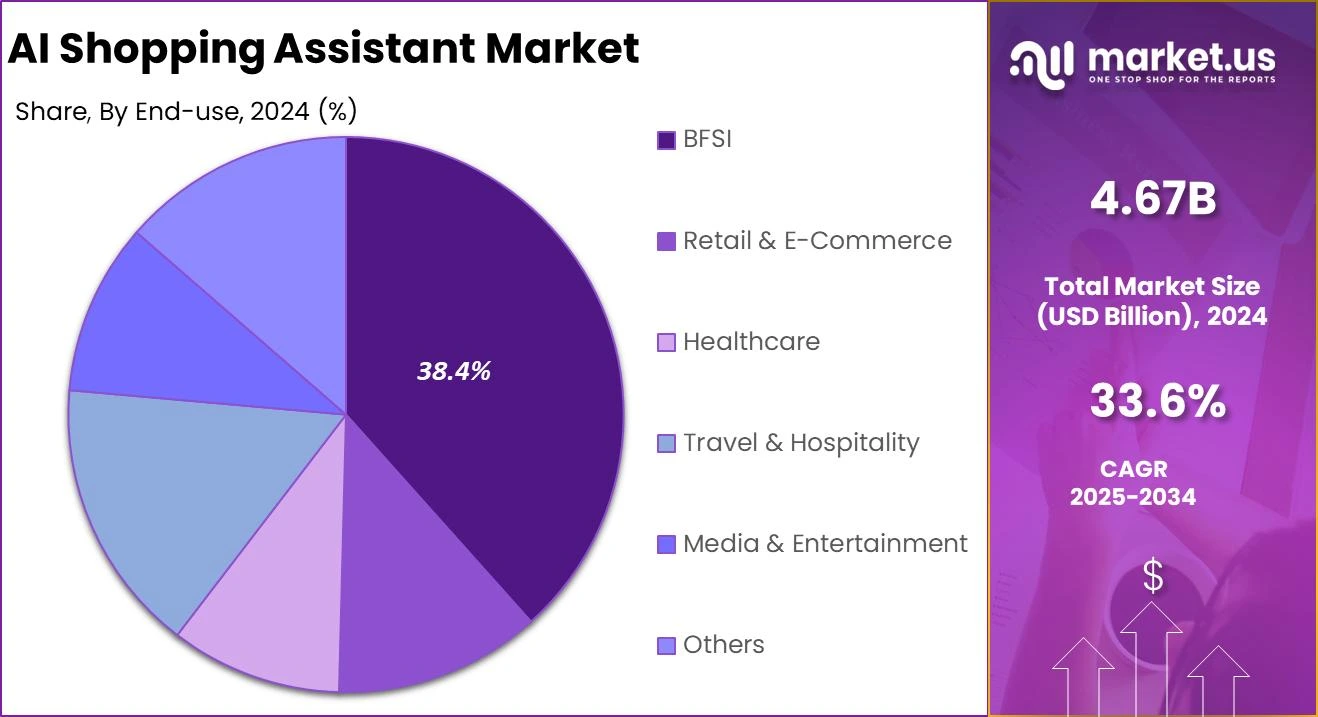
The market is already showing a clear preference for full solutions over narrow tools. The Solution segment held 75.2% of the market in 2024, which suggests businesses want something that can actually be deployed, not just admired in a demo. Meanwhile, Natural Language Processing led technology with 45.6% because it makes shopping feel conversational instead of mechanical. That human-like flow is a big part of why these systems are catching on.
Voice also matters more than category labels might suggest. The Voice segment held 42.6%, and that fits the wider move toward spoken, low-friction commerce. In other words, people don’t always want to type filters or browse endlessly. Sometimes they just want to say what they need and get a useful answer back.
On the demand side, the BFSI sector held 38.4%, which is a good reminder that shopping-assistant logic is spreading beyond retail into comparison-heavy financial products. That broader use case matters because it shows the market isn’t tied to one shopping category. It’s really about helping people decide faster, wherever decisions happen.
The main segments at a glance
These are the parts of the market that matter most in the current setup, and the split is sharper than the category labels imply. A lot of readers expect a more even spread, but the data leans clearly toward complete platforms and conversation-driven interfaces.
| Category | Leading segment | 2024 share |
|---|---|---|
| By Offering | Solution | 75.2% |
| By Technology | Natural Language Processing (NLP) | 45.6% |
| By Type | Voice | 42.6% |
| By End-use | BFSI | 38.4% |
- By Offering: Solution, Services
- By Technology: Natural Language Processing (NLP), Machine Learning (ML), Computer Vision (CV), Others
- By Type: Voice, Text, Visual, Multimodal
- By End-use: BFSI, Retail & E-Commerce, Healthcare, Travel & Hospitality, Media & Entertainment, Others
Put simply, the market is rewarding tools that make shopping easier without making the experience feel robotic. That balance is harder to get right than it sounds, which is probably why the leading segments are concentrated around the most usable formats.
How North America and the U.S. are keeping the lead
North America still anchors the category, holding more than 39.4% of the market in 2024 and generating USD 1.83 billion in revenue. The U.S. alone reached USD 1.56 billion in 2024 and is growing at 27.2% CAGR. Those are strong numbers, but the real story is the environment behind them. The region benefits from high internet penetration, advanced AI infrastructure, and a cluster of companies pushing conversational commerce hard, including Microsoft, Google LLC, and Amazon.com, Inc.
That leadership isn’t just about scale. It’s about how quickly the ecosystem turns product demos into consumer habits. In some markets, new digital tools sit in pilot mode for years. In North America, they often move from pilot to everyday use much faster, especially when the companies behind them already shape how people search, browse, and buy.
Recent U.S. and North America moves that show where the market is heading
Several 2025 product updates show the market shifting from chatty assistants to more agent-like shopping systems. That’s a meaningful change. It means the assistant is no longer just answering questions. It’s starting to act.
- November 2025: Meta Platforms, Inc. expanded its AI shopping assistant beyond ads to retail websites, with integration across Facebook, Instagram, WhatsApp, and Shopify.
- November 2025: Amazon.com upgraded Rufus so it can search by activity or event, add items to carts automatically, track deals, and use natural conversation.
- November 2025: Google LLC added conversational search, agentic checkout, and an AI feature that calls stores to check product availability and prices.
Those moves point to a simple direction: the shopping journey is becoming more assisted, more connected, and more automated. That doesn’t automatically mean every shopper will love it, but it does mean the category is moving from “helpful feature” to “core experience.”
Why generative AI and agentic checkout are becoming the next buying layer

Generative AI is no longer just a supporting feature. It’s becoming the interface. Around 39% of consumers already use generative AI when shopping online, and more than 50% plan to use it this year. That level of intent suggests the behavior is moving from curiosity into habit, which is usually when a market starts to change shape.
This momentum points toward generative AI shopping assistants that do more than suggest products. They support virtual try-ons, dynamic content, demand forecasting, fraud detection, and the kind of conversational flow that makes agentic checkout shopping feel less like a button click and more like a transaction being handled for you. That may sound small on paper, but in actual shopping behavior, it’s a big shift. The less effort a buyer has to spend, the more natural the process becomes.
This is where shopping stops being a catalog problem and starts becoming an automation problem. That’s the part many retailers are still catching up to. It’s not just about helping people browse. It’s about helping them decide, confirm, and purchase with less friction at every step.
What is still holding buyers back
The biggest brake is trust, not interest. Only 15% of shoppers use retailer-branded AI shopping assistants, even though 70% have tried AI tools in some form. That gap says a lot. People are willing to experiment with AI, but they’re still careful about handing over too much control when a purchase is involved.
Generational adoption is uneven too. Younger shoppers are clearly more open to it, while older consumers are moving more cautiously. That doesn’t mean the older group won’t adopt later. It just means the path to trust is longer.
- 70% of shoppers have tried AI tools
- Fewer than 15% use retailer-branded AI shopping assistants
- 24% of Gen Z use AI shopping assistants
- 7% of Boomers use AI shopping assistants
This trust gap is one of the main reasons the market can look huge on paper while still feeling early in practice. Growth is real, but so is hesitation.
What the market still has to solve before it scales cleanly
The opportunity is obvious, but the friction is just as real. Data privacy worries, algorithmic bias, and system integration problems keep showing up as the main barriers to wider adoption. And if you’ve ever watched a promising digital tool get tangled up in messy data, you know how quickly a good idea can lose momentum.
Retailers need high-quality data, consistent product feeds, and enough technical control to keep AI product recommendation engines accurate across websites, apps, and social platforms. If that sounds messy, it is. In many organizations, product data lives in too many places, in too many formats, with too many gaps. The assistant can only be as reliable as the information feeding it.
That mess is why the most ambitious systems are also the hardest to run well. It’s not enough to launch a smart interface. The back end has to stay clean, current, and integrated, or the user experience falls apart pretty quickly.
The pressure points investors and operators keep circling
- Privacy concerns: shoppers hesitate to share browsing and purchase history
- Bias risk: training data can skew recommendations or limit product variety
- Integration complexity: systems must work across websites, mobile apps, and social media
- Operational dependency: merchants need structured product data to keep assistants accurate
These issues don’t kill the market, but they do shape who wins. The companies that solve trust, data quality, and integration first are likely to get the biggest payoff.
FAQ
The questions below come from the smaller doubts readers usually have after they understand the market size, growth rate, and leading segments. And honestly, they’re the right questions to ask, because the headline numbers only tell part of the story.
Q: What is the AI shopping assistant market worth today?
It was valued at USD 4.67 billion in 2024 and is projected to reach USD 84.6 billion by 2034.
Q: Which segment leads the AI shopping assistant market?
The Solution segment leads with a 75.2% share, followed by NLP at 45.6% and Voice at 42.6%.
Q: Why are generative AI shopping assistants gaining so much attention?
Because they make recommendations feel more natural, support virtual try-ons and dynamic content, and are already being used by 39% of consumers shopping online.
Q: What is the biggest barrier to wider adoption?
Trust. Privacy concerns, bias risks, and poor integration are still slowing adoption even as demand rises.
Conclusion
The AI shopping assistant market is scaling because it solves a very current retail problem: people want faster, more personal shopping, and businesses want better conversion with less manual support. That’s a strong combination, and it explains why the category keeps pulling in new investment, new features, and new expectations from shoppers.
With USD 84.6 billion projected by 2034, the question is no longer whether these tools matter, but which ones can earn trust while actually improving the buying experience. That’s the real test now. Not whether AI can assist shopping, but whether it can do it well enough that people keep coming back.

Related Products



Nubia NaviX Ultra AI phone launches with Doubao and 7,100mAh battery
Nubia’s NaviX Ultra is its second attempt at an AI-first phone, and this one leans harder into hardware. The China launch pairs ByteDance’s Doubao Mobile Assistant with Qualcomm’s Snapdragon 8 Elite Gen 5, plus a 200MP triple camera, a 7,100mAh battery, and 90W wired charging. The Nubia N...

Samsung AI Chip Shortage Could Last Through 2028 as Demand Surges
Samsung’s AI chip shortage warnings now point to a problem that could stretch into 2027 and 2028, even as quarterly operating profit jumped 19-fold. The pressure is coming from strong demand for memory chips used in AI servers and data centres, while factory output is still lagging behind....

Qualcomm Brands Cut Shipments Amid Memory Shortage
Q1 2026 Results and Outlook Qualcomm reports Q1 2026 revenue of $12.2 billion and projects Q2 revenue at $10.2 to $11 billion. The results come as the company identifies a global memory shortage weighing on handset production. On the Q1 earnings call, Chief Financial Officer Akash Palkhiwala no...

iPhone 18 Pro Max price hike could make Apple’s next flagship pricier
The iPhone 18 Pro Max price hike talk is centered on two cost pressures: Apple’s shift to 2nm silicon and rising memory prices. A tipster also claims the China starting price could reach CNY 11,000, which would push Apple’s next premium model higher if those cost trends hold. A20 Pro chip...

Google Assistant going away on Sept. 4 as Gemini takes over Android
Google Assistant is going away on Sept. 4, 2026, with Gemini set to replace it on supported Android devices after a rollout that may take weeks. Google says the change starts with phones and tablets, then extends to Wear OS watches, headphones, earbuds and most Android Auto setups, while c...