


iPhone 18 Pro variable aperture echoes Android’s old camera play

iPhone 18 Pro variable aperture starts at f/1.48 and moves through four steps to f/4.0 on Apple’s 48MP main camera. That puts Apple in familiar territory for smartphone photography, since Android phones have been using adjustable aperture ideas for years, even if Apple’s version is simpler to follow for most users.
What stands out here is not that variable aperture is new. It is that Apple is bringing a long-running camera trick back into the spotlight with a more mainstream framing. For readers tracking phone camera hardware, the comparison with Samsung, Huawei, and Xiaomi is the real story.
News Highlights
- Apple’s iPhone 18 Pro variable aperture reportedly begins at f/1.48 and shifts across four steps to f/4.0 on the 48MP main camera.
- That setup places Apple alongside Android phones that have used aperture control for years, especially in premium camera-focused models.
- Samsung helped popularize the idea on Galaxy flagships with a dual-aperture system that switched between f/1.5 and f/2.4.
- Huawei and Xiaomi later expanded the concept with more manual and stepless aperture control, making Apple’s version look relatively restrained.
Samsung dual aperture camera started the idea on Galaxy flagships
Samsung’s first widely known implementation used f/1.5 and f/2.4 switching on the Galaxy S9, after the W2018 tried it earlier in China. The basic idea was simple: open up the lens more in low light, then switch to a narrower setting when scenes needed more depth control or less incoming light.
That made the camera system useful in two very different conditions without asking the user to learn much. In practice, it gave dark scenes more light and bright scenes more control, which is why it became one of the better-known premium Android camera features of its time.
The Galaxy S9 version did not offer endless adjustment, but it set the tone. It showed that physical aperture changes could be marketed as a meaningful camera advantage, not just a technical detail buried in the spec sheet. For years after that, adjustable aperture stayed closely tied to the Android flagship race.
Huawei Mate 50 Pro aperture and Xiaomi 14 Ultra stepless aperture went further
Huawei pushed the idea further with manual aperture control mode on the Mate 50 Pro, where the 50MP main camera moved across 10 physical steps from f/1.4 to f/4.0. That gave users more room to shape exposure and background separation than Samsung’s simpler switching setup.
Xiaomi then expanded the concept again with a stepless aperture on the 14 Ultra. Instead of fixed jumps, the system was presented as more fluid and creative, letting the hardware behave in a way that felt closer to a traditional camera tool. In the outline’s terms, the result was more natural background separation and a stronger starburst effect camera lens.
This is where Apple’s approach looks more conservative. The iPhone 18 Pro variable aperture is still notable, but it uses four steps rather than the wider adjustment ranges seen on some Android phones. That does not make it less important. It just means Apple is choosing a version that is easier for mainstream users to understand and likely easier to explain in a product launch.
For buyers, the comparison matters because it puts the iPhone 18 Pro into a category that Android has already explored in different ways. Samsung made aperture switching familiar, Huawei made it more granular, and Xiaomi pushed toward a more flexible feel. Apple’s move suggests it sees enough value in the feature to bring it to the iPhone in a simplified form.
In other words, the iPhone 18 Pro is not inventing variable aperture. It is joining an existing camera path that Android phones have been developing for years. The difference is mostly in presentation, not in the core idea. Apple’s version appears designed to be straightforward, while Android’s earlier versions often leaned harder into experimentation and camera control.
For anyone watching smartphone cameras closely, that makes the iPhone 18 Pro a familiar story with a new badge on it. The hardware may be new for Apple, but the concept is already well established across premium Android phones.

Related Products








iPhone 18 Pro Max variable aperture leak points to Pro Max-only camera
The iPhone 18 Pro Max variable aperture feature may be limited to Apple’s largest Pro model, according to a new tip. If the leak is accurate, the Pro Max could get a rare camera advantage over the smaller iPhone 18 Pro, with the bigger chassis possibly needed to fit the mechanism. The clai...

Apple Tests Variable Aperture Lens and Telephoto Upgrade for iPhone 18 Pro
Apple Tests Variable Aperture Lens and Upgraded Telephoto for iPhone 18 Pro The iPhone 18 series is entering a phase of camera-focused development, with the iPhone 18 Pro and iPhone 18 Pro Max expected to launch in September, while the vanilla iPhone 18 is tipped for a 2027 debut. A post from...
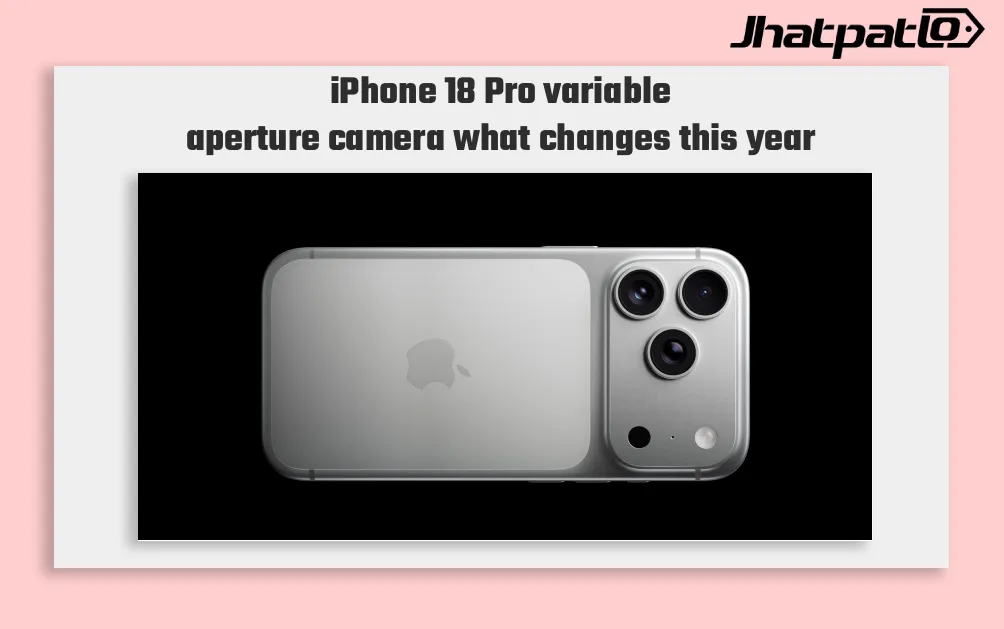
iPhone 18 Pro Tipped to Add Variable Aperture Camera Later This Year
Apple’s next Pro phones tipped for camera shift Apple’s iPhone 18 Pro and iPhone 18 Pro Max are believed to go official later this year with a notable camera update, according to a new leak. The claim centers on a variable aperture main camera for the Pro models, while separate reports point...

iPhone 18 Pro camera ranking falls to second on DXOMARK
Apple’s iPhone 18 Pro has slipped to second place in DXOMARK’s camera ranking, with the Huawei Pura 80 Ultra now ahead. DXOMARK gave Apple’s flagship 172 points, which still keeps it near the top of the ultra-premium camera class and ahead of every other phone except Huawei. The iPhone 18...

Galaxy S27 variable aperture plan shelved as Samsung weighs costs
Samsung’s Galaxy S27 series now appears unlikely to copy Apple’s upcoming variable aperture camera feature. According to the outline, Samsung reportedly dropped the main-camera upgrade for its next flagship line as component prices rise and a thicker camera module makes the change harder t...