


Samsung Tests 12,000mAh and 18,000mAh Silicon-Carbon Batteries for Phones
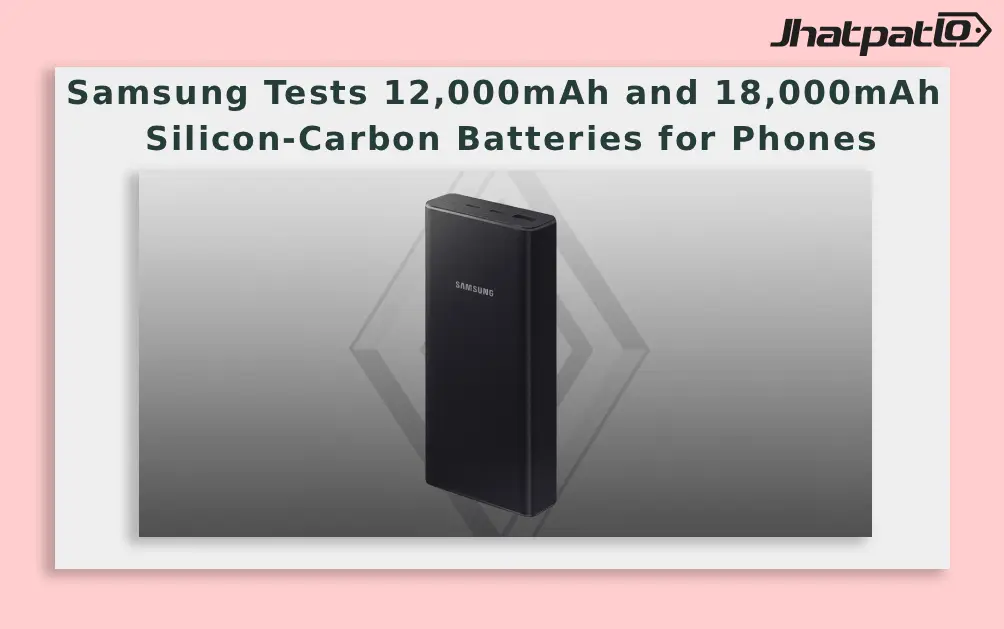
Samsung SDI Testing Next-Gen Silicon-Carbon Batteries for Phones
Samsung is reportedly testing high-capacity silicon-carbon smartphone batteries, including 12,000mAh and 18,000mAh prototypes. A leaked document outlines how Samsung SDI is refining cell stacking designs and battery-management software to improve reliability, thermal performance, and efficiency. The company has taken a cautious approach to new battery technologies since the Galaxy Note 7 incidents in 2016 and remains in evaluation mode before any commercial rollout. If development succeeds, thinner high-capacity cells could power future flagship smartphones and foldables without adding device thickness.
Details and Testing Outcomes
The South Korean tech firm is testing silicon-carbon smartphone batteries, including 12,000mAh and 18,000mAh prototypes, according to information shared in a post on X by user Schrödinger. The post also claims that a larger 20,000mAh silicon-carbon battery previously under evaluation failed durability testing after about 960 charge cycles.
Silicon-carbon batteries can store more energy than lithium-ion cells by using a silicon-based anode instead of graphite, allowing higher capacity without significantly increasing battery size. Several modern smartphone models, especially from Chinese firms, have already adopted this technology.
Leaked testing details suggest that the 20,000mAh unit used a dual-cell design combining a 12,000mAh primary cell measuring about 6.3mm thick with a secondary 8,000mAh cell measuring roughly 4mm. The prototype reportedly did not meet Samsung's durability targets during testing, prompting continued development with smaller silicon-carbon battery configurations.
One prototype reportedly offers a total capacity of 12,000mAh and uses a dual-cell structure consisting of a 6,800mAh cell measuring around 4.7mm and a 5,200mAh cell measuring approximately 3.2mm. The intended combined thickness is under about 9.3mm, although some test samples reportedly exceeded that limit.
Samsung is also reportedly testing an 18,000mAh configuration built using three cells rated at 6,699mAh, 6,000mAh, and 5,257mAh, with thicknesses of roughly 4.2mm, 3.9mm, and 3.28mm, respectively. The target stacked thickness is about 12.3mm, but additional thermal interface layers between the cells have reportedly pushed some prototypes to around 12.8mm.
The testing programme reportedly aims for a lifespan of around 1,500 charge cycles for the 12,000mAh and 18,000mAh batteries, although development is still ongoing. The 12,000mAh version is said to prioritise stability and could theoretically deliver around 20 to 25 hours of screen-on time on a smartphone connected to both mobile data and Wi-Fi.
Tech specifications
- 12,000mAh dual-cell: 6,800mAh and 5,200mAh cells; thicknesses around 4.7mm and 3.2mm; combined target under 9.3mm
- 18,000mAh triple-cell: 6,699mAh, 6,000mAh, 5,257mAh; thicknesses around 4.2mm, 3.9mm, 3.28mm; stacked target about 12.3mm; some samples around 12.8mm due to thermal layers
- 20,000mAh prototype: dual-cell with 12,000mAh primary (≈6.3mm) and 8,000mAh secondary (≈4mm); durability testing reportedly failed
- Test lifespan goal: approximately 1,500 charge cycles for the 12k and 18k units
- End-user projection for 12k: 20–25 hours of screen-on time under typical usage
Officials involved said the testing remains ongoing and there is no timeline for a commercial rollout. If the programme advances, Samsung could pursue thinner, high-capacity cells for future flagship and foldable devices.
Related Products


Galaxy S27 Ultra battery leak points to 5800mAh test cell
Galaxy S27 Ultra battery leak chatter is now centered on Samsung testing 5,600mAh and 5,800mAh cells for the next Ultra. That would move the phone past Samsung’s long-running 5,000mAh limit and signal a clearer response to the battery expectations shaping premium Android flagships. Priorit...
Huawei Could Test a 10000mAh Battery Phone in New Leak
Huawei’s Battery Test Signals a Shift Beyond Fast Charging Huawei is reportedly testing a smartphone battery above 10,000mAh, a move that would push phone endurance into new territory if it reaches a commercial device. The leak also says the company may be working with new battery material an...

Samsung Galaxy Z Fold 8 to Get Larger Battery, Rumors Say
Samsung's Galaxy Z Fold 7 was launched in India by the South Korean tech giant in July 2025 as the flagship book-style foldable handset. The device carried a 4,400mAh battery, a capacity that has remained consistent across generations since the Galaxy Z Fold 2. In the current cycle of indu...

iPhone Ultra battery capacity leaks point to 5,000 mAh foldable
iPhone Ultra battery capacity leaks are now pointing to a foldable Apple device with a 5,000 mAh-class battery setup. The latest certification details suggest a rated total of 4,883 mAh across two cells, which is close enough to frame launch expectations. That puts Apple’s rumored foldable...

Samsung Galaxy S27 Pro May Be Closer to the Ultra Than Expected
Samsung’s Galaxy S27 Pro is tipped for a 5,000mAh battery, a figure that would match the Ultra in the 2026 lineup. The leak also points to a smaller body and no S Pen, which may explain the space trade-off.Galaxy S27 Pro Battery Match Raises Questions for the S27 UltraSamsung’s next flagship cycle i...

Samsung Galaxy Z Flip 8 Battery Leak Raises a Big Question About the Upgrade
Samsung is expected to unveil the Galaxy Z Flip 8 alongside the Galaxy Z Fold 8 at its usual summer launch event, which typically takes place in July. A new report points to a battery setup that could keep the overall capacity similar to the current generation, with the usual spli...