


Split AC Working Explained: What Really Happens After You Press Power
Introduction
The strongest clue is the one most people ignore: the machine can still be rated to cool at 52°C, and that tells you this is not just about comfort, but about how hard the system can keep working when the heat gets brutal.
This split AC working explained through the Godrej Eon Magnus 1.6-ton inverter split AC (19M3TG) shows what happens after you press the power button, and why efficiency, humidity, and durability all sit inside the same cooling cycle.
Quick Highlights
- Cooling is really heat transfer, not “making cold.”
- The compressor and refrigerant do most of the heavy lifting.
- Humidity drops because moisture condenses on the coil.
- Inverter speed control can improve comfort and savings.
- Ratings like 52°C and ISEER tell you how it behaves in real heat.
What a split AC is actually doing when it cools a room
The basic job is simple to say and easy to miss: the AC moves heat from inside the room to outside it.
That happens through a closed circuit of copper pipes carrying refrigerant between the indoor and outdoor units, with four stages doing the work — compression, condensation, expansion, and evaporation.
The indoor unit absorbs heat and moisture; the outdoor unit rejects that heat so it does not come back into the room.

So when you feel cool air on your face, what’s really happening is a controlled exchange. Heat leaves the room, the refrigerant carries it away, and the cycle keeps repeating until the room reaches the set temperature. It sounds almost too simple, but the engineering behind it is what makes the difference between a decent AC and one that struggles the moment the weather gets rough.
The four-step refrigerant cycle inside the machine
The refrigerant starts as a low-pressure gas in the outdoor compressor, gets compressed into a hot high-pressure gas, then loses heat in the condenser and turns into a liquid.
After that, it passes through a capillary tube expansion device in the Godrej Eon Magnus, where pressure drops sharply and the refrigerant becomes a cold low-pressure mixture of liquid and vapour before entering the indoor coil.
That low-pressure state matters more than most people realize. Pressure drop is what makes the refrigerant cold enough to absorb room heat efficiently. Think of it like opening a tightly sealed bottle of soda: the sudden release changes everything. Here, that change is carefully controlled so the refrigerant can keep cycling instead of just warming up and stopping.
Why the indoor coil makes the room cooler and less humid
The evaporator coil inside the indoor unit absorbs heat from warm room air, and the refrigerant evaporates back into a cool gas.
Some moisture also condenses on that coil, which is why split AC humidity removal is part of the comfort story, not a side effect.
The indoor unit contains the evaporator, blower, and controls; the outdoor unit contains the compressor, condenser, and outdoor fan.
Here’s the thing: humidity is often what makes a room feel sticky even when the temperature seems okay. So, when the coil pulls moisture out of the air, the comfort improvement is bigger than the number on the thermostat suggests. That’s also why a room can feel pleasantly dry and cool at the same time. The system is doing two jobs at once, and that’s a big part of why it feels so effective.
Why inverter compressor speed control changes the way an AC feels
The compressor is the part that decides how aggressively the system works, and in modern inverter machines it can slow down once the room reaches the target temperature.
The Godrej Eon Magnus uses a rotary inverter compressor with five convertible cooling capacity levels, ranging from 40% to 110%, and Godrej says that can deliver up to 70% power savings depending on usage conditions and internal lab tests.
That matters most at night or in steadier conditions, when full output would be wasteful.

Now, this is where a lot of people feel the difference without really naming it. A non-inverter AC tends to cycle on and off more noticeably, while an inverter system can settle into a steadier rhythm. That usually means fewer temperature swings, less noise in some conditions, and less unnecessary power draw once the room is already close to comfortable.
What goes wrong when installation or airflow is poor
Poorly installed or insulated refrigerant lines can reduce performance, while incorrect drainage can cause water leakage.
A dirty indoor filter restricts airflow and makes the system work harder, which is one reason good installation and maintenance matter more than the brochure suggests.
This part gets overlooked all the time. People blame the AC when the real issue is the setup around it. If the airflow is blocked, if the drainage is sloppy, or if the refrigerant lines are poorly handled, the machine has to fight against avoidable problems. That’s not just inconvenient. It can directly affect cooling performance, efficiency, and how long the unit stays trouble-free.
Which specifications matter most when the weather gets extreme
As outside temperature rises, the AC has to work harder because the refrigerant and ambient air are closer in temperature, so the system needs more force to push heat out.
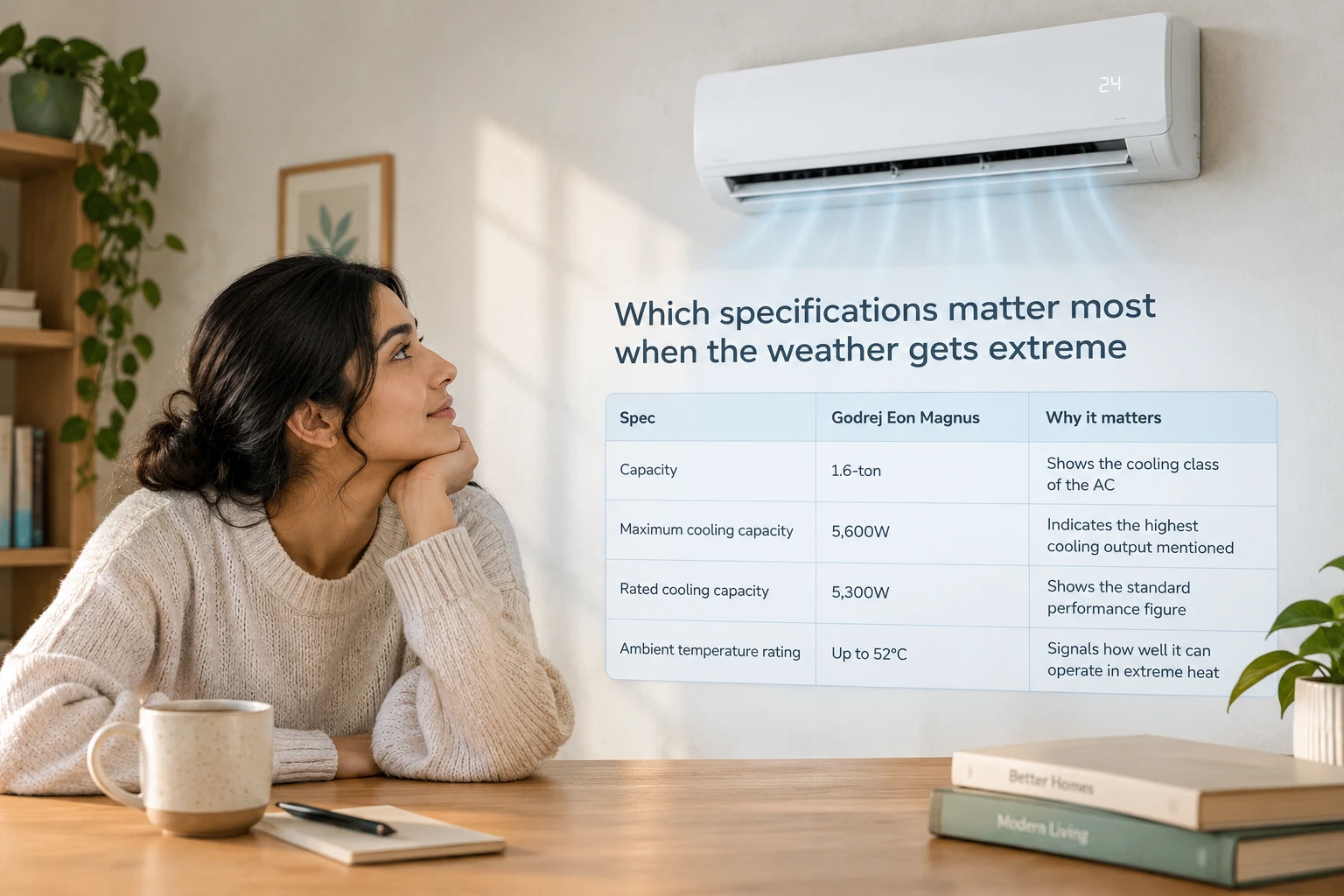
The Eon Magnus is rated for AC cooling at 52°C, has a 1.6-ton classification, a maximum cooling capacity of 5,600W, and a rated cooling capacity of 5,300W.
That set of numbers is what tells you whether the machine is only comfortable on paper or still useful in a brutal summer.
And that’s the part many buyers should care about more. In a mild climate, almost any half-decent machine can feel fine. But when outdoor heat climbs hard, the AC’s real-world behavior shows up fast. A model that can keep performing at high ambient temperatures gives you a better chance of steady cooling when you need it most, not just when conditions are easy.
| Spec | Godrej Eon Magnus | Why it matters |
|---|---|---|
| Capacity | 1.6-ton | Shows the cooling class of the AC |
| Maximum cooling capacity | 5,600W | Indicates the highest cooling output mentioned |
| Rated cooling capacity | 5,300W | Shows the standard performance figure |
| Ambient temperature rating | Up to 52°C | Signals how well it can operate in extreme heat |
Why refrigerant type and efficiency rating both deserve attention
R32 refrigerant in AC systems matters because it has zero ozone depletion potential and a lower global warming potential than R410A.
The Ministry of Environment and Forests notes a 100-year GWP of 675 for R32 versus 2,088 for R410A, but that does not cancel out electricity use over the AC’s lifetime.
Efficiency still has to do the heavy lifting, which is where the ISEER rating for split AC becomes useful.
In other words, refrigerant choice is important, but it isn’t the whole story. A greener refrigerant is good, sure. But if the system wastes electricity every day, the long-term picture still isn’t ideal. That’s why you want to look at both environmental impact and actual operating efficiency together. They’re related, but they’re not interchangeable.
What ISEER tells you that a star label does not
ISEER, or Indian Seasonal Energy Efficiency Ratio, measures how much heat the AC removes compared with the energy it consumes, across seasonal conditions rather than one fixed test point.
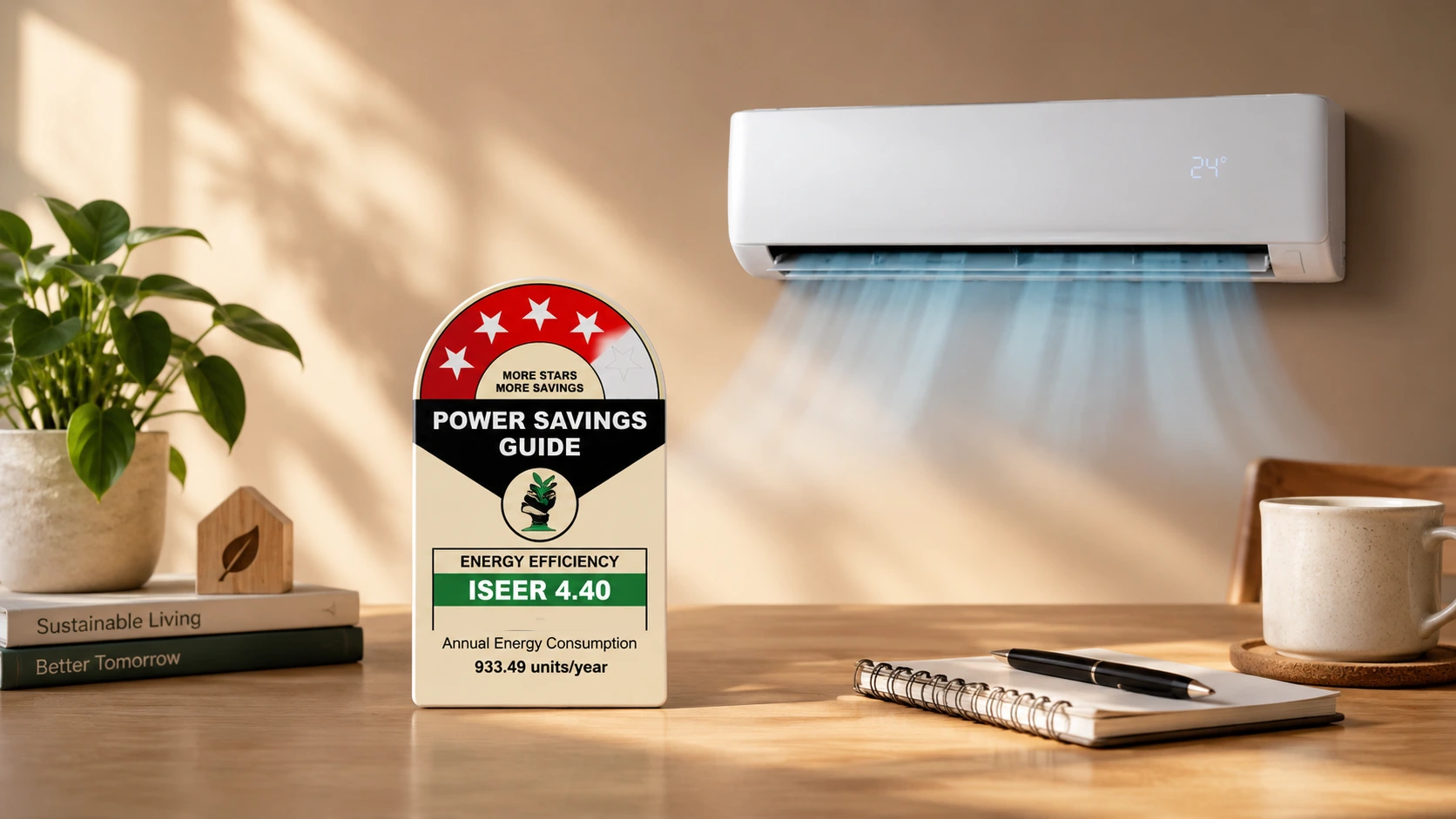
An ISEER of 4 or higher is considered good, and the Eon Magnus has a 3-star BEE rating, an ISEER of 4.40, and a stated annual electricity consumption of 933.49 units under the standard 1,600-hour testing condition.
That is why star ratings help, but ISEER gives the cleaner read on seasonal performance.
So if you’ve ever looked at two ACs with similar star labels and wondered why one seems better on the spec sheet, this is usually why. ISEER gives you a more practical sense of how the machine behaves across changing weather, not just in a neat test scenario. It’s a more honest lens for everyday use, especially if your summers are long and unforgiving.
What else is worth checking before you buy
The small things often decide whether an AC survives a humid, dusty home without becoming annoying.
Anti-corrosive blue fin coating matters in coastal or damp places, and Godrej uses hydrophilic blue-fin coatings on both the evaporator and condenser.
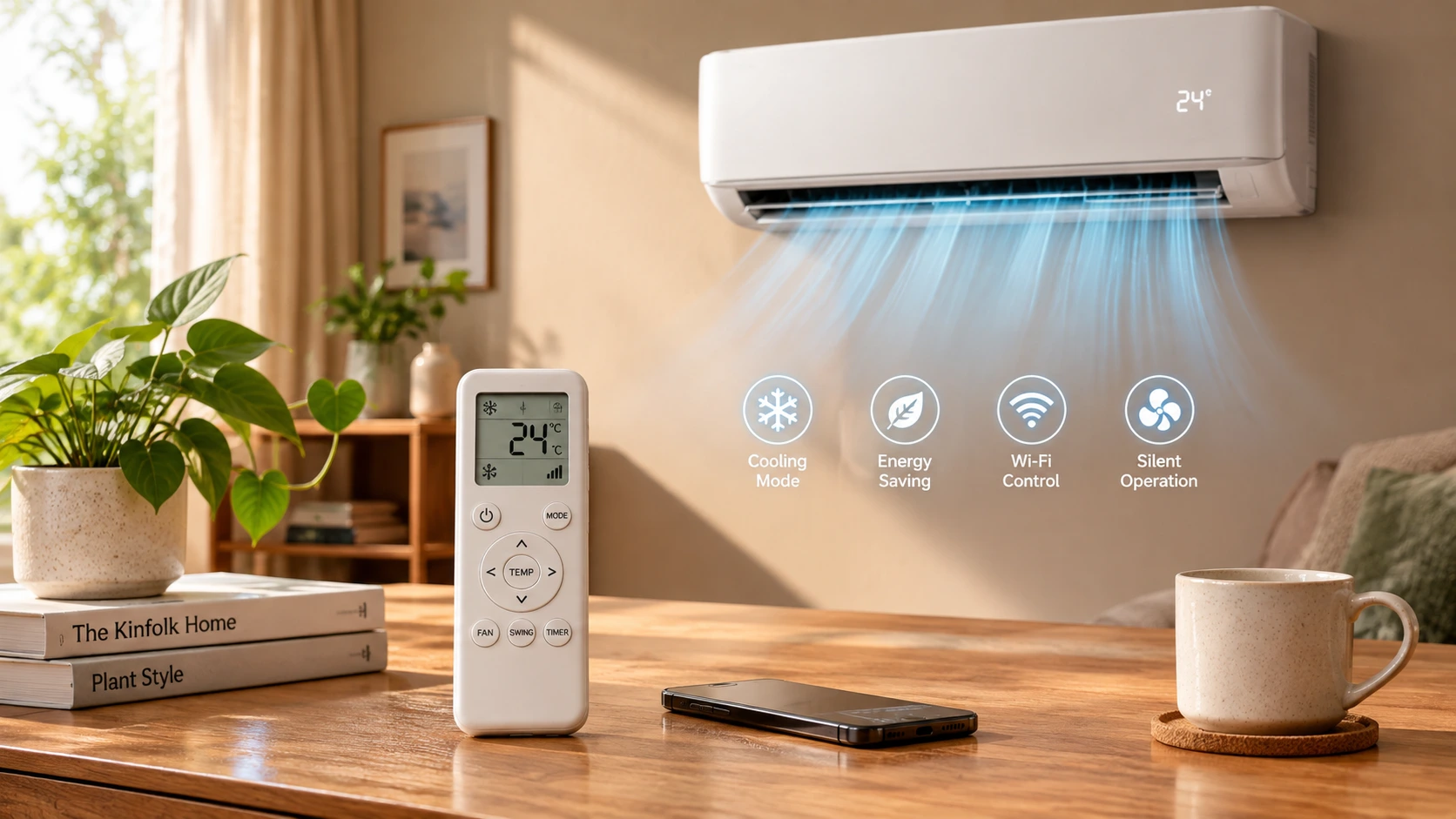
From there, the useful extras are the ones that reduce friction in daily use: 40dB to 44dB indoor noise claims, i-Sense, anti-freeze, Hygiene+ / Blow, Smart Diagnosis, Wi-Fi connected AC controls, voice control, energy monitoring, scheduling, geofencing, and support for Matter with Google Home, Alexa, and Apple Home.
This is the part where the day-to-day experience starts to matter as much as the cooling itself. A machine can look great on paper and still be mildly frustrating if it’s too noisy, awkward to control, or more prone to moisture and dirt issues than it should be. That’s why the finishing details matter. They’re not just “extra features.” They shape how livable the AC feels over months and years.
- Hydrophilic blue-fin coatings on both the evaporator and condenser
- 40dB to 44dB indoor noise claims
- i-Sense temperature sensor in the remote
- Anti-freeze function
- Hygiene+ / Blow drying function
- Smart Diagnosis
- Wi-Fi connected AC controls
- Voice control
- Energy monitoring
- Scheduling
- Geofencing
- Matter support for Google Home, Alexa, and Apple Home
FAQ
These are the doubts people usually have after they understand the cooling cycle but still want the practical version of it.
Q: Does a split AC remove humidity as well as cool air?
Yes. Moisture condenses on the cold evaporator coil, so the room feels less humid while the air cools.
Q: Is a lower-GWP refrigerant enough to make an AC efficient?
No. R32 is better than R410A on the environmental side, but electricity use still depends on efficiency, usage, insulation, and maintenance.
Q: What is a good ISEER rating for a split AC?
An ISEER of 4 or higher is considered good, and 4.40 is a solid number for the Godrej Eon Magnus.
Q: Why does AC cooling at 52°C matter?
It shows the AC is designed to keep working when outdoor heat is extreme, which is often where weaker systems start to struggle.
Conclusion
The real story behind a split AC is not the remote or the air coming out of the vent; it is the chain of heat transfer, refrigerant movement, compressor control, and efficiency choices that decide how well it works over time.
If you are comparing models, judge them by the cycle, the ratings, the refrigerant, and the build details — not just the sticker price or the star label.
That’s the practical takeaway. Once you understand how the system actually works, the spec sheet becomes a lot less confusing. And honestly, it becomes a lot more useful too. You start spotting the difference between marketing language and the numbers that really affect comfort, power use, and reliability in the real world.

Related Products




iPhone 17e Set to Launch This Month With Three Upgrades
Launch Timing and Upgrades A new report suggests Apple plans to unveil the iPhone 17e via a press release on February 19, with the device arriving later this month. The timing aligns with earlier chatter that the affordable model could surface in February rather than spring, and the reports des...

Oppo and MediaTek Preview On-Device AI Omni Model at MWC 2026
MWC 2026 Preview: Oppo and MediaTek unveil on-device AI Oppo and MediaTek announced new on-device artificial intelligence capabilities for future smartphones at the Mobile World Congress (MWC) 2026. The two companies are collaborating to develop and deploy new AI features for Oppo phones...

iQOO Neo 10 Gets Black and White Amazon Special Editions in India
iQOO Neo 10 gets new colour variants in India iQOO has teased new black and white colour variants for the Neo 10 in India, adding Amazon Special editions to the phone that first launched in May 2025 in Inferno Red and Titanium Chrome. The update was shared by iQOO India CEO Nipun Marya on X,...

OnePlus Nord Buds 4 Pro Set to Launch in India on March 19
OnePlus Nord Buds 4 Pro Launch in India OnePlus has announced that the Nord Buds 4 Pro will launch in India on March 19 at 12 pm IST. The new true wireless stereo (TWS) earbuds will go on sale through two e-commerce platforms and the OnePlus India online store, with two colour options c...

Tim Cook Reveals Apple's Secret: People and Culture Can't Be Replicated Ahead of 50th Anniversary
Apple's Secret: People and Culture Drive Its Long Run Apple CEO Tim Cook said the secret behind the company's enduring success lies in its people and culture, in remarks tied to the Cupertino-based tech giant's upcoming 50th anniversary on April 1. In a CBS Sunday Morning interview,...